
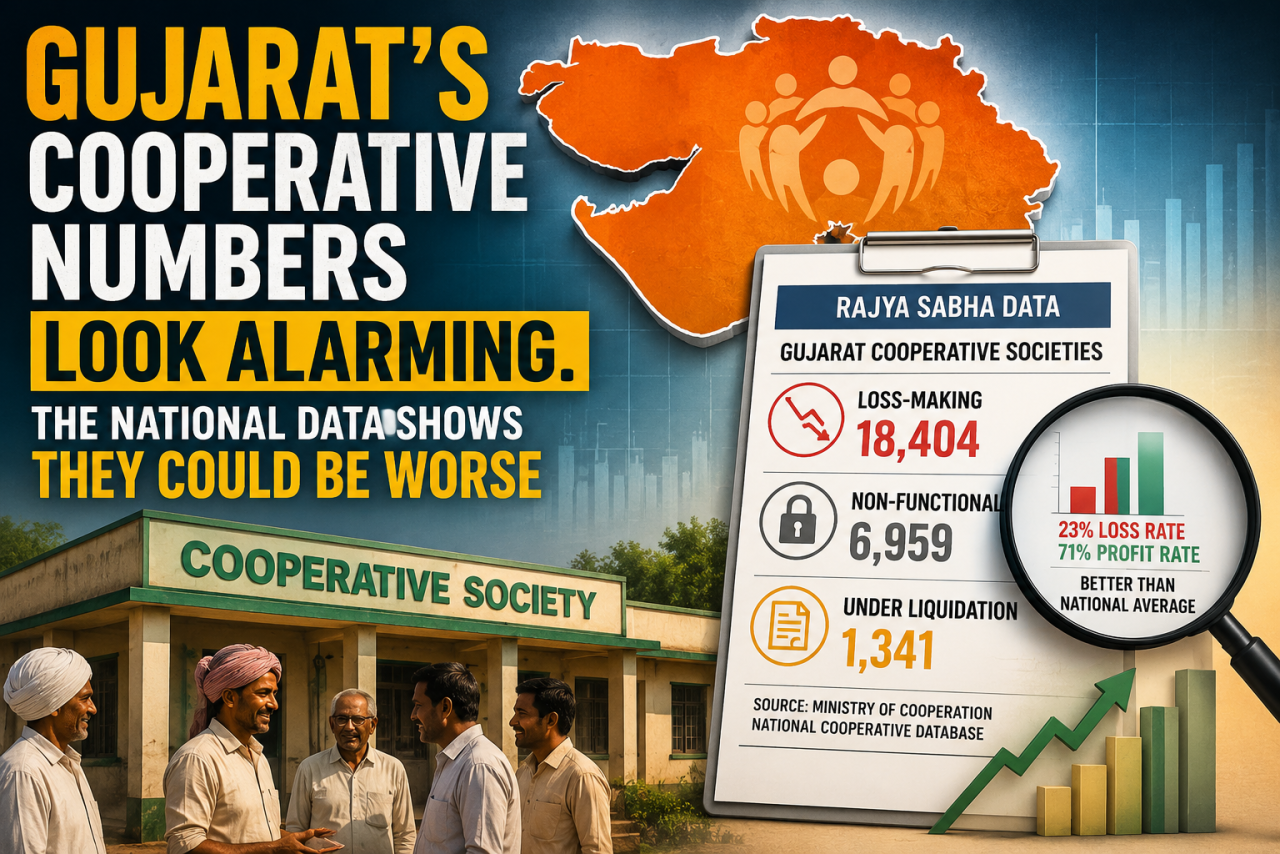
18,404 loss-making cooperatives sound alarming, but national data reveals Gujarat's cooperative sector is performing better than many of India's largest states.
Fresh figures tabled in the Rajya Sabha have drawn attention to the health of Gujarat's cooperative sector. According to the Ministry of Cooperation's National Cooperative Database, 18,404 cooperative societies in the state are operating at a loss, while nearly 8,300 have either stopped functioning or are in the process of liquidation.
At first glance, the numbers appear alarming for a state whose cooperative movement has long been regarded as a national success story. However, a broader comparison with other states and national trends reveals a more nuanced picture. While Gujarat faces genuine governance challenges, its cooperative sector remains comparatively stronger than many of its peers.
Gujarat's Cooperative Landscape
Gujarat has 88,119 registered cooperative societies, the second-highest number in India after Maharashtra's 2.27 lakh. Of these:
- 79,823 are functional
- 6,959 are non-functional
- 1,341 are under liquidation
Together, around 8,300 societies, nearly one in ten registered cooperatives in the state, are either dormant or undergoing closure.
Among the functional societies:
- 56,977 are profit-making
- 18,404 are loss-making
- 4,442 have not disclosed financial information
The figure of 18,404 loss-making cooperatives has dominated the discussion. However, these societies account for roughly 23 percent of Gujarat's functioning cooperatives, a proportion that compares favourably with the national average.
How Gujarat Compares With Other States
A comparison with other large states puts Gujarat's numbers in perspective.
Maharashtra, India's largest cooperative state, has 71,593 loss-making societies, representing nearly one-third of its functional cooperatives. Telangana, despite having only 60,680 registered societies, reports 22,819 loss-making cooperatives, exceeding Gujarat's total despite a significantly smaller cooperative base.
Meanwhile, Madhya Pradesh records 18,433 non-functional societies, the highest in the country, ahead of Uttar Pradesh's 16,951.
Nationally, India has 8.53 lakh registered cooperative societies, of which 6.63 lakh are functional. Among these:
- 3.56 lakh are profit-making
- 2.50 lakh are loss-making
This means nearly 38 percent of India's functioning cooperatives are operating at a loss.
Against this backdrop, Gujarat's 23 percent loss rate and 71 percent profit-making share suggest that its cooperative network remains financially healthier than many comparable states.
The Bigger Governance Concern
The more significant issue emerging from the data is not merely financial losses but the absence of reliable financial reporting.
Across India, 56,689 cooperative societies have no available financial data. Gujarat alone accounts for 4,442 functioning societies without disclosed financial information.
Unlike loss-making cooperatives, which remain visible to regulators, societies that fail to report their accounts create a transparency gap. Without audited financial information, it becomes difficult to determine whether these entities are financially viable, inactive, or vulnerable to misuse. From a governance perspective, this lack of disclosure may pose a greater long-term risk than reported losses.
Thousands Remain Stuck in Administrative Limbo
Another pattern visible in the data is the growing number of dormant cooperatives that remain officially registered for years.
Gujarat has 6,959 non-functional societies, yet only 1,341 are formally under liquidation. The majority therefore continue to exist on official records despite carrying out little or no business activity.
The national picture is similar. Across India, around 1.41 lakh cooperative societies are non-functional, while only 49,177 are under liquidation.
Such inactive entities remain in administrative limbo, potentially retaining eligibility for elections, loans, or government schemes despite being operationally defunct. Cleaning up these records has become an important governance challenge across the country.
Government's Revival Strategy
To address financially weak cooperatives, the Union government has established the Co-operative Rehabilitation, Reconstruction and Development Fund under the Multi-State Cooperative Societies (Amendment) Act, 2023.
The initiative aims to revive financially distressed cooperatives instead of allowing them to remain indefinitely inactive. Its effectiveness, however, will depend on whether it can reduce the growing backlog of dormant societies and improve financial transparency across the sector.
Final Take
The Rajya Sabha data certainly highlights areas of concern within Gujarat's cooperative sector. Thousands of societies remain loss-making, while many others have become inactive or fail to disclose financial information.
Yet the broader national comparison also shows that Gujarat continues to perform better than many large states in terms of financial sustainability. Rather than signalling the collapse of its cooperative movement, the data points to a sector that remains relatively resilient but requires stronger oversight, improved financial reporting, and faster resolution of dormant entities.
The numbers warrant careful scrutiny, but they do not support the conclusion that Gujarat's cooperative model is in systemic decline. The larger governance challenge lies not only in loss-making societies but also in ensuring transparency and accountability across India's vast cooperative ecosystem.
Fresh figures tabled in the Rajya Sabha have drawn attention to the health of Gujarat's cooperative sector. According to the Ministry of Cooperation's National Cooperative Database, 18,404 cooperative societies in the state are operating at a loss, while nearly 8,300 have either stopped functioning or are in the process of liquidation.
At first glance, the numbers appear alarming for a state whose cooperative movement has long been regarded as a national success story. However, a broader comparison with other states and national trends reveals a more nuanced picture. While Gujarat faces genuine governance challenges, its cooperative sector remains comparatively stronger than many of its peers.
Gujarat's Cooperative Landscape
Gujarat has 88,119 registered cooperative societies, the second-highest number in India after Maharashtra's 2.27 lakh. Of these:
- 79,823 are functional
- 6,959 are non-functional
- 1,341 are under liquidation
Together, around 8,300 societies, nearly one in ten registered cooperatives in the state, are either dormant or undergoing closure.
Among the functional societies:
- 56,977 are profit-making
- 18,404 are loss-making
- 4,442 have not disclosed financial information
The figure of 18,404 loss-making cooperatives has dominated the discussion. However, these societies account for roughly 23 percent of Gujarat's functioning cooperatives, a proportion that compares favourably with the national average.
How Gujarat Compares With Other States
A comparison with other large states puts Gujarat's numbers in perspective.
Maharashtra, India's largest cooperative state, has 71,593 loss-making societies, representing nearly one-third of its functional cooperatives. Telangana, despite having only 60,680 registered societies, reports 22,819 loss-making cooperatives, exceeding Gujarat's total despite a significantly smaller cooperative base.
Meanwhile, Madhya Pradesh records 18,433 non-functional societies, the highest in the country, ahead of Uttar Pradesh's 16,951.
Nationally, India has 8.53 lakh registered cooperative societies, of which 6.63 lakh are functional. Among these:
- 3.56 lakh are profit-making
- 2.50 lakh are loss-making
This means nearly 38 percent of India's functioning cooperatives are operating at a loss.
Against this backdrop, Gujarat's 23 percent loss rate and 71 percent profit-making share suggest that its cooperative network remains financially healthier than many comparable states.
The Bigger Governance Concern
The more significant issue emerging from the data is not merely financial losses but the absence of reliable financial reporting.
Across India, 56,689 cooperative societies have no available financial data. Gujarat alone accounts for 4,442 functioning societies without disclosed financial information.
Unlike loss-making cooperatives, which remain visible to regulators, societies that fail to report their accounts create a transparency gap. Without audited financial information, it becomes difficult to determine whether these entities are financially viable, inactive, or vulnerable to misuse. From a governance perspective, this lack of disclosure may pose a greater long-term risk than reported losses.
Thousands Remain Stuck in Administrative Limbo
Another pattern visible in the data is the growing number of dormant cooperatives that remain officially registered for years.
Gujarat has 6,959 non-functional societies, yet only 1,341 are formally under liquidation. The majority therefore continue to exist on official records despite carrying out little or no business activity.
The national picture is similar. Across India, around 1.41 lakh cooperative societies are non-functional, while only 49,177 are under liquidation.
Such inactive entities remain in administrative limbo, potentially retaining eligibility for elections, loans, or government schemes despite being operationally defunct. Cleaning up these records has become an important governance challenge across the country.
Government's Revival Strategy
To address financially weak cooperatives, the Union government has established the Co-operative Rehabilitation, Reconstruction and Development Fund under the Multi-State Cooperative Societies (Amendment) Act, 2023.
The initiative aims to revive financially distressed cooperatives instead of allowing them to remain indefinitely inactive. Its effectiveness, however, will depend on whether it can reduce the growing backlog of dormant societies and improve financial transparency across the sector.
Final Take
The Rajya Sabha data certainly highlights areas of concern within Gujarat's cooperative sector. Thousands of societies remain loss-making, while many others have become inactive or fail to disclose financial information.
Yet the broader national comparison also shows that Gujarat continues to perform better than many large states in terms of financial sustainability. Rather than signalling the collapse of its cooperative movement, the data points to a sector that remains relatively resilient but requires stronger oversight, improved financial reporting, and faster resolution of dormant entities.
The numbers warrant careful scrutiny, but they do not support the conclusion that Gujarat's cooperative model is in systemic decline. The larger governance challenge lies not only in loss-making societies but also in ensuring transparency and accountability across India's vast cooperative ecosystem.























Leave a Comment