
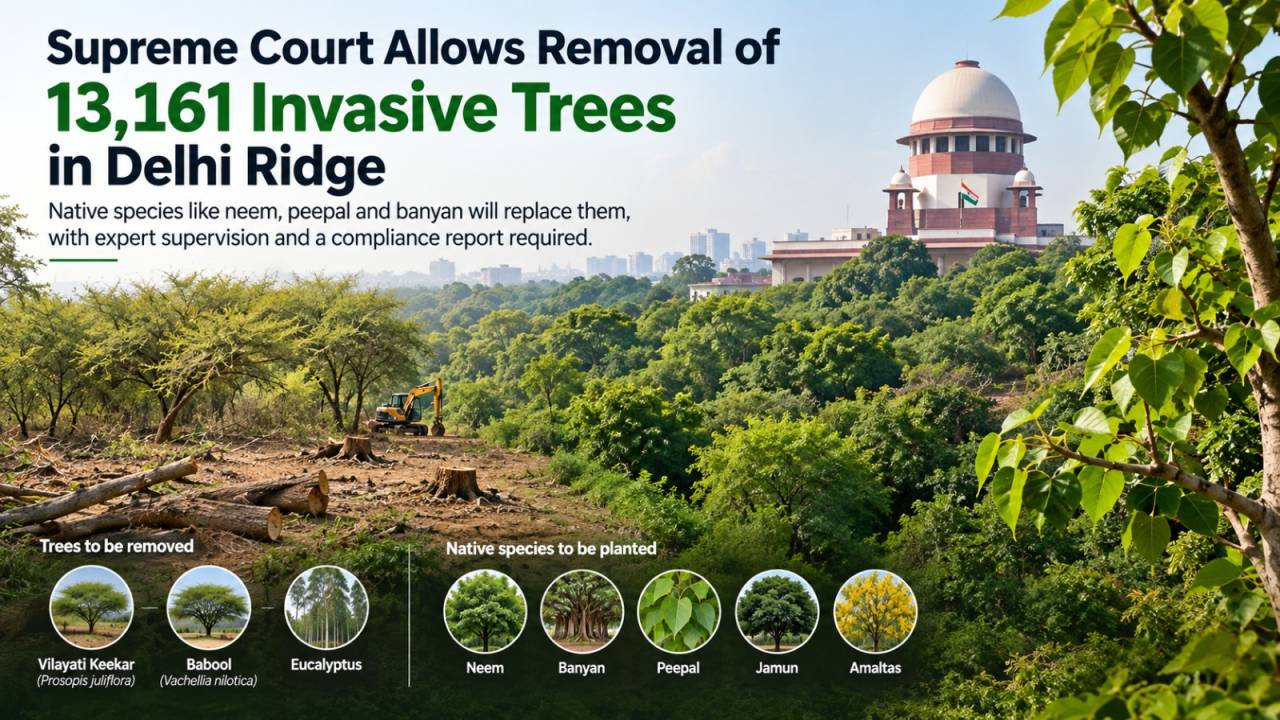
Delhi’s Central Ridge is set for a major ecological overhaul as the Supreme Court clears the removal of over 13,000 invasive trees and mandates scientific supervision of the restoration.
The Supreme Court allowed the Delhi government to remove over 13,000 invasive trees from the Central Ridge and plant native species in their place. The work will cover about 70 hectares of the Ridge, one of the capital's most important green areas.
A bench led by Chief Justice of India Surya Kant, with Justices Joymalya Bagchi and V Mohana, passed the order. It was responding to a petition from Delhi's forest and wildlife department. The department moved the top court after some petitioners in the Delhi High Court tried to stop its restoration work. It said September is the only time of year suitable for planting, so it needed a quick decision.
Which Trees Will Go, and Which Will Come
Invasive species are plants that spread aggressively and crowd out local vegetation. The court named Vilayati Keekar (Prosopis juliflora), babool (Vachellia nilotica) and eucalyptus as trees that need to be uprooted. In their place, the Ridge will get native trees such as neem, banyan, peepal, jamun and amaltas.
The Chief Justice also explained how such trees became so common in India. In the 1970s, the paper industry was growing, and many farmers planted eucalyptus and similar trees without knowing the harm they could cause. He said that hardly anyone plants them now. Farmers have found a better option in the poplar, or "Popla", tree, which is eco-friendly and can be used for both timber and paper.
The Numbers Behind the Plan
Solicitor General Tushar Mehta and Additional Solicitor General Aishwarya Bhati appeared for the Delhi government. They told the court that the department's annual plan for 2026-27 covers the removal of 22,188 invasive trees across 191 hectares.
Part of this work is already done. The department said around 9,000 invasive trees have been cleared and about 5.31 lakh shrubs and trees have been planted. According to Bhati, about 13,161 invasive trees remain, spread over roughly 70 hectares. This is the work the court has now cleared.
The Objection and the Court's Answer
Senior advocate Shoeb Alam, appearing for the petitioners, opposed the move. His main worry was that topsoil was being stripped away while trees were being uprooted, which could damage the land the Ridge depends on.
The bench said the concern was fair. It felt, however, that a balance could be struck if an expert agency supervised the work, rather than stopping it altogether.
Conditions Set by the Court
To address the petitioners' fears, the court laid down several conditions:
- The work must follow the Delhi Eco-restoration Plan 2026-30, prepared by the Forest Research Institute (FRI) in Dehradun.
- It must be carried out under the supervision of the Ridge Management Board.
- Once the exercise is finished, a compliance report must be filed in court.
- The court also asked the FRI to inspect the site and submit its own report.
Final Take
Delhi's Ridge is often called the city's green lung. It helps keep the air cleaner and the temperature lower in a capital that struggles with pollution and heat. Experts have long argued that native trees suit the local climate and support birds, insects and other wildlife better than aggressive foreign species.
This order gives the government a clear go-ahead in the planting season. It also makes the authorities answerable, since they must follow a scientific plan, work under supervision and report back to the court. How carefully the work is done will decide whether it restores the Ridge or causes new damage.
The Supreme Court allowed the Delhi government to remove over 13,000 invasive trees from the Central Ridge and plant native species in their place. The work will cover about 70 hectares of the Ridge, one of the capital's most important green areas.
A bench led by Chief Justice of India Surya Kant, with Justices Joymalya Bagchi and V Mohana, passed the order. It was responding to a petition from Delhi's forest and wildlife department. The department moved the top court after some petitioners in the Delhi High Court tried to stop its restoration work. It said September is the only time of year suitable for planting, so it needed a quick decision.
Which Trees Will Go, and Which Will Come
Invasive species are plants that spread aggressively and crowd out local vegetation. The court named Vilayati Keekar (Prosopis juliflora), babool (Vachellia nilotica) and eucalyptus as trees that need to be uprooted. In their place, the Ridge will get native trees such as neem, banyan, peepal, jamun and amaltas.
The Chief Justice also explained how such trees became so common in India. In the 1970s, the paper industry was growing, and many farmers planted eucalyptus and similar trees without knowing the harm they could cause. He said that hardly anyone plants them now. Farmers have found a better option in the poplar, or "Popla", tree, which is eco-friendly and can be used for both timber and paper.
The Numbers Behind the Plan
Solicitor General Tushar Mehta and Additional Solicitor General Aishwarya Bhati appeared for the Delhi government. They told the court that the department's annual plan for 2026-27 covers the removal of 22,188 invasive trees across 191 hectares.
Part of this work is already done. The department said around 9,000 invasive trees have been cleared and about 5.31 lakh shrubs and trees have been planted. According to Bhati, about 13,161 invasive trees remain, spread over roughly 70 hectares. This is the work the court has now cleared.
The Objection and the Court's Answer
Senior advocate Shoeb Alam, appearing for the petitioners, opposed the move. His main worry was that topsoil was being stripped away while trees were being uprooted, which could damage the land the Ridge depends on.
The bench said the concern was fair. It felt, however, that a balance could be struck if an expert agency supervised the work, rather than stopping it altogether.
Conditions Set by the Court
To address the petitioners' fears, the court laid down several conditions:
- The work must follow the Delhi Eco-restoration Plan 2026-30, prepared by the Forest Research Institute (FRI) in Dehradun.
- It must be carried out under the supervision of the Ridge Management Board.
- Once the exercise is finished, a compliance report must be filed in court.
- The court also asked the FRI to inspect the site and submit its own report.
Final Take
Delhi's Ridge is often called the city's green lung. It helps keep the air cleaner and the temperature lower in a capital that struggles with pollution and heat. Experts have long argued that native trees suit the local climate and support birds, insects and other wildlife better than aggressive foreign species.
This order gives the government a clear go-ahead in the planting season. It also makes the authorities answerable, since they must follow a scientific plan, work under supervision and report back to the court. How carefully the work is done will decide whether it restores the Ridge or causes new damage.























Leave a Comment