
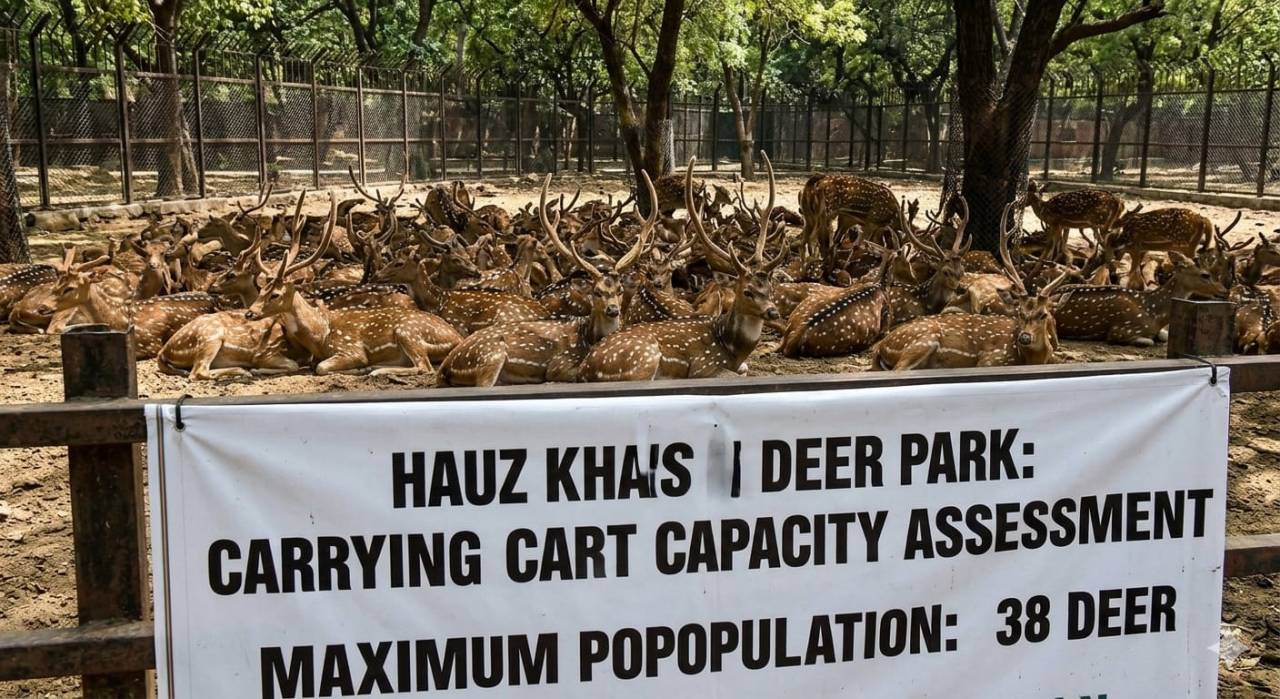
Too many deer, too little space—now the Supreme Court steps in to reset Hauz Khas Deer Park.
The Supreme Court-appointed Central Empowered Committee (CEC) has issued a critical recommendation to drastically reduce the deer population at the AN Jha Deer Park in Hauz Khas, citing severe ecological stress and animal welfare concerns. In a detailed report submitted on March 6, the panel proposed that only 38 spotted deer should remain in the 10.26-acre urban enclosure, with the remaining population—estimated to be several hundred—translocated to wildlife reserves in Rajasthan.
The recommendation marks a pivotal moment in the management of one of Delhi’s most popular green spaces. The move is designed to transition the facility from an overcrowded enclosure back to a sustainable "mini-zoo" status, provided that specific habitat restoration and enrichment measures are strictly implemented.
Ecological Collapse and Overcrowding
The primary driver behind the CEC’s recommendation is the staggering discrepancy between the park's actual population and its scientifically calculated carrying capacity. According to the report, the deer park is currently experiencing an ecological crisis due to "drastic population reduction" being avoided for too long.
Recent data from the Wildlife Institute of India (WII) highlights the scale of the issue. Using a direct count method, the WII estimated the population at approximately 459 individuals (459 ± 31.8). Even a more conservative video-based count suggested a minimum of 370 deer. However, the Central Zoo Authority (CZA) guidelines for spotted deer prescribe a minimum outdoor enclosure area of 1,500 square meters per pair.
Given that the AN Jha Deer Park has a gross area of 10.26 acres (approximately 41,500 square meters), with only about 29,000 square meters of usable space, the math is stark. The report concludes that the environment can sustainably accommodate only 19 deer units (pairs), resulting in a scientifically assessed carrying capacity of just 38 deer.
Signs of Habitat Degradation
The CEC’s inspections flagged visible signs of ecological failure within the enclosure. Years of housing hundreds of herbivores in a space meant for a few dozen have led to:
- Overgrazing: The natural forage has been depleted, leaving the soil exposed.
- Soil Compaction: Constant trampling by the dense herd has hardened the earth, preventing new vegetation from taking root.
- Degradation of Ground Vegetation: The loss of floral diversity indicates "sustained stress on the habitat," making long-term sustainability impossible under current conditions.
The committee noted that the park, established in 1968 with just six deer brought from Uttarakhand, has become a victim of its own success. Without natural predators to check the population, the numbers exploded over the decades, turning a scenic park into an unsustainable urban "island" of overcrowding.
The Translocation Strategy
To address the crisis, the panel has advocated for the translocation of the excess deer to predator-rich landscapes, such as the Ramgarh Vishdhari Tiger Reserve and Mukundara Hills Tiger Reserve in Rajasthan. This process has already begun in phases; between 2023 and 2025, 261 deer were successfully moved to these locations.
The report defends this practice against critics of translocation, stating that contemporary wildlife management recognizes prey augmentation as a "legitimate and widely accepted conservation tool." By moving the deer to tiger reserves, they serve a functional role in the ecosystem, aiding in the restoration of natural prey-predator dynamics.
However, the CEC also pointed out "procedural gaps" in previous translocation efforts. The report noted a lack of microchips or identification tags on the 261 deer already moved, which has made it difficult for authorities to track individual survival rates post-release. Future moves are expected to follow stricter protocols to ensure the welfare of the animals during and after transit.
Path Toward "Mini-Zoo" Restoration
While the translocation is a necessary "drain" for the current population, the CEC has offered a roadmap for the future of the Hauz Khas site. The panel suggested that the park could have its "mini-zoo" recognition restored—a status previously cancelled by the CZA in late 2023—if the Delhi Development Authority (DDA) undertakes significant infrastructure and habitat improvements.
Proposed measures for the 38 deer remaining in Delhi include:
- Restoring water bodies and lakes within the park boundaries
- Repairing damaged fencing to ensure animal safety and prevent escapes
- Constructing functional water troughs and night shelters
- Planting native grasses to restore the natural food chain and soil health
Conclusion
The final decision now rests with the Supreme Court. The CEC’s report makes it clear that maintaining the status quo is no longer an option for the welfare of the animals or the health of Delhi’s urban environment. By reducing the population to a manageable 38 individuals, the committee hopes to balance the public's desire for urban wildlife spaces with the cold, scientific reality of ecological limits.





















Leave a Comment