
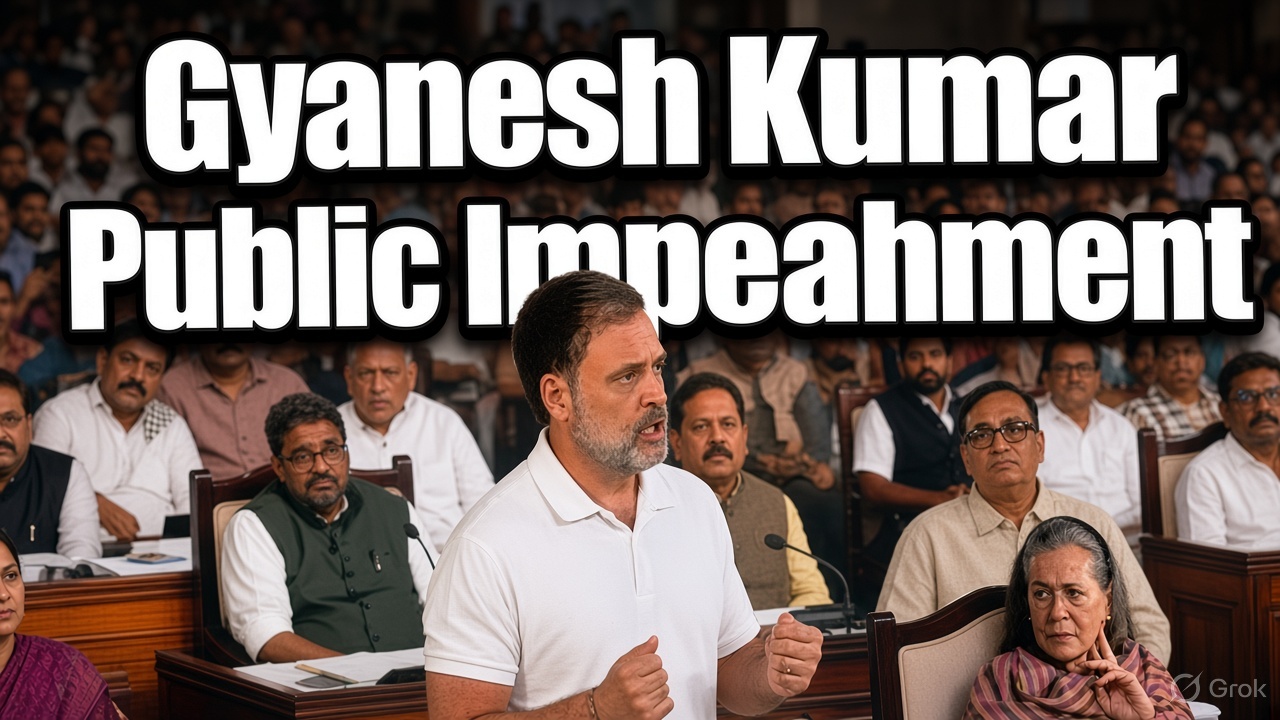
Can a symbolic impeachment strengthen democracy? The INDIA bloc's unprecedented action puts electoral accountability and the right to dissent under the spotlight.
The public impeachment of Chief Election Commissioner (CEC) Gyanesh Kumar on October 31, 2026, was an unusual moment in India's political history. Organised by the Opposition INDIA bloc at Congress president Mallikarjun Kharge's residence in New Delhi, the event followed a parliamentary format, with former Lok Sabha Speaker Meira Kumar presiding over the proceedings.
Critics, particularly from the Bharatiya Janata Party (BJP), dismissed the exercise as a mockery of Parliament and democracy. However, those who witnessed the proceedings could see something beyond the political confrontation. The gathering was conducted with seriousness and considerable gravitas, seeking to draw public attention to questions about electoral transparency, institutional accountability and citizens' voting rights.
It was not a constitutional impeachment in the legal sense. It was a symbolic political exercise intended to demonstrate the Opposition's dissatisfaction with the functioning of the Election Commission and its handling of electoral processes.
Why the INDIA Bloc Organised the Public Impeachment
The immediate background was the Opposition's demand for the removal of Gyanesh Kumar over alleged electoral irregularities, particularly concerns surrounding the Special Intensive Revision (SIR) of electoral rolls.
The INDIA bloc had earlier submitted notices in Parliament seeking his removal. A notice signed by 130 Lok Sabha members on March 12, 2026, was rejected by the Lok Sabha Speaker under the Judges (Inquiry) Act, 1968. The Opposition's corresponding notice in the Rajya Sabha was also rejected.
Following these developments, the Opposition decided to take its protest beyond Parliament and organise a public proceeding modelled on a parliamentary sitting.
During the event, Kharge moved the symbolic motion and presented six charges against the CEC. These included allegations of electoral manipulation, deletion of voters from electoral rolls, changes to voter registration procedures, centralisation of electoral data and compromising the independence of the Election Commission.
These remain allegations made by the Opposition and should not be treated as established findings.
The distinction matters. The gathering had no legal authority to remove the CEC or pronounce a binding judgment against him. Under Article 324(5) of the Constitution, the Chief Election Commissioner can be removed through a procedure similar to that applicable to a Supreme Court judge.
However, the absence of legal force does not automatically make a peaceful political exercise meaningless.
An Exercise in Democratic Dissent
One of the defining features of the event was its attempt to follow parliamentary conventions rather than the format of an ordinary political rally.
Meira Kumar's presence as the presiding authority brought institutional experience to the proceedings. As a former Lok Sabha Speaker, she represented the parliamentary tradition that the organisers sought to invoke.
The participation of Opposition leaders, civil society representatives and people claiming to have been affected by voter-list deletions also broadened the discussion beyond party politics.
At the centre of the debate was a fundamental democratic principle: the right to vote.
Article 326 of the Constitution provides for elections to the Lok Sabha and state legislative assemblies on the basis of adult suffrage, subject to constitutional and legal provisions. Electoral rolls therefore deserve the highest standards of transparency and accuracy. Every eligible citizen must have a fair opportunity to exercise this right.
Questions about voter deletions, registration procedures and electoral administration cannot simply be dismissed as political inconveniences. They require credible explanations and appropriate institutional scrutiny.
At the same time, allegations of deliberate electoral manipulation must be supported by verifiable evidence. Accountability must work both ways.
Rahul Gandhi and Meira Kumar's Concluding Speeches
The concluding speeches by Rahul Gandhi and Meira Kumar were among the most significant moments of the gathering.
Both interventions reflected the seriousness of the issues being raised. Rather than reducing the proceedings to political rhetoric, their concluding remarks maintained a sober tone appropriate to a discussion involving constitutional institutions and the democratic rights of citizens.
Rahul Gandhi's participation connected the event to the Opposition's wider campaign against alleged vote theft and its demand for greater electoral accountability. His repeated concerns about electoral transparency have become a central part of the Congress's political argument.
Meira Kumar's role, meanwhile, gave the proceedings a parliamentary context. Her presence reinforced the importance of protecting democratic principles and ensuring that citizens' voting rights remain central to the functioning of the political system.
For those present, the overall atmosphere was markedly different from the confrontational exchanges usually associated with political gatherings. The speeches were dignified, measured and focused on the larger questions confronting the country.
Mockery of Democracy or Constitutional Expression?
The BJP's criticism was expected. Its leaders argued that the Opposition was staging a mock Parliament instead of accepting the outcome of established constitutional procedures. BJP spokesperson Sambit Patra described the exercise as a mockery of Parliament and democracy.
However, there is an important distinction between claiming constitutional authority and exercising constitutional freedoms.
The INDIA bloc could not remove the CEC through a symbolic gathering. Nor could its resolution replace the procedure prescribed by the Constitution. But political representatives and citizens have the right to assemble peacefully, express disagreement and question public institutions.
Articles 19(1)(a) and 19(1)(b) protect freedom of speech and expression and the right to assemble peacefully, subject to reasonable restrictions.
A symbolic public proceeding cannot substitute for Parliament or the judiciary. Equally, its lack of legal authority does not make the exercise inherently undemocratic.
The more important question is whether the concerns raised receive serious consideration and whether the institutions concerned are willing to address legitimate questions about their functioning.
Democracy Needs Space for Dissent
The public impeachment of Gyanesh Kumar may not change his constitutional position, but it has brought electoral accountability and institutional credibility into the national conversation.
The Election Commission occupies a vital position in India's democratic framework. Its credibility depends not only on conducting elections but also on public confidence in the fairness, transparency and impartiality of the electoral process.
The Opposition must substantiate its allegations with evidence. The Election Commission, in turn, must ensure that its decisions and procedures inspire public confidence. Political accusations cannot replace proof, just as institutional authority cannot become a reason to avoid scrutiny.
The significance of October 31 lies less in the symbolic resolution against Gyanesh Kumar and more in the democratic questions it has brought to the forefront.
Democracy is not sustained by elections alone. It requires independent institutions, accountable public officials, an informed electorate and sufficient space for disagreement.
The public impeachment may remain an unprecedented political experiment rather than a constitutional proceeding. But the questions it raised about voting rights, electoral transparency and democratic dissent deserve serious consideration.
A democracy does not become stronger by silencing criticism. It becomes stronger when institutions can withstand scrutiny, answer difficult questions and retain the trust of the people.















Leave a Comment