
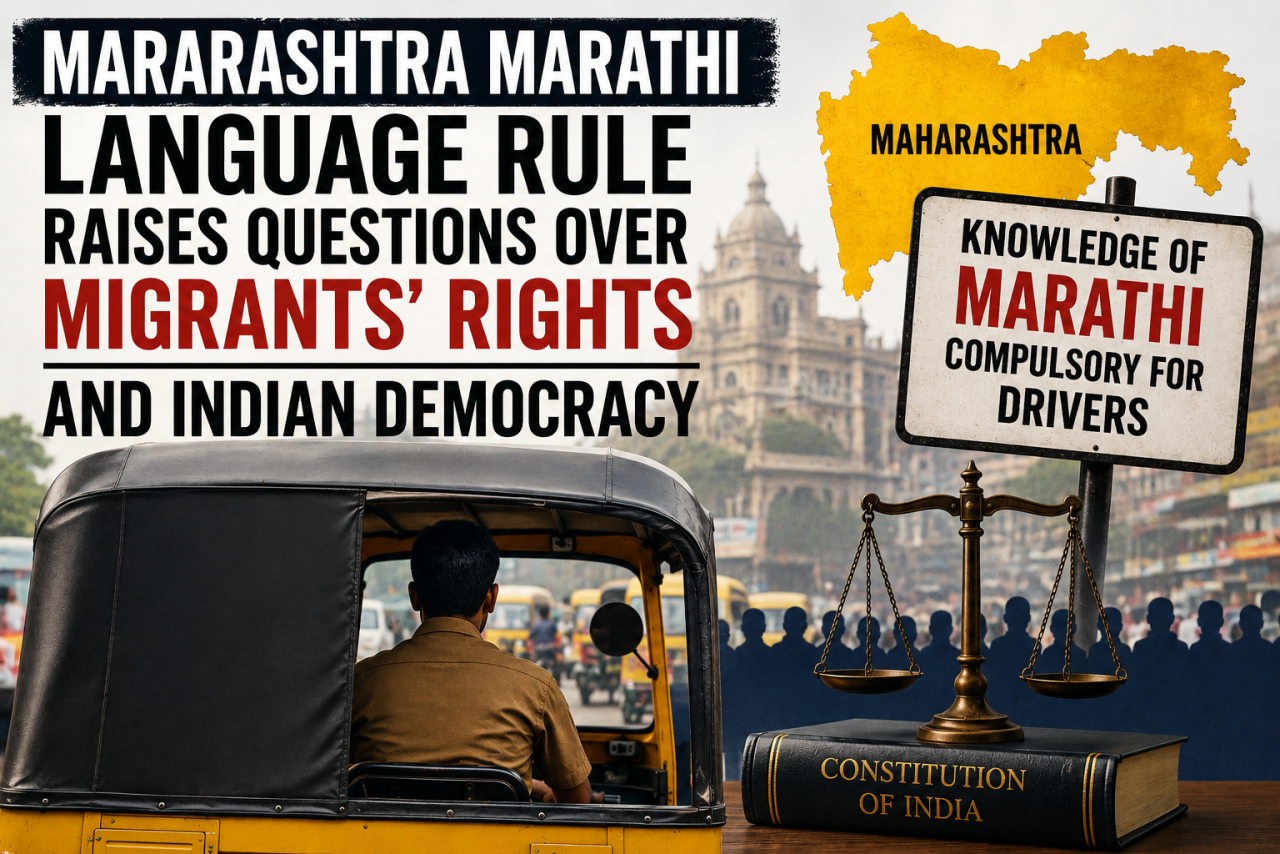
Can a regional language become a condition for earning a livelihood in a country where every citizen has the right to move and work across states?
A government has many responsibilities. It must maintain law and order, provide public services, protect citizens, create opportunities and ensure that institutions work fairly. But there is one area where the State must tread with particular care. That is the language a citizen chooses to speak.
The debate over Maharashtra’s reported move to make knowledge of Marathi compulsory for auto-rickshaw, taxi and app-based cab drivers raises a much larger question than language policy. It raises a basic democratic question. Can the State decide which language a citizen must know in order to earn a livelihood?
The reported rule provides for action against drivers who do not have working knowledge of Marathi. Licences can reportedly be suspended for up to three months, with repeated violations potentially leading to cancellation. The requirement relates to practical Marathi for drivers and permit holders of autos, taxis and app-based motor cabs fitted with electronic meters.
At first sight, the argument may appear reasonable. A driver should be able to communicate with passengers. Knowledge of the local language can certainly help a migrant understand the city, interact with people and become part of the local community. There is nothing wrong with encouraging people who settle in Maharashtra to learn Marathi.
The problem begins when encouragement becomes compulsion and compulsion is connected with the right to earn a living.
India is not a country built around one language, one culture or one regional identity. It is a Union of states whose people have always moved across geographical and linguistic boundaries. A person born in Bihar may work in Mumbai. Someone from Maharashtra may build a career in Bengaluru. A Tamil-speaking engineer may work in Delhi, while a Hindi-speaking worker may find employment in Kerala.
This movement of people is not an accident of modern India. It is one of the forces that has helped build the Indian economy.
Mumbai itself is one of the strongest examples of this reality.
The city became India’s financial and commercial centre not by keeping outsiders away but by absorbing people from different regions. Migrants have worked in its factories, offices, markets, transport system, construction sector, hotels and countless other businesses. They have contributed to the city while also becoming part of its social fabric.
Migration can create anxiety. Local residents may worry about jobs, housing, wages, public services and changes in the cultural character of their cities. These concerns cannot simply be dismissed. A democratic government must listen to them.
But listening to anxiety and converting it into official discrimination are two different things.
The State’s responsibility is to manage social change, not to punish people for being part of it.
Language is an important part of cultural identity. Marathi deserves respect and encouragement in Maharashtra, just as every Indian language deserves protection and promotion. But cultural pride becomes dangerous when it is turned into a test of citizenship or employability.
A democratic government should ask whether a rule is necessary for public safety and efficient service or whether it is being used to send a political message.
If a taxi driver cannot understand a passenger’s basic instructions, the government can prescribe reasonable communication standards. Such standards should be directly connected with the job. But if knowledge of a particular language becomes a condition for retaining a livelihood, the government must explain why such a harsh measure is necessary and proportionate.
There is another danger. Once the State begins deciding which language citizens should know for employment, where does the principle stop?
Can another state demand that migrant workers pass a test in its regional language before entering certain occupations? Can a state government impose language conditions on private employment? Can a citizen who has lived in a state for years but speaks another Indian language be treated as less entitled to work there?
These questions matter because India’s unity does not mean uniformity. The Constitution recognises linguistic and cultural diversity. The strength of Indian democracy lies partly in allowing different identities to exist within one constitutional framework.
The answer to migration cannot be linguistic exclusion.
If migrants are not learning the local language, governments can provide affordable language courses. Transport departments can introduce basic language training for drivers. Municipal bodies can offer practical language lessons at transport centres. Employers and app-based companies can be encouraged to provide communication training.
These measures would help both migrants and local residents.
There is a difference between telling someone to learn the language of the place where they live and telling them to learn it or risk losing their livelihood.
The first promotes integration. The second can create fear.
A mature democracy should never underestimate the political consequences of such fear. Migrants who already feel economically vulnerable may begin to feel that their status as Indian citizens does not guarantee equal dignity outside their home states. That would be a deeply unhealthy message for a country whose citizens have the constitutional right to move and work across India.
The government must therefore distinguish between legitimate public administration and political symbolism.
A driver should be competent, responsible and capable of communicating with passengers. A language requirement can be justified only when it serves that purpose in a fair and reasonable manner. It should not become an instrument for deciding who belongs and who does not.
India’s cities are changing rapidly. People will continue to move towards places where jobs and opportunities exist. This movement cannot be stopped through administrative orders. Nor should it be treated as a threat to local culture.
The better approach is assimilation through contact, education and everyday interaction. Languages grow when people speak them, not when governments turn them into barriers.
Maharashtra can rightly take pride in Marathi. It can encourage every newcomer to learn it. But that encouragement will have greater moral force if Marathi is presented as a language of welcome rather than a condition for survival.
The larger issue is not Marathi versus any other language. It is the relationship between the citizen and the State.
In a democracy, the government exists to expand the citizen’s freedom, not unnecessarily narrow it. It must protect cultural identities without weakening equal citizenship. It must respond to local concerns without creating new divisions.
India has survived and prospered because a person can belong to one state by birth, another by residence and to the whole country by citizenship.
That idea must not be weakened in the name of language.
A government can promote a language. It can teach a language. It can celebrate a language. But when the State begins threatening a citizen’s livelihood because he or she does not know a particular regional language, it crosses into territory that a constitutional democracy should approach with extreme caution.
The answer to migration should be integration, not intimidation. The answer to linguistic diversity should be dialogue, not compulsion.
A government has many responsibilities. It must maintain law and order, provide public services, protect citizens, create opportunities and ensure that institutions work fairly. But there is one area where the State must tread with particular care. That is the language a citizen chooses to speak.
The debate over Maharashtra’s reported move to make knowledge of Marathi compulsory for auto-rickshaw, taxi and app-based cab drivers raises a much larger question than language policy. It raises a basic democratic question. Can the State decide which language a citizen must know in order to earn a livelihood?
The reported rule provides for action against drivers who do not have working knowledge of Marathi. Licences can reportedly be suspended for up to three months, with repeated violations potentially leading to cancellation. The requirement relates to practical Marathi for drivers and permit holders of autos, taxis and app-based motor cabs fitted with electronic meters.
At first sight, the argument may appear reasonable. A driver should be able to communicate with passengers. Knowledge of the local language can certainly help a migrant understand the city, interact with people and become part of the local community. There is nothing wrong with encouraging people who settle in Maharashtra to learn Marathi.
The problem begins when encouragement becomes compulsion and compulsion is connected with the right to earn a living.
India is not a country built around one language, one culture or one regional identity. It is a Union of states whose people have always moved across geographical and linguistic boundaries. A person born in Bihar may work in Mumbai. Someone from Maharashtra may build a career in Bengaluru. A Tamil-speaking engineer may work in Delhi, while a Hindi-speaking worker may find employment in Kerala.
This movement of people is not an accident of modern India. It is one of the forces that has helped build the Indian economy.
Mumbai itself is one of the strongest examples of this reality.
The city became India’s financial and commercial centre not by keeping outsiders away but by absorbing people from different regions. Migrants have worked in its factories, offices, markets, transport system, construction sector, hotels and countless other businesses. They have contributed to the city while also becoming part of its social fabric.
Migration can create anxiety. Local residents may worry about jobs, housing, wages, public services and changes in the cultural character of their cities. These concerns cannot simply be dismissed. A democratic government must listen to them.
But listening to anxiety and converting it into official discrimination are two different things.
The State’s responsibility is to manage social change, not to punish people for being part of it.
Language is an important part of cultural identity. Marathi deserves respect and encouragement in Maharashtra, just as every Indian language deserves protection and promotion. But cultural pride becomes dangerous when it is turned into a test of citizenship or employability.
A democratic government should ask whether a rule is necessary for public safety and efficient service or whether it is being used to send a political message.
If a taxi driver cannot understand a passenger’s basic instructions, the government can prescribe reasonable communication standards. Such standards should be directly connected with the job. But if knowledge of a particular language becomes a condition for retaining a livelihood, the government must explain why such a harsh measure is necessary and proportionate.
There is another danger. Once the State begins deciding which language citizens should know for employment, where does the principle stop?
Can another state demand that migrant workers pass a test in its regional language before entering certain occupations? Can a state government impose language conditions on private employment? Can a citizen who has lived in a state for years but speaks another Indian language be treated as less entitled to work there?
These questions matter because India’s unity does not mean uniformity. The Constitution recognises linguistic and cultural diversity. The strength of Indian democracy lies partly in allowing different identities to exist within one constitutional framework.
The answer to migration cannot be linguistic exclusion.
If migrants are not learning the local language, governments can provide affordable language courses. Transport departments can introduce basic language training for drivers. Municipal bodies can offer practical language lessons at transport centres. Employers and app-based companies can be encouraged to provide communication training.
These measures would help both migrants and local residents.
There is a difference between telling someone to learn the language of the place where they live and telling them to learn it or risk losing their livelihood.
The first promotes integration. The second can create fear.
A mature democracy should never underestimate the political consequences of such fear. Migrants who already feel economically vulnerable may begin to feel that their status as Indian citizens does not guarantee equal dignity outside their home states. That would be a deeply unhealthy message for a country whose citizens have the constitutional right to move and work across India.
The government must therefore distinguish between legitimate public administration and political symbolism.
A driver should be competent, responsible and capable of communicating with passengers. A language requirement can be justified only when it serves that purpose in a fair and reasonable manner. It should not become an instrument for deciding who belongs and who does not.
India’s cities are changing rapidly. People will continue to move towards places where jobs and opportunities exist. This movement cannot be stopped through administrative orders. Nor should it be treated as a threat to local culture.
The better approach is assimilation through contact, education and everyday interaction. Languages grow when people speak them, not when governments turn them into barriers.
Maharashtra can rightly take pride in Marathi. It can encourage every newcomer to learn it. But that encouragement will have greater moral force if Marathi is presented as a language of welcome rather than a condition for survival.
The larger issue is not Marathi versus any other language. It is the relationship between the citizen and the State.
In a democracy, the government exists to expand the citizen’s freedom, not unnecessarily narrow it. It must protect cultural identities without weakening equal citizenship. It must respond to local concerns without creating new divisions.
India has survived and prospered because a person can belong to one state by birth, another by residence and to the whole country by citizenship.
That idea must not be weakened in the name of language.
A government can promote a language. It can teach a language. It can celebrate a language. But when the State begins threatening a citizen’s livelihood because he or she does not know a particular regional language, it crosses into territory that a constitutional democracy should approach with extreme caution.
The answer to migration should be integration, not intimidation. The answer to linguistic diversity should be dialogue, not compulsion.


















Leave a Comment