
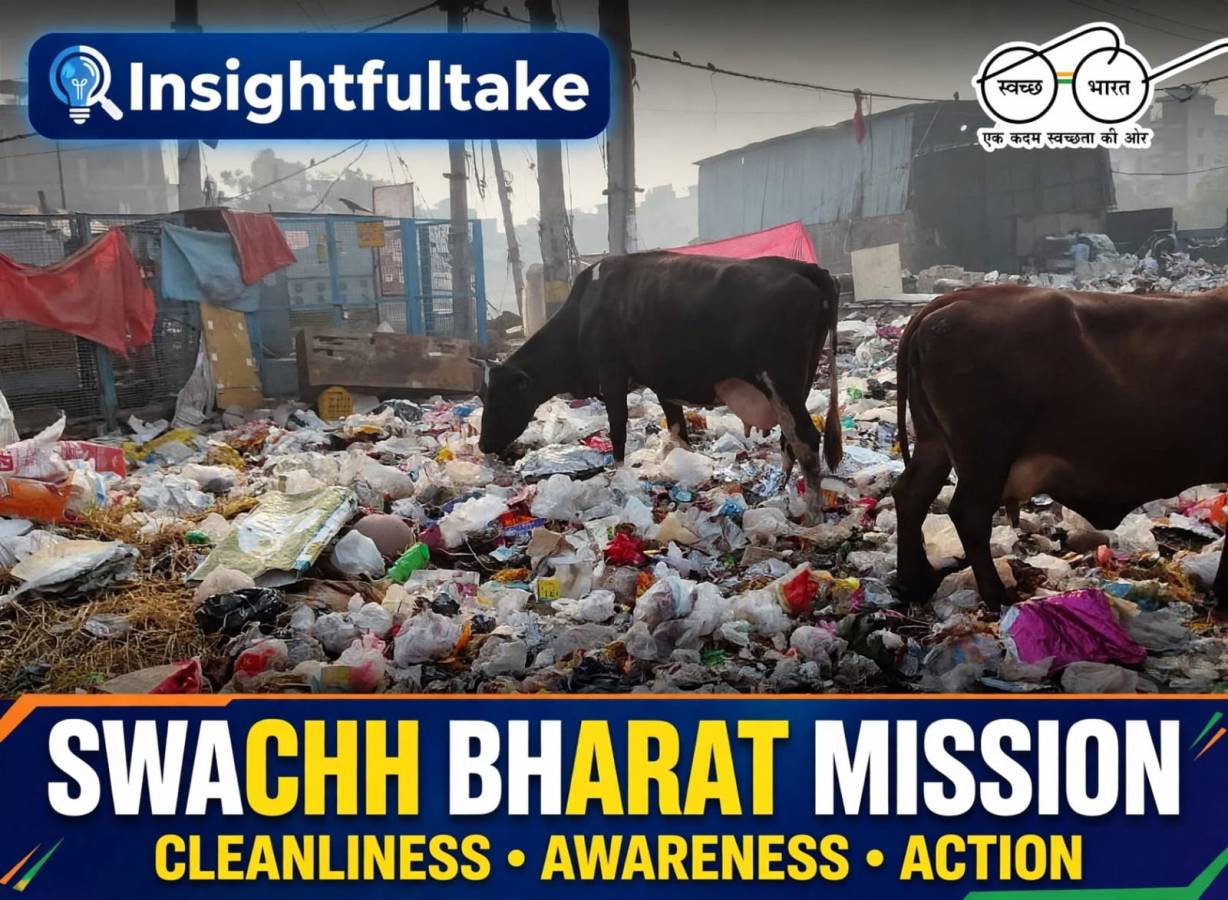
India built millions of toilets, but overflowing landfills and unmanaged garbage expose the unfinished promise of Swachh Bharat.
When Prime Minister Narendra Modi launched the Swachh Bharat Mission on 2 October 2014, the choice of date carried symbolic significance. The launch coincided with the birth anniversary of Mahatma Gandhi, who regarded cleanliness as an essential part of public life and personal responsibility.
The mission promised nothing less than a transformation of India's sanitation system. Its objectives included eliminating open defecation by 2 October 2019, ensuring access to household toilets, improving waste management, ending manual scavenging and encouraging lasting behavioural change.
More than a decade later, India has made considerable progress in expanding toilet access. Yet the sight of garbage-filled streets, plastic-covered drains, overflowing landfills and cattle searching for food in waste heaps raises an uncomfortable question: Has India become as clean as the Swachh Bharat Mission promised?
The answer lies somewhere between substantial progress and unfinished promises.
The Promise and the Achievements
The Swachh Bharat Mission was divided into two major components: Swachh Bharat Mission-Gramin (SBM-G) for rural India and Swachh Bharat Mission-Urban (SBM-U) for towns and cities.
The first phase concentrated on toilet construction and eliminating open defecation. The government reported the construction of more than 10 crore individual household toilets and a rise in rural sanitation coverage from approximately 39 per cent in 2014 to nearly universal coverage by 2019.
India was subsequently declared Open Defecation Free (ODF).
The second phase shifted attention towards sustaining ODF status and improving solid and liquid waste management. Under the rural programme, villages were encouraged to achieve ODF Plus status by maintaining toilet usage and introducing arrangements for waste disposal and cleanliness.
Urban India also witnessed improvements. Door-to-door garbage collection expanded, more cities received ODF and ODF Plus certifications, and cleanliness rankings under Swachh Survekshan encouraged municipal bodies to compete for better positions.
These achievements should not be dismissed. Access to toilets has improved the dignity, safety and convenience of millions of households. Research published in Nature has also associated improved sanitation and reduced open defecation with lower infant and under-five mortality.
The mission succeeded in making sanitation a national political and public priority. That itself represents a significant change.
However, constructing infrastructure and ensuring that it works consistently are two different challenges.
Toilets Built, But Are They Being Used?
One of the persistent criticisms of the mission concerns the gap between toilet construction and actual usage.
Independent surveys and field studies have found that access to toilets does not automatically guarantee their regular use. In some locations, toilets were constructed without adequate water connections. Elsewhere, poor construction, maintenance problems and the absence of arrangements for emptying filled pits discouraged continued use.
Social habits and preferences also played a role in certain communities, making behavioural change more difficult than infrastructure delivery.
Community toilets have faced additional problems, including inadequate cleaning, poor maintenance and unreliable water supply.
These shortcomings explain why the second phase placed greater emphasis on sustaining ODF status rather than simply counting newly constructed toilets.
A toilet that cannot be used regularly is not a successful sanitation intervention. Similarly, declaring a village ODF does not end the responsibility of ensuring that sanitation facilities remain functional.
India's Growing Garbage Problem
If toilet construction was the most visible achievement of the first phase, solid waste management remains one of the biggest tests of the mission.
Indian cities generate enormous quantities of municipal waste every day. Although door-to-door collection has expanded, segregation at source, scientific processing and safe disposal remain uneven.
In many urban neighbourhoods, household waste is still mixed before collection. Plastic, food waste, construction debris and other discarded materials frequently end up at the same dumping locations.
Open dumping and waste burning continue to affect communities. Drains become clogged with plastic, while animals often search through garbage heaps for food.
The problem is not simply the absence of garbage collection. It is the failure to establish an effective system covering the entire waste cycle, from household segregation to transportation, processing, recycling and final disposal.
Without these arrangements, collecting garbage from streets merely transfers the problem from neighbourhoods to dumping grounds.
Delhi's Landfills Tell a Different Story
The national capital offers a particularly revealing example of the gap between cleanliness rankings and ground realities.
The New Delhi Municipal Council (NDMC), which administers the Lutyens' Delhi area, has consistently performed well in cleanliness assessments. However, the larger Municipal Corporation of Delhi (MCD), which serves most of the city's population and geographical area, faces a much more difficult waste management challenge.
The contrast is visible in the condition of Delhi's three major landfill sites: Ghazipur, Bhalswa and Okhla.
For years, these locations have accumulated enormous quantities of legacy waste. Biomining and remediation projects have attempted to reduce the garbage mountains and reclaim land. Some progress has been made, but the problem remains far from resolved.
Fresh municipal waste continues to reach these sites even as authorities work to clear accumulated garbage.
The scale of the challenge is considerable. MCD areas generate thousands of tonnes of waste daily, placing pressure on existing collection, segregation and processing infrastructure.
The consequences extend beyond an unpleasant visual environment. Landfills contribute to air pollution, foul odours, groundwater contamination risks and public health concerns. Fires and emissions from decomposing waste further complicate the situation.
Delhi's experience demonstrates why cleanliness cannot be measured only by the number of toilets built, the frequency of garbage collection or a city's position in an annual ranking.
The real test is whether waste is being scientifically processed and disposed of without creating another environmental problem.
Where Did the Swachh Bharat Cess Money Go?
The mission also raised questions about financing, expenditure and accountability.
The government introduced a 0.5 per cent Swachh Bharat Cess on taxable services in November 2015. The levy remained in place until the introduction of the Goods and Services Tax in July 2017.
Collections are estimated to have reached approximately ₹20,000 crore or more during its operation.
The money was intended to support sanitation-related activities, including toilet construction and community facilities, through designated funding arrangements.
Government responses and parliamentary discussions indicated that substantial amounts were released for the intended purposes. However, questions also emerged over delayed transfers, incomplete utilisation and the broader management of dedicated cess collections.
These concerns reflect a recurring problem in public finance. Announcing a budgetary allocation or collecting a dedicated tax does not necessarily mean that the money has translated into effective public services.
The second phase of the mission has received substantial financial commitments. Yet state-level planning, administrative capacity, technical limitations and difficulties in utilising allocated funds have continued to affect implementation in several areas.
The issue is not merely how much money the government spends, but how effectively that expenditure improves sanitation on the ground.
Cleanliness Cannot Be Achieved Through Campaigns Alone
The Swachh Bharat Mission deserves recognition for bringing sanitation into the centre of national development discussions. Its toilet construction programme expanded access on an unprecedented scale, while public campaigns helped change the conversation around hygiene and open defecation.
But the mission also illustrates the limitations of a campaign-driven approach to a problem that requires permanent institutional systems.
Cleanliness is not a one-time achievement. It requires regular municipal services, functioning drainage networks, adequate water supply, trained sanitation workers, scientific waste processing and responsible public behaviour.
Citizens also have a role. Throwing household waste into open spaces, mixing recyclable material with food waste and treating public places as convenient dumping grounds undermine the work of sanitation workers and municipal authorities.
However, individual responsibility cannot become an excuse for weak public infrastructure. Municipal bodies must provide accessible collection systems, enforce segregation rules and ensure that collected waste reaches appropriate processing facilities.
Likewise, governments must look beyond photographs, certificates and annual rankings. Independent assessments of actual waste processing, landfill remediation, toilet functionality and sanitation outcomes are essential.
The Unfinished Mission of a Clean India
Twelve years after its launch, the Swachh Bharat Mission presents a mixed but important legacy.
India has expanded toilet access, improved awareness and made sanitation a mainstream development priority. These are measurable achievements that deserve acknowledgement.
At the same time, overflowing landfills, inadequate waste segregation, poor maintenance and continuing environmental pollution reveal how much remains to be done.
The original promise was never limited to constructing toilets or declaring villages open-defecation-free. It was about creating a country where cleanliness became part of everyday life, supported by reliable infrastructure and responsible public behaviour.
That transformation cannot be achieved through slogans alone.
The next stage of Swachh Bharat must focus less on counting facilities and more on measuring their functionality. It must move beyond collection targets towards scientific processing, recycling, landfill remediation and effective municipal accountability.
A clean India should not be judged by how many cities receive certificates or how many toilets appear in official records. It should be judged by what citizens see when they step outside their homes.
The real success of Swachh Bharat will come when garbage mountains become a thing of the past, public spaces remain clean without constant campaigns, and sanitation becomes an everyday civic habit rather than an annual government achievement.



















Leave a Comment