
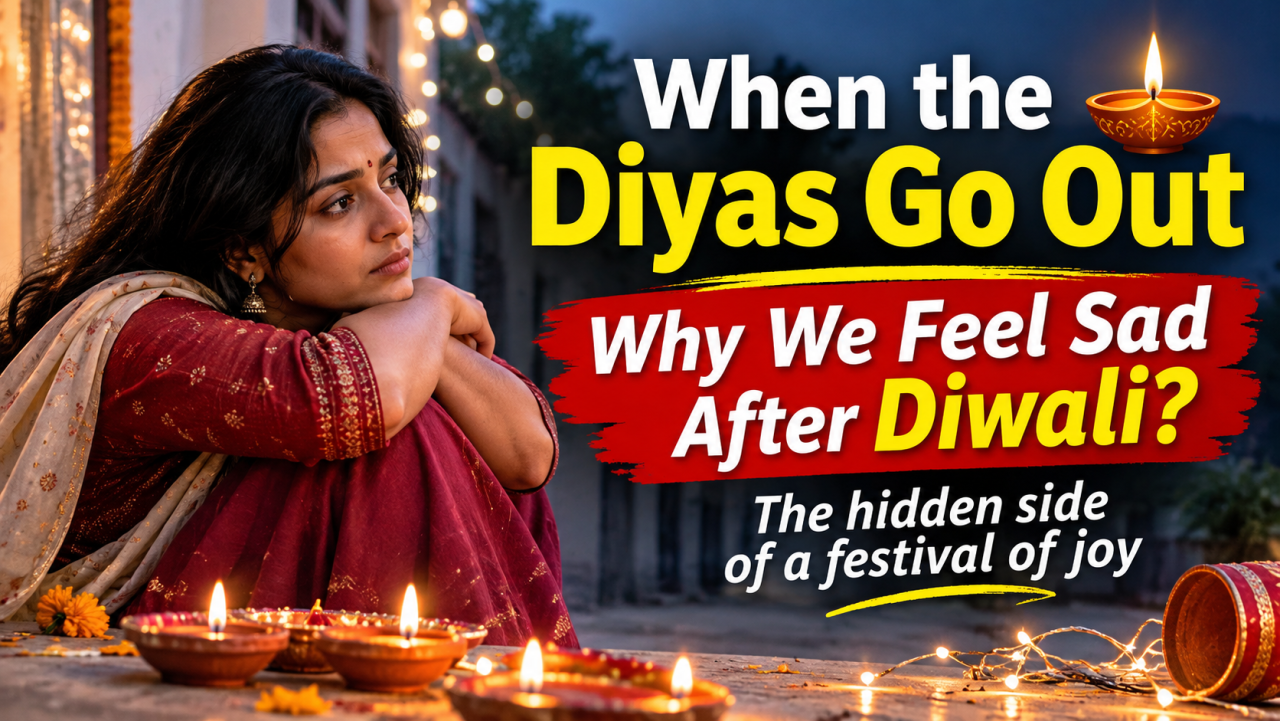
When the diyas go out and celebrations end, an unexpected silence takes over. Why does a festival of happiness sometimes leave behind a feeling of emptiness?
There is something unusual about the days immediately after Diwali. The noise of firecrackers gradually fades, decorative lights are switched off, sweets disappear from dining tables, guests return to their homes and markets begin losing their festive energy. Life returns to its familiar rhythm. Yet, for many people, something feels different.
The house may look the same, the family members may still be around and the responsibilities may not have changed. Still, there is an unexplained quietness. A strange sense of emptiness settles in, sometimes accompanied by nostalgia, tiredness or a mild sadness that is difficult to describe.
Why does a festival associated with happiness, prosperity and the victory of light over darkness sometimes leave people feeling emotionally low?
Perhaps the answer lies not in Diwali itself but in the emotional contrast between the celebration we experience and the ordinary life to which we return.
The Emotional High and the Sudden Return to Normality
Festivals temporarily change the structure of everyday life. People take time off work, travel to meet relatives, prepare special meals, decorate their homes and make arrangements for celebrations. Even those who do not actively participate become part of the atmosphere through illuminated streets, crowded markets and the excitement around them.
For a few days, life acquires a different pace. There are more conversations, more social interactions and more reasons to step outside the usual routine.
Psychologists sometimes describe the emotional dip following an exciting event as a form of post-event letdown. It is not necessarily depression or a mental health condition. It can simply be the mind adjusting after a period of heightened stimulation and anticipation.
The contrast can be particularly noticeable after Diwali because the festival involves several days of preparation and celebration. The anticipation builds gradually, reaches its peak and then ends. The mind, accustomed to excitement, suddenly finds itself dealing with ordinary schedules again.
The silence after the celebration can feel louder than the noise that preceded it.
When Happiness Becomes a Memory
Diwali is not just a festival of lights. For many people, it is also a festival of memories.
Childhood celebrations, grandparents distributing sweets, parents supervising preparations, cousins gathering under one roof and the excitement of buying new clothes remain deeply embedded in personal memory.
As people grow older, these experiences change. Some family members are no longer around. Children leave home for education or work. Relatives become geographically distant, and the traditional family gathering becomes increasingly difficult to organise.
The festival may continue, but the people and circumstances that once gave it a particular meaning may have changed.
This is where post-Diwali melancholy becomes more personal. A familiar sweet may remind someone of a grandmother. An empty chair may recall a parent who is no longer present. A family photograph may reveal how much life has changed since the previous celebration.
The sadness is not always about what is missing today. Sometimes it is about the realisation that certain moments cannot be recreated.
In that sense, Diwali can become an annual reminder of time passing.
The Social Media Celebration and the Reality Gap
Another dimension of post-festival sadness comes from the way celebrations are presented in the digital world.
Social media turns festivals into visual exhibitions. Beautifully decorated homes, expensive gifts, designer clothes, family vacations, elaborate meals and smiling group photographs create an impression that everyone is experiencing extraordinary happiness.
But photographs rarely tell the complete story.
Behind an attractive festive picture may be financial stress, family disagreements, loneliness or the pressure to maintain appearances. Someone celebrating alone may feel particularly isolated while watching hundreds of apparently joyful family gatherings online.
The problem is not that people share their happiness. The problem arises when we begin measuring our own lives against carefully selected moments from other people's lives.
After Diwali, when the festive excitement declines, this comparison can become more uncomfortable. People may start thinking about what they could not afford, whom they could not meet or how their celebrations differed from those they observed online.
A festival that should bring people closer can unintentionally expose the inequalities and emotional distances that exist in society.
The Financial Hangover Nobody Talks About
There is also a practical explanation for the post-Diwali emotional slowdown.
For many Indian households, Diwali is an expensive occasion. New clothes, sweets, gifts, travel, home renovation, decorations and social obligations can place considerable pressure on monthly budgets.
The excitement of shopping often temporarily overshadows financial calculations. Credit cards and easy payment options make spending feel less immediate. But once the celebrations are over, bills, pending payments and depleted savings become more visible.
The emotional impact of this financial reality should not be underestimated.
For lower-income households, the contrast can be even sharper. The festival may have brought a few moments of enjoyment, but electricity bills, school fees, rent, food expenses and employment uncertainties remain unchanged.
The lights may have illuminated the neighbourhood, but they have not necessarily improved the circumstances of everyone living in it.
This makes post-Diwali melancholy partly a social and economic experience, rather than merely an individual emotional response.
The Loneliness Hidden Behind Family Celebrations
Festivals are often described as occasions that bring families together. However, togetherness does not always eliminate loneliness.
Some people attend family gatherings but feel emotionally disconnected. Others live away from their hometowns and cannot travel because of work, financial limitations or personal circumstances.
For elderly people, festivals can highlight the absence of children who have settled elsewhere. For young professionals, they can bring the realisation that friendships and family relationships have changed with time.
There are also people who have lost loved ones and find festivals particularly difficult because every familiar ritual brings back memories.
During Diwali, the social expectation is to be happy. Admitting sadness can therefore feel uncomfortable. People may smile, participate in rituals and exchange greetings while quietly carrying emotions they cannot easily express.
Perhaps one reason the days after Diwali feel emotionally heavy is that the social pressure to celebrate finally disappears, allowing suppressed feelings to surface.
The Environmental and Physical Aftermath
The physical environment also influences how people feel.
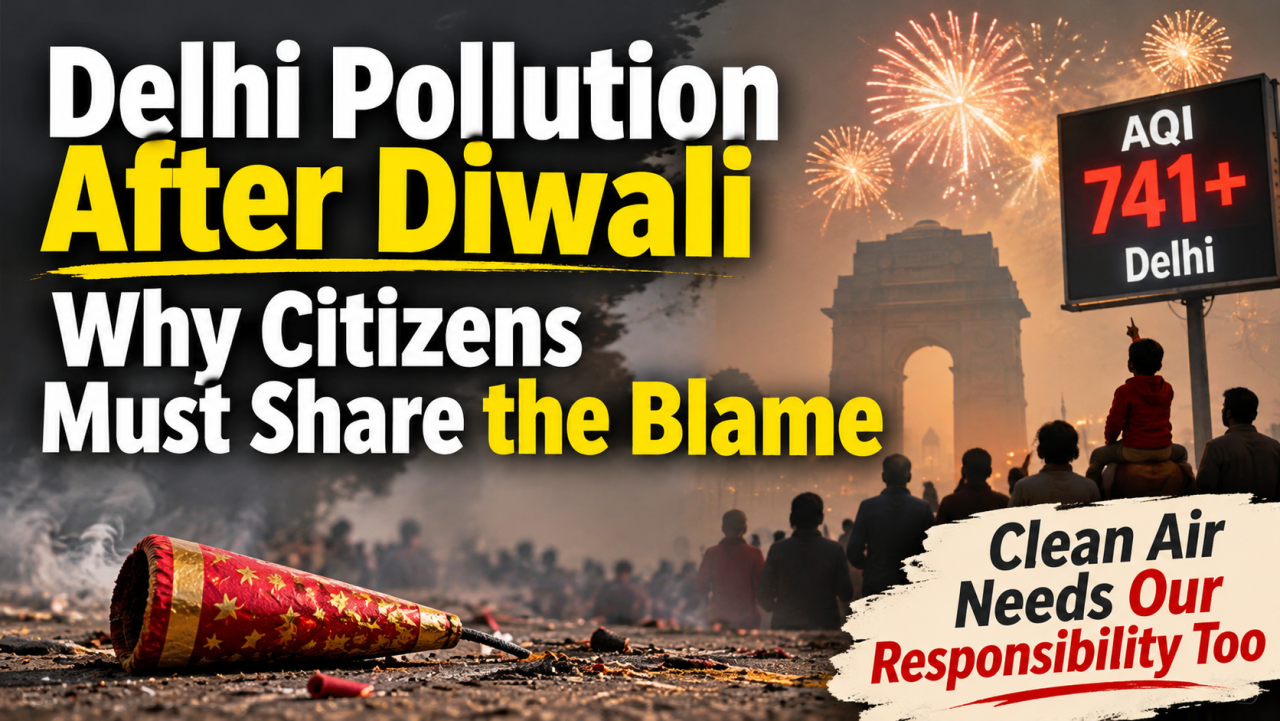
In several Indian cities, Diwali celebrations are followed by deteriorating air quality, smoke, dust and pollution. The colourful lights and festive atmosphere give way to hazy skies, uncomfortable mornings and concerns about respiratory health.
Late nights, irregular meals, excessive sweets, travel fatigue and disrupted sleep schedules can add to physical exhaustion.
The connection between physical well-being and emotional state is well established. Poor sleep, fatigue and environmental discomfort can affect mood, concentration and energy levels.
Therefore, what appears to be unexplained sadness may sometimes be a combination of emotional adjustment and physical exhaustion.
Perhaps We Are Missing the Meaning, Not the Festival
There is a deeper question worth asking. Have modern celebrations become so focused on consumption and spectacle that the period after them feels particularly empty?
Diwali traditionally carries ideas of renewal, hope, gratitude, reflection and the triumph of light over darkness. Yet, much of the contemporary celebration revolves around shopping, gifts, decoration, social gatherings and public displays of prosperity.
None of these activities is inherently wrong. They are part of the joy of festivals. But when the experience becomes dependent entirely on external excitement, its emotional value can disappear as soon as the decorations come down.
Perhaps the real purpose of a festival should not be measured by how spectacularly it is celebrated but by what remains after it ends.
Does it encourage us to reconnect with someone we have neglected? Does it inspire us to help someone who cannot afford the celebration? Does it give us an opportunity to reflect on our relationships, priorities and responsibilities?
If the answer is yes, the spirit of Diwali can survive long after the diyas have been extinguished.
Learning to Accept the Quiet Days
Feeling a little low after a major festival is not necessarily something that needs to be corrected immediately. Sometimes, it is simply an emotional transition.
Returning gradually to regular sleeping hours, spending time outdoors, reconnecting with friends, resuming everyday activities and avoiding excessive social media comparison can help restore balance.
More importantly, people should allow themselves to acknowledge their feelings without treating them as a personal failure.
Those who experience persistent sadness, loss of interest in everyday activities, significant changes in sleep or appetite, or difficulty functioning should consider speaking with a qualified mental health professional. Such symptoms should not automatically be dismissed as post-festival blues.
The days after Diwali also offer an opportunity to extend the spirit of the festival beyond a few celebrations. A visit to an elderly relative, a conversation with someone living alone, helping a struggling family or simply sharing a meal without any special occasion can make ordinary days meaningful.
After all, light has little meaning if it exists only for a night.
When the Diyas Go Out, Life Begins Again
Perhaps the melancholy after Diwali is not simply sadness about the end of a festival. It is a reminder of how much we depend on moments of togetherness, anticipation and belonging to make ordinary life feel special.
The festival lasts a few days, but the emotions it awakens can remain much longer.
The challenge is to carry something of that warmth into the everyday world. To remember that happiness need not always arrive with new clothes, illuminated balconies, expensive gifts or crowded celebrations.
Sometimes, it can be found in a familiar voice, an unhurried conversation, a shared cup of tea or the presence of someone who makes an ordinary evening feel less lonely.
The diyas may go out, the decorations may disappear and the streets may return to their usual appearance. But perhaps the real test of Diwali is whether we can keep a little of its light alive in the days that follow.












Leave a Comment