
A film cleared for release disappeared within 48 hours, reigniting debate over free expression, institutional transparency, and how democracies confront difficult chapters of their history.
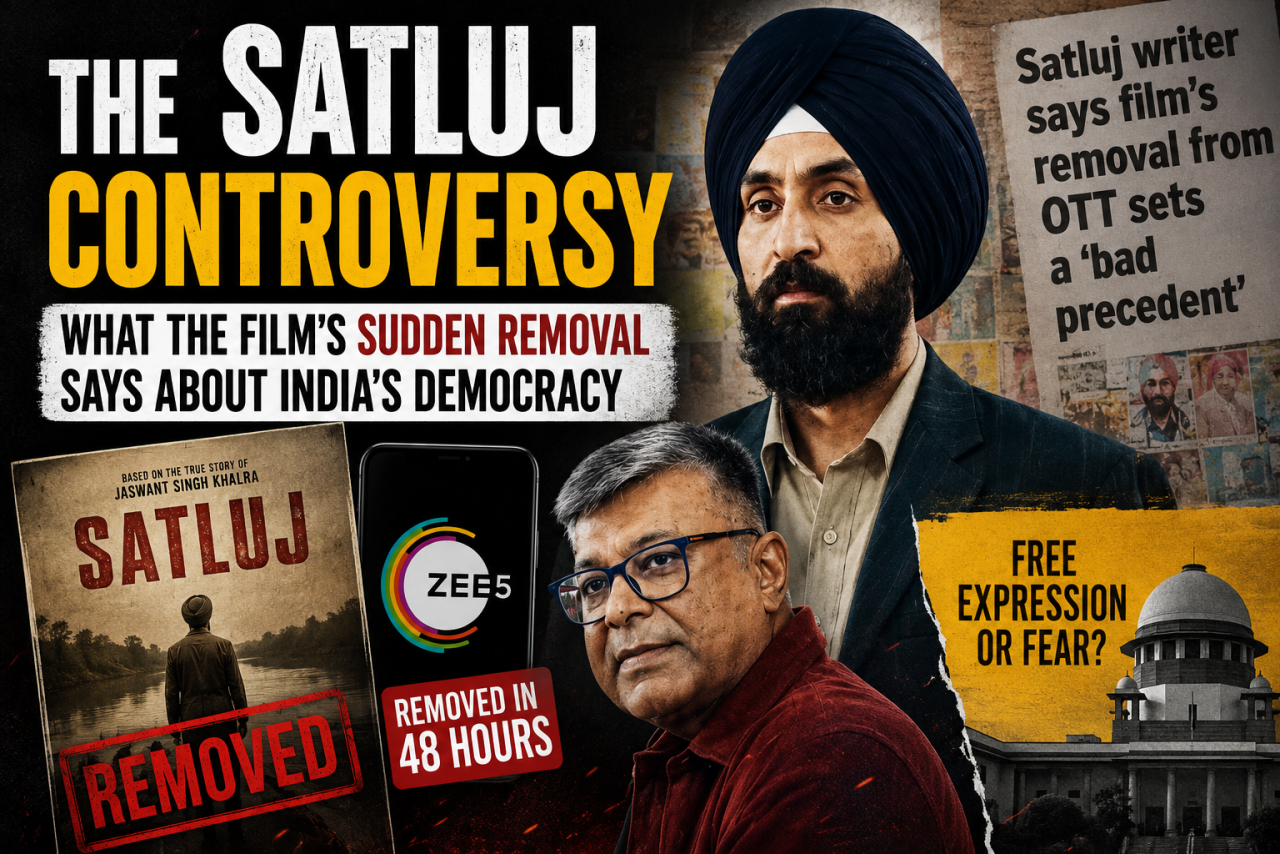
Diljit Dosanjh's Satluj streamed on Zee5 for less than 48 hours before it vanished from Indian screens. The film, a biographical account of human rights activist Jaswant Singh Khalra's investigation into alleged illegal cremations during Punjab's militancy years, had already spent close to three years fighting the Central Board of Film Certification over more than a hundred cut demands. It changed its name twice, from Ghallughara to Punjab '95 to Satluj, before finally releasing uncut on July 3. By July 5, Zee5 pulled it from India, citing only vague "current developments," while keeping it available to international audiences on Zee5 Global. The platform's own statement thanked viewers for their support even as it withdrew the film from them.
This sequence deserves scrutiny beyond the Bollywood news cycle it has generated. A film that had already cleared every institutional hurdle, carried no theatrical cuts, and told the true story of a man who disappeared in 1995 and whose case later resulted in the conviction of four Punjab Police personnel, was still not permitted to remain available to Indian viewers for even a week. The central question is not whether the film was controversial. It is why a democratic state, equipped with courts, a film certification board, and established legal processes to address such disputes, could not simply allow due process to prevail instead of resorting to a quiet, unexplained takedown.
The episode also raises broader concerns about the predictability of India's institutional processes. If a film that has completed certification and secured release can still disappear without a detailed public explanation, it creates uncertainty not only for filmmakers but also for audiences. Transparency in such decisions is essential to maintaining confidence in regulatory institutions.
The pattern is not entirely isolated. Reports have documented the Union Ministry of Information and Broadcasting denying screening permission to 19 films at last year's International Film Festival of Kerala, including a century-old Soviet classic and the United Kingdom's Oscar submission. Viewed alongside the removal of Satluj, these developments invite a larger debate about whether difficult or politically sensitive stories are increasingly encountering administrative barriers rather than open public discussion.
Industry voices have also reflected on the implications. Organisations such as the Federation of Western India Cine Employees have argued that actors and filmmakers should exercise caution before taking up projects that could potentially create social unrest. While such concerns may be rooted in maintaining public order, they also risk shifting responsibility away from institutions entrusted with safeguarding lawful artistic expression. Writer Niren Bhatt, who co-wrote Satluj, warned that repeated uncertainty surrounding politically sensitive films could encourage self-censorship, discouraging storytellers from exploring complex historical subjects.
The response outside official channels has been equally significant. The Delhi Sikh Gurudwara Management Committee announced plans to organise public screenings of the film across schools and colleges in Delhi, presenting the initiative as a means of ensuring that Jaswant Singh Khalra's story remains accessible despite the streaming withdrawal. Whether one agrees with the film's interpretation or not, such parallel efforts reflect a growing perception that important historical narratives may not always find a stable place within mainstream distribution platforms.
India's Constitution guarantees freedom of speech and expression while also permitting reasonable restrictions under law. That framework exists to balance public interest with individual liberty through transparent legal processes rather than opaque administrative outcomes. Democracies inevitably confront difficult histories, contested memories, and uncomfortable questions. Their resilience is measured not by the absence of disagreement but by the confidence with which institutions allow lawful debate to unfold.
The Satluj controversy is therefore larger than the fate of a single film. It raises important questions about transparency, institutional consistency, artistic freedom, and public trust. Regardless of where one stands on the film itself, the manner of its sudden removal has prompted a wider conversation about how democratic institutions respond to uncomfortable narratives. That conversation deserves openness, clarity, and accountability, because public confidence in institutions is strengthened not by avoiding scrutiny but by demonstrating that established processes remain dependable even in the most sensitive cases.
Diljit Dosanjh's Satluj streamed on Zee5 for less than 48 hours before it vanished from Indian screens. The film, a biographical account of human rights activist Jaswant Singh Khalra's investigation into alleged illegal cremations during Punjab's militancy years, had already spent close to three years fighting the Central Board of Film Certification over more than a hundred cut demands. It changed its name twice, from Ghallughara to Punjab '95 to Satluj, before finally releasing uncut on July 3. By July 5, Zee5 pulled it from India, citing only vague "current developments," while keeping it available to international audiences on Zee5 Global. The platform's own statement thanked viewers for their support even as it withdrew the film from them.
This sequence deserves scrutiny beyond the Bollywood news cycle it has generated. A film that had already cleared every institutional hurdle, carried no theatrical cuts, and told the true story of a man who disappeared in 1995 and whose case later resulted in the conviction of four Punjab Police personnel, was still not permitted to remain available to Indian viewers for even a week. The central question is not whether the film was controversial. It is why a democratic state, equipped with courts, a film certification board, and established legal processes to address such disputes, could not simply allow due process to prevail instead of resorting to a quiet, unexplained takedown.
The episode also raises broader concerns about the predictability of India's institutional processes. If a film that has completed certification and secured release can still disappear without a detailed public explanation, it creates uncertainty not only for filmmakers but also for audiences. Transparency in such decisions is essential to maintaining confidence in regulatory institutions.
The pattern is not entirely isolated. Reports have documented the Union Ministry of Information and Broadcasting denying screening permission to 19 films at last year's International Film Festival of Kerala, including a century-old Soviet classic and the United Kingdom's Oscar submission. Viewed alongside the removal of Satluj, these developments invite a larger debate about whether difficult or politically sensitive stories are increasingly encountering administrative barriers rather than open public discussion.
Industry voices have also reflected on the implications. Organisations such as the Federation of Western India Cine Employees have argued that actors and filmmakers should exercise caution before taking up projects that could potentially create social unrest. While such concerns may be rooted in maintaining public order, they also risk shifting responsibility away from institutions entrusted with safeguarding lawful artistic expression. Writer Niren Bhatt, who co-wrote Satluj, warned that repeated uncertainty surrounding politically sensitive films could encourage self-censorship, discouraging storytellers from exploring complex historical subjects.
The response outside official channels has been equally significant. The Delhi Sikh Gurudwara Management Committee announced plans to organise public screenings of the film across schools and colleges in Delhi, presenting the initiative as a means of ensuring that Jaswant Singh Khalra's story remains accessible despite the streaming withdrawal. Whether one agrees with the film's interpretation or not, such parallel efforts reflect a growing perception that important historical narratives may not always find a stable place within mainstream distribution platforms.
India's Constitution guarantees freedom of speech and expression while also permitting reasonable restrictions under law. That framework exists to balance public interest with individual liberty through transparent legal processes rather than opaque administrative outcomes. Democracies inevitably confront difficult histories, contested memories, and uncomfortable questions. Their resilience is measured not by the absence of disagreement but by the confidence with which institutions allow lawful debate to unfold.
The Satluj controversy is therefore larger than the fate of a single film. It raises important questions about transparency, institutional consistency, artistic freedom, and public trust. Regardless of where one stands on the film itself, the manner of its sudden removal has prompted a wider conversation about how democratic institutions respond to uncomfortable narratives. That conversation deserves openness, clarity, and accountability, because public confidence in institutions is strengthened not by avoiding scrutiny but by demonstrating that established processes remain dependable even in the most sensitive cases.



















Leave a Comment