
Can government schools continue serving as shelters after vacations end? MCD says no, citing student safety as Delhi schools prepare to reopen.
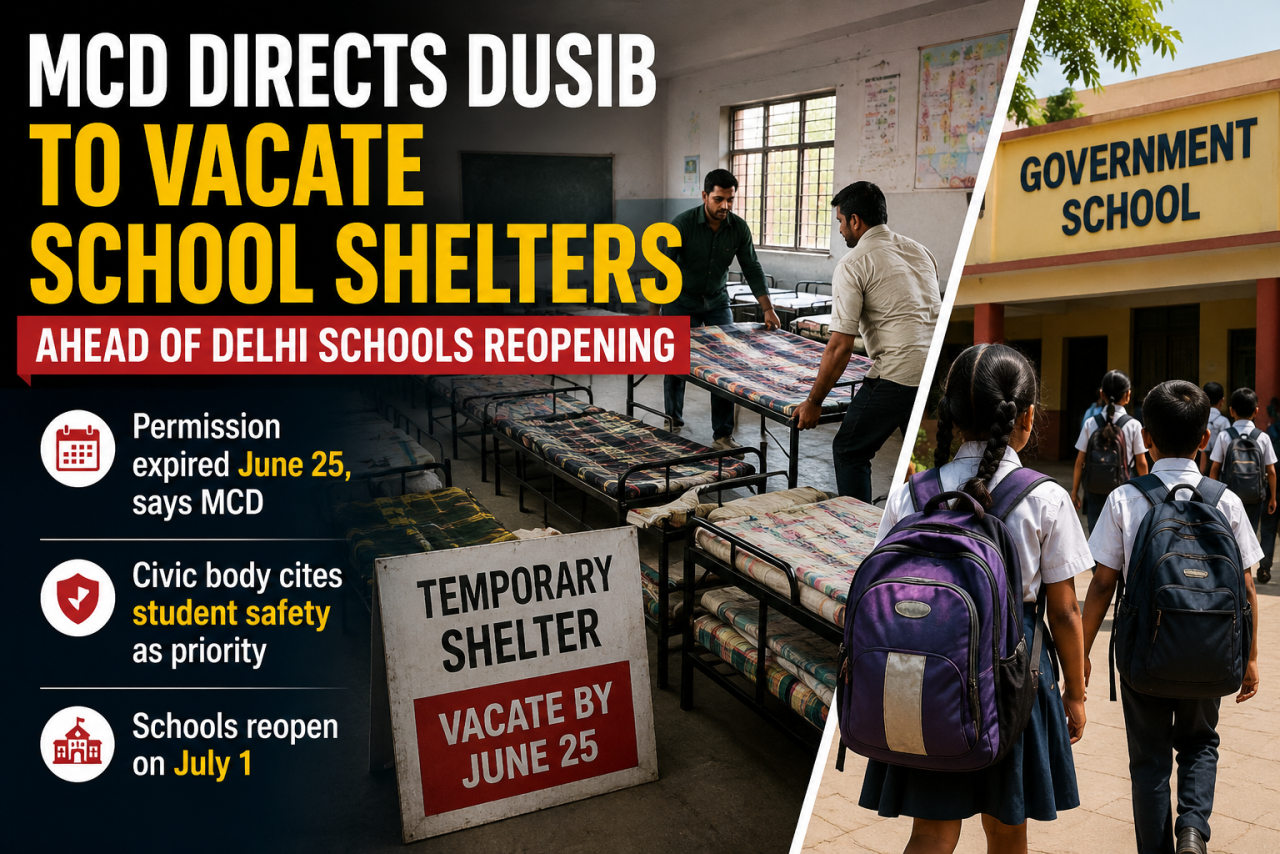
The Municipal Corporation of Delhi (MCD) has directed the Delhi Urban Shelter Improvement Board (DUSIB) to vacate government school buildings that were being used as temporary night shelters, triggering an administrative dispute just as Delhi's government schools prepare to reopen.
In a letter dated June 30, the MCD stated that permission granted to use the school premises as shelters had expired on June 25. However, DUSIB reportedly maintains that it is entitled to continue occupying the buildings until July 15. With schools scheduled to reopen, the civic body has insisted that the premises be handed back immediately so classrooms can be restored for students.
The Core Issue
At the heart of the dispute is a disagreement over the validity of the shelter arrangement. According to the MCD, the original approval allowed school buildings to function as temporary shelters only for a fixed period between mid-May and late June. Once that period ended, the buildings were required to revert to their primary purpose as educational institutions.
The corporation argues that any subsequent request by DUSIB to extend the arrangement does not override the original terms, particularly when schools are resuming academic activities.
Why the Shelters Were Established
The temporary shelters were created following directions from the Delhi High Court, which instructed authorities to provide accommodation for people staying near hospitals in south Delhi. Many of the occupants were attendants and family members of patients who had no affordable place to stay while their relatives received medical treatment.
Government school buildings, largely vacant during the summer vacation, were considered a practical short-term solution because of their spacious classrooms and halls.
However, with the summer break ending and students returning to classrooms, the MCD maintains that the continued use of school premises as shelters is no longer appropriate and could affect the safe functioning of educational institutions.
What Officials Found During Inspection
Inspections conducted on June 29 indicated that the temporary shelters had significantly altered the use of school facilities. In at least one government school, classrooms had been converted into dormitory-style accommodation, with approximately 25 beds installed in each room.
Officials observed that staff had already begun removing the beds ahead of the new academic session, suggesting that preparations to restore the classrooms were underway even before the MCD's formal communication.
Despite the ongoing developments, officials from DUSIB, the MCD, and the Directorate of Education had not issued any public statement at the time of reporting, leaving uncertainty over whether all affected school buildings would be vacated before students returned.
Why the Issue Matters
The episode highlights the challenges of temporarily repurposing educational infrastructure for humanitarian needs. While schools can provide emergency accommodation during vacations, restoring them for academic use requires more than simply removing beds.
Classrooms must be thoroughly cleaned, sanitised, inspected for any structural alterations, and returned to a condition suitable for students and teachers before learning can safely resume.
As schools reopen, administrators are expected to ensure that any premises previously used for non-educational purposes have been fully restored, sanitation standards have been met, and no shelter occupants remain on campus.
The broader question of which authority has the final say over extending such temporary arrangements remains a matter for the MCD, DUSIB, and the Delhi High Court. For schools, however, the immediate priority is ensuring that a temporary humanitarian initiative does not compromise the safety, hygiene, and learning environment of returning students.
The Municipal Corporation of Delhi (MCD) has directed the Delhi Urban Shelter Improvement Board (DUSIB) to vacate government school buildings that were being used as temporary night shelters, triggering an administrative dispute just as Delhi's government schools prepare to reopen.
In a letter dated June 30, the MCD stated that permission granted to use the school premises as shelters had expired on June 25. However, DUSIB reportedly maintains that it is entitled to continue occupying the buildings until July 15. With schools scheduled to reopen, the civic body has insisted that the premises be handed back immediately so classrooms can be restored for students.
The Core Issue
At the heart of the dispute is a disagreement over the validity of the shelter arrangement. According to the MCD, the original approval allowed school buildings to function as temporary shelters only for a fixed period between mid-May and late June. Once that period ended, the buildings were required to revert to their primary purpose as educational institutions.
The corporation argues that any subsequent request by DUSIB to extend the arrangement does not override the original terms, particularly when schools are resuming academic activities.
Why the Shelters Were Established
The temporary shelters were created following directions from the Delhi High Court, which instructed authorities to provide accommodation for people staying near hospitals in south Delhi. Many of the occupants were attendants and family members of patients who had no affordable place to stay while their relatives received medical treatment.
Government school buildings, largely vacant during the summer vacation, were considered a practical short-term solution because of their spacious classrooms and halls.
However, with the summer break ending and students returning to classrooms, the MCD maintains that the continued use of school premises as shelters is no longer appropriate and could affect the safe functioning of educational institutions.
What Officials Found During Inspection
Inspections conducted on June 29 indicated that the temporary shelters had significantly altered the use of school facilities. In at least one government school, classrooms had been converted into dormitory-style accommodation, with approximately 25 beds installed in each room.
Officials observed that staff had already begun removing the beds ahead of the new academic session, suggesting that preparations to restore the classrooms were underway even before the MCD's formal communication.
Despite the ongoing developments, officials from DUSIB, the MCD, and the Directorate of Education had not issued any public statement at the time of reporting, leaving uncertainty over whether all affected school buildings would be vacated before students returned.
Why the Issue Matters
The episode highlights the challenges of temporarily repurposing educational infrastructure for humanitarian needs. While schools can provide emergency accommodation during vacations, restoring them for academic use requires more than simply removing beds.
Classrooms must be thoroughly cleaned, sanitised, inspected for any structural alterations, and returned to a condition suitable for students and teachers before learning can safely resume.
As schools reopen, administrators are expected to ensure that any premises previously used for non-educational purposes have been fully restored, sanitation standards have been met, and no shelter occupants remain on campus.
The broader question of which authority has the final say over extending such temporary arrangements remains a matter for the MCD, DUSIB, and the Delhi High Court. For schools, however, the immediate priority is ensuring that a temporary humanitarian initiative does not compromise the safety, hygiene, and learning environment of returning students.


























Leave a Comment