
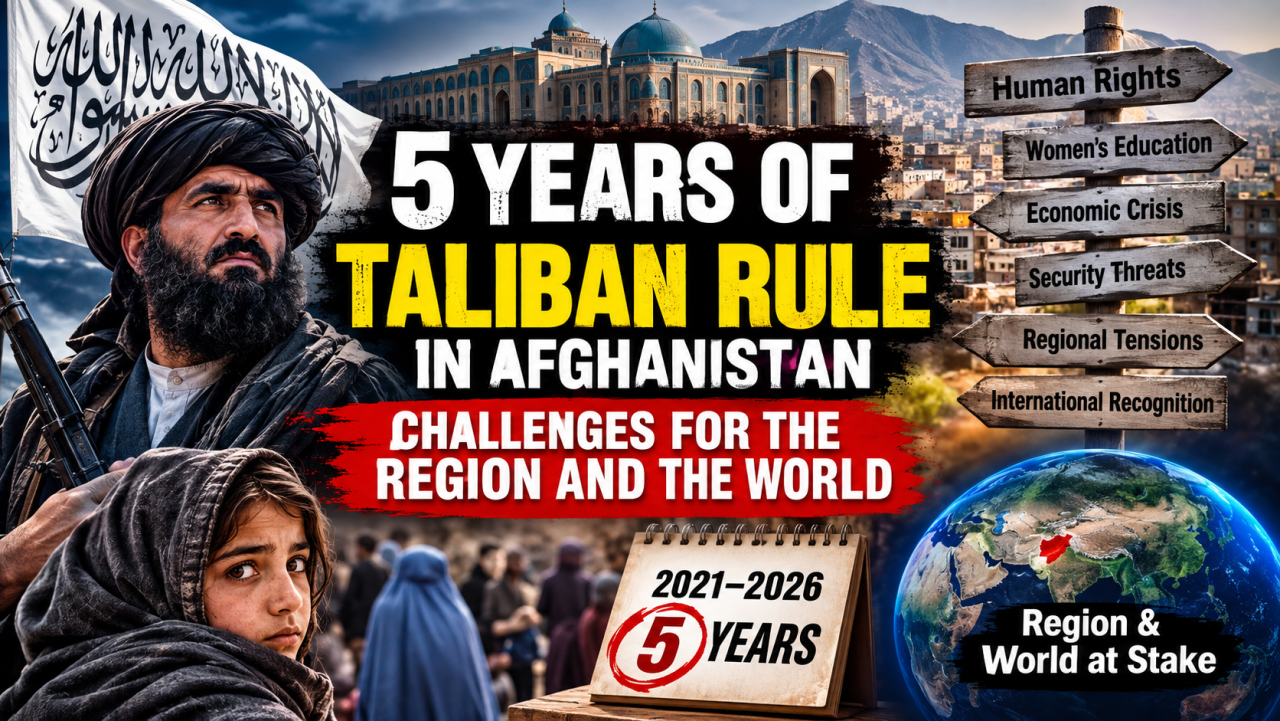
Five years after seizing Kabul, the Taliban controls Afghanistan but faces a harder battle for economic stability, regional security, human rights and international legitimacy.
Five years after the Taliban returned to power in Kabul, Afghanistan stands at a difficult crossroads. The Taliban has survived the collapse of the Western-backed government, consolidated control over almost the entire country and demonstrated that it can maintain a degree of internal order. Yet survival has not translated into legitimacy, prosperity or social stability.
On August 15, 2026, the Taliban marked five years since its fighters entered Kabul and the government of Ashraf Ghani collapsed. The anniversary was presented by the Taliban as a moment of victory over foreign intervention. A parade was held outside the former US embassy in Kabul, with Taliban officials portraying their rule as evidence of Afghanistan's independence and resistance to Western domination.
But beyond the symbolism of victory lies a far more complicated question. What has five years of Taliban rule meant for Afghanistan, its neighbours and the wider international community?
The answer is deeply contested.
From Insurgency to State Power
When the Taliban seized Kabul in 2021, many observers questioned whether the movement that had fought for two decades could actually govern a country.
Five years later, the Taliban has answered one part of that question. It has retained control.
Armed opposition groups have failed to seriously challenge its authority across most of Afghanistan, while the Taliban has strengthened its control over state institutions and major economic resources. The security environment has also changed significantly from the years of full-scale war between the Taliban, Afghan government forces and international troops.
For ordinary Afghans, the end of large-scale warfare has brought an important degree of relief.
But peace is not necessarily the same as stability.
A country can be free from conventional war and still remain trapped in poverty, political repression, humanitarian dependence and social exclusion. Afghanistan's experience under the Taliban demonstrates precisely that contradiction.
The Human Rights Challenge
The most serious criticism of Taliban rule concerns human rights, particularly the position of women and girls.
Five years after the takeover, approximately 2.4 million Afghan girls remain excluded from secondary education. Afghanistan remains the only country in the world where girls and women are formally denied access to secondary and higher education on such a scale.
Restrictions extend far beyond education.
Women have been progressively pushed out of employment and public life, while regulations governing movement, clothing and participation in society have dramatically reduced their independence. UN Women has warned that the exclusion of women has become increasingly normalised, with half of Afghan women surveyed reporting that they leave their homes only once or twice a month because of restrictions.
This is not merely an Afghan domestic issue.
It has become one of the biggest obstacles to international recognition of the Taliban government. The international community faces a difficult dilemma. Engaging with Kabul is necessary for humanitarian assistance, security cooperation and regional diplomacy, but normalising a government that systematically excludes women raises profound questions about international norms.
An Economy Still Struggling to Stand
The Taliban has repeatedly claimed that Afghanistan is moving towards economic self-reliance. There have been efforts to increase domestic revenue, improve customs collection and reduce dependence on foreign financing.
Yet the economic foundations remain fragile.
The collapse of the previous government's international funding model after 2021 created an enormous shock. Foreign assistance declined sharply, while Afghanistan's financial isolation and frozen overseas assets compounded the pressure.
The result has been an economy in which millions continue to depend on humanitarian assistance.
The problem is made worse by climate-related disasters. Droughts, earthquakes and other natural disasters have repeatedly damaged communities that already possess limited capacity to recover. Aid organisations have warned that humanitarian needs are rising even as international funding becomes increasingly inadequate.
Afghanistan therefore faces a difficult economic equation. The Taliban wants international investment and trade without accepting many of the political and social conditions attached to international recognition.
The outside world, meanwhile, wants economic engagement to improve Afghan lives but does not want such engagement to become unconditional acceptance of Taliban policies.
The Security Challenge
Security remains another major concern.
The Taliban has succeeded in preventing Afghanistan from returning to the nationwide battlefield that existed before 2021. Yet militant groups remain active, and the presence and activities of extremist organisations continue to worry Afghanistan's neighbours and Western governments.
The Islamic State Khorasan Province remains a particular security concern. At the same time, Afghanistan's relationship with Pakistan has deteriorated sharply.
For years, Pakistan was widely regarded as having significant influence over the Taliban. That relationship has become increasingly strained because of disputes over militant activity, border security and the Tehrik-e-Taliban Pakistan.
Islamabad accuses Afghan territory of being used by militants attacking Pakistan, while the Taliban rejects such accusations. The resulting tensions have already produced serious military confrontations between the two countries.
For the neighbourhood, this could become one of the most dangerous consequences of prolonged Taliban rule.
An unstable relationship between Kabul and Islamabad risks transforming Afghanistan's western and southern borders into a permanent security flashpoint.
Afghanistan and Its Neighbours
The Taliban's five-year survival has forced neighbouring countries to reconsider their policies.
Iran, Pakistan, China and the Central Asian states cannot afford to ignore Kabul. Afghanistan sits at the crossroads of South Asia, Central Asia and the Middle East, making its stability important for trade, migration, terrorism and regional connectivity.
China has maintained engagement with the Taliban while looking at Afghanistan's mineral resources and potential connectivity projects. Iran has also maintained relations with Kabul, while Central Asian countries have sought practical arrangements to protect their borders and economic interests.
India, too, has gradually moved from cautious distance towards pragmatic engagement.
New Delhi initially closed its embassy after the Taliban takeover but later reopened a technical mission and expanded diplomatic contacts. The recent movement towards allowing Taliban-appointed diplomats in India reflects a recognition of a basic geopolitical reality: the Taliban controls Kabul, and India cannot afford to leave Afghanistan entirely to competing regional powers.
Yet India, like many other countries, has stopped short of treating engagement as unconditional political approval.
The Recognition Problem
Perhaps the Taliban's greatest international challenge is legitimacy.
The movement has demonstrated that it can govern through control, but governing through control is not the same as earning legitimacy.
The international community remains deeply divided between the need to engage with the authorities in Kabul and the reluctance to grant full diplomatic legitimacy to a government that excludes large sections of its population from political and social life.
Russia has moved further than most countries by formally recognising the Taliban government, while several other countries have expanded diplomatic and economic contacts without extending the same level of recognition.
This creates an unusual diplomatic situation.
The Taliban is neither completely isolated nor fully accepted.
It occupies a grey zone in international politics where foreign governments communicate with it, negotiate with it and sometimes cooperate with it, while still withholding the full legitimacy that the Taliban seeks.
The Challenge for the World
The international community now faces a difficult balancing act.
Complete isolation could worsen Afghanistan's humanitarian crisis and create greater opportunities for extremist groups, organised crime and illegal migration.
But unrestricted engagement could be interpreted as acceptance of policies that violate fundamental rights, particularly the rights of women and girls.
The challenge is therefore not simply whether the world should talk to the Taliban. It is how the world should engage without abandoning its principles.
Humanitarian assistance must reach Afghans without becoming a political reward. Economic engagement must create opportunities for ordinary citizens rather than merely strengthening an authoritarian state. Security cooperation must prevent Afghanistan from once again becoming a sanctuary for international terrorism.
And above all, the rights of Afghan women and girls cannot be treated as a secondary diplomatic issue.
Five Years On, the Taliban Has Won Power but Not the Future
The Taliban can legitimately claim one major achievement after five years. It has survived.
It has outlasted the government it defeated, maintained territorial control and forced the international community to deal with it as Afghanistan's de facto authority.
But the more difficult test lies ahead.
Can the Taliban build an economy capable of supporting its population? Can it prevent Afghanistan from becoming a source of regional insecurity? Can it manage relations with Pakistan? Can it persuade India, China, Iran, Russia and the West that Afghanistan is a reliable partner? And, most importantly, can it create a political order in which women, minorities and different sections of Afghan society have a meaningful place?
The answers will determine whether the Taliban's five-year anniversary is remembered merely as the celebration of a military victory or as the beginning of a sustainable political order.
For Afghanistan's neighbours, the stakes are enormous. For the wider world, the lesson is equally important.
The Taliban has demonstrated that taking power is possible. The next five years will determine whether it can turn power into governance, governance into stability and stability into legitimacy.
Afghanistan's future will ultimately depend not on how long the Taliban can remain in power, but on whether the country can become a place where security does not come at the cost of freedom, and where political control does not come at the cost of an entire generation's future.
Five years after the Taliban returned to power in Kabul, Afghanistan stands at a difficult crossroads. The Taliban has survived the collapse of the Western-backed government, consolidated control over almost the entire country and demonstrated that it can maintain a degree of internal order. Yet survival has not translated into legitimacy, prosperity or social stability.
On August 15, 2026, the Taliban marked five years since its fighters entered Kabul and the government of Ashraf Ghani collapsed. The anniversary was presented by the Taliban as a moment of victory over foreign intervention. A parade was held outside the former US embassy in Kabul, with Taliban officials portraying their rule as evidence of Afghanistan's independence and resistance to Western domination.
But beyond the symbolism of victory lies a far more complicated question. What has five years of Taliban rule meant for Afghanistan, its neighbours and the wider international community?
The answer is deeply contested.
From Insurgency to State Power
When the Taliban seized Kabul in 2021, many observers questioned whether the movement that had fought for two decades could actually govern a country.
Five years later, the Taliban has answered one part of that question. It has retained control.
Armed opposition groups have failed to seriously challenge its authority across most of Afghanistan, while the Taliban has strengthened its control over state institutions and major economic resources. The security environment has also changed significantly from the years of full-scale war between the Taliban, Afghan government forces and international troops.
For ordinary Afghans, the end of large-scale warfare has brought an important degree of relief.
But peace is not necessarily the same as stability.
A country can be free from conventional war and still remain trapped in poverty, political repression, humanitarian dependence and social exclusion. Afghanistan's experience under the Taliban demonstrates precisely that contradiction.
The Human Rights Challenge
The most serious criticism of Taliban rule concerns human rights, particularly the position of women and girls.
Five years after the takeover, approximately 2.4 million Afghan girls remain excluded from secondary education. Afghanistan remains the only country in the world where girls and women are formally denied access to secondary and higher education on such a scale.
Restrictions extend far beyond education.
Women have been progressively pushed out of employment and public life, while regulations governing movement, clothing and participation in society have dramatically reduced their independence. UN Women has warned that the exclusion of women has become increasingly normalised, with half of Afghan women surveyed reporting that they leave their homes only once or twice a month because of restrictions.
This is not merely an Afghan domestic issue.
It has become one of the biggest obstacles to international recognition of the Taliban government. The international community faces a difficult dilemma. Engaging with Kabul is necessary for humanitarian assistance, security cooperation and regional diplomacy, but normalising a government that systematically excludes women raises profound questions about international norms.
An Economy Still Struggling to Stand
The Taliban has repeatedly claimed that Afghanistan is moving towards economic self-reliance. There have been efforts to increase domestic revenue, improve customs collection and reduce dependence on foreign financing.
Yet the economic foundations remain fragile.
The collapse of the previous government's international funding model after 2021 created an enormous shock. Foreign assistance declined sharply, while Afghanistan's financial isolation and frozen overseas assets compounded the pressure.
The result has been an economy in which millions continue to depend on humanitarian assistance.
The problem is made worse by climate-related disasters. Droughts, earthquakes and other natural disasters have repeatedly damaged communities that already possess limited capacity to recover. Aid organisations have warned that humanitarian needs are rising even as international funding becomes increasingly inadequate.
Afghanistan therefore faces a difficult economic equation. The Taliban wants international investment and trade without accepting many of the political and social conditions attached to international recognition.
The outside world, meanwhile, wants economic engagement to improve Afghan lives but does not want such engagement to become unconditional acceptance of Taliban policies.
The Security Challenge
Security remains another major concern.
The Taliban has succeeded in preventing Afghanistan from returning to the nationwide battlefield that existed before 2021. Yet militant groups remain active, and the presence and activities of extremist organisations continue to worry Afghanistan's neighbours and Western governments.
The Islamic State Khorasan Province remains a particular security concern. At the same time, Afghanistan's relationship with Pakistan has deteriorated sharply.
For years, Pakistan was widely regarded as having significant influence over the Taliban. That relationship has become increasingly strained because of disputes over militant activity, border security and the Tehrik-e-Taliban Pakistan.
Islamabad accuses Afghan territory of being used by militants attacking Pakistan, while the Taliban rejects such accusations. The resulting tensions have already produced serious military confrontations between the two countries.
For the neighbourhood, this could become one of the most dangerous consequences of prolonged Taliban rule.
An unstable relationship between Kabul and Islamabad risks transforming Afghanistan's western and southern borders into a permanent security flashpoint.
Afghanistan and Its Neighbours
The Taliban's five-year survival has forced neighbouring countries to reconsider their policies.
Iran, Pakistan, China and the Central Asian states cannot afford to ignore Kabul. Afghanistan sits at the crossroads of South Asia, Central Asia and the Middle East, making its stability important for trade, migration, terrorism and regional connectivity.
China has maintained engagement with the Taliban while looking at Afghanistan's mineral resources and potential connectivity projects. Iran has also maintained relations with Kabul, while Central Asian countries have sought practical arrangements to protect their borders and economic interests.
India, too, has gradually moved from cautious distance towards pragmatic engagement.
New Delhi initially closed its embassy after the Taliban takeover but later reopened a technical mission and expanded diplomatic contacts. The recent movement towards allowing Taliban-appointed diplomats in India reflects a recognition of a basic geopolitical reality: the Taliban controls Kabul, and India cannot afford to leave Afghanistan entirely to competing regional powers.
Yet India, like many other countries, has stopped short of treating engagement as unconditional political approval.
The Recognition Problem
Perhaps the Taliban's greatest international challenge is legitimacy.
The movement has demonstrated that it can govern through control, but governing through control is not the same as earning legitimacy.
The international community remains deeply divided between the need to engage with the authorities in Kabul and the reluctance to grant full diplomatic legitimacy to a government that excludes large sections of its population from political and social life.
Russia has moved further than most countries by formally recognising the Taliban government, while several other countries have expanded diplomatic and economic contacts without extending the same level of recognition.
This creates an unusual diplomatic situation.
The Taliban is neither completely isolated nor fully accepted.
It occupies a grey zone in international politics where foreign governments communicate with it, negotiate with it and sometimes cooperate with it, while still withholding the full legitimacy that the Taliban seeks.
The Challenge for the World
The international community now faces a difficult balancing act.
Complete isolation could worsen Afghanistan's humanitarian crisis and create greater opportunities for extremist groups, organised crime and illegal migration.
But unrestricted engagement could be interpreted as acceptance of policies that violate fundamental rights, particularly the rights of women and girls.
The challenge is therefore not simply whether the world should talk to the Taliban. It is how the world should engage without abandoning its principles.
Humanitarian assistance must reach Afghans without becoming a political reward. Economic engagement must create opportunities for ordinary citizens rather than merely strengthening an authoritarian state. Security cooperation must prevent Afghanistan from once again becoming a sanctuary for international terrorism.
And above all, the rights of Afghan women and girls cannot be treated as a secondary diplomatic issue.
Five Years On, the Taliban Has Won Power but Not the Future
The Taliban can legitimately claim one major achievement after five years. It has survived.
It has outlasted the government it defeated, maintained territorial control and forced the international community to deal with it as Afghanistan's de facto authority.
But the more difficult test lies ahead.
Can the Taliban build an economy capable of supporting its population? Can it prevent Afghanistan from becoming a source of regional insecurity? Can it manage relations with Pakistan? Can it persuade India, China, Iran, Russia and the West that Afghanistan is a reliable partner? And, most importantly, can it create a political order in which women, minorities and different sections of Afghan society have a meaningful place?
The answers will determine whether the Taliban's five-year anniversary is remembered merely as the celebration of a military victory or as the beginning of a sustainable political order.
For Afghanistan's neighbours, the stakes are enormous. For the wider world, the lesson is equally important.
The Taliban has demonstrated that taking power is possible. The next five years will determine whether it can turn power into governance, governance into stability and stability into legitimacy.
Afghanistan's future will ultimately depend not on how long the Taliban can remain in power, but on whether the country can become a place where security does not come at the cost of freedom, and where political control does not come at the cost of an entire generation's future.
















Leave a Comment