
The world is getting hotter, climate disasters are becoming costlier, and millions are still left without financial protection.
The world is running out of time to contain global warming, but it is also running short of money to deal with its consequences. That contradiction is at the centre of COP31, which opened in Antalya, Turkey, on November 9, bringing together representatives from nearly every country for two weeks of climate negotiations.
Scheduled to continue until November 20, the UN climate summit is expected to focus less on announcing fresh promises and more on delivering commitments already made under the Paris Agreement.
The opening day brought two important warnings. The World Meteorological Organization (WMO) reported that global temperatures remain dangerously high, while a separate analysis by climate policy experts highlighted another growing crisis: the enormous financial losses caused by climate disasters and the lack of insurance to cover them.
Together, the findings raise an uncomfortable question. As climate risks increase, who will pay for the damage?
A Record-Hot Decade and the 1.5°C Warning
The WMO released its State of the Climate Update for COP31 on the summit's opening day. Its findings underline the speed at which global temperatures are rising.
Each of the past 12 years has ranked among the warmest ever recorded. The years 2023, 2024, 2025 and 2026 have featured prominently in the record-breaking temperature trend.
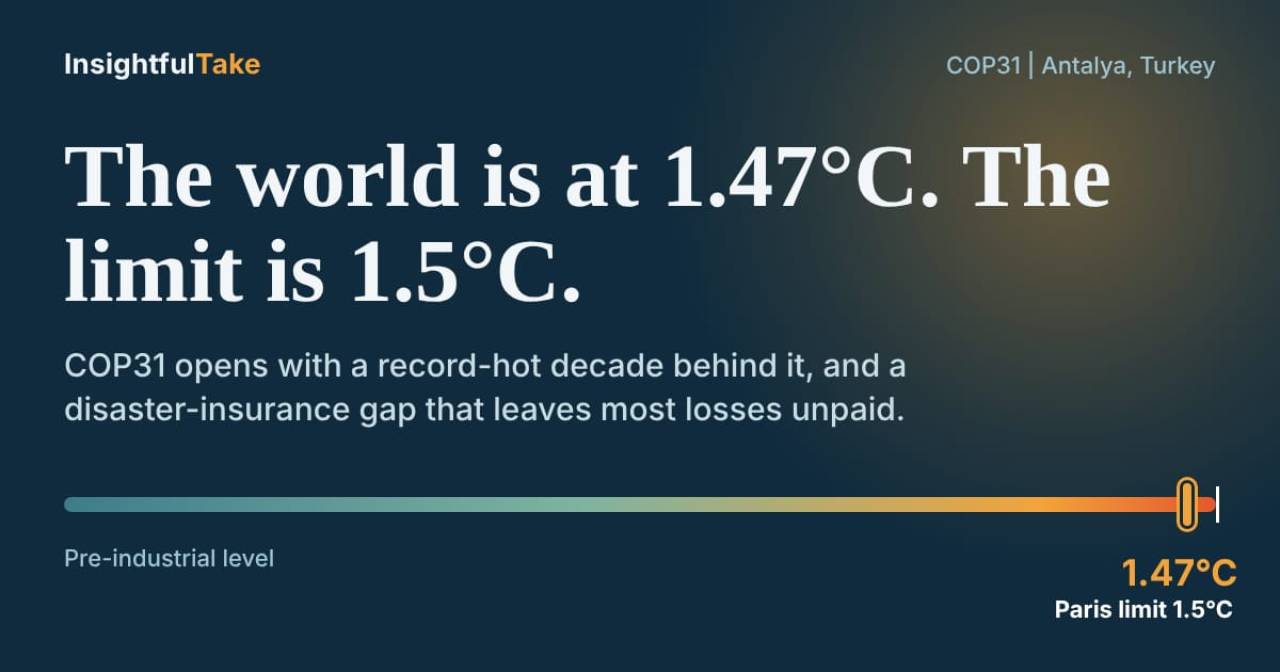
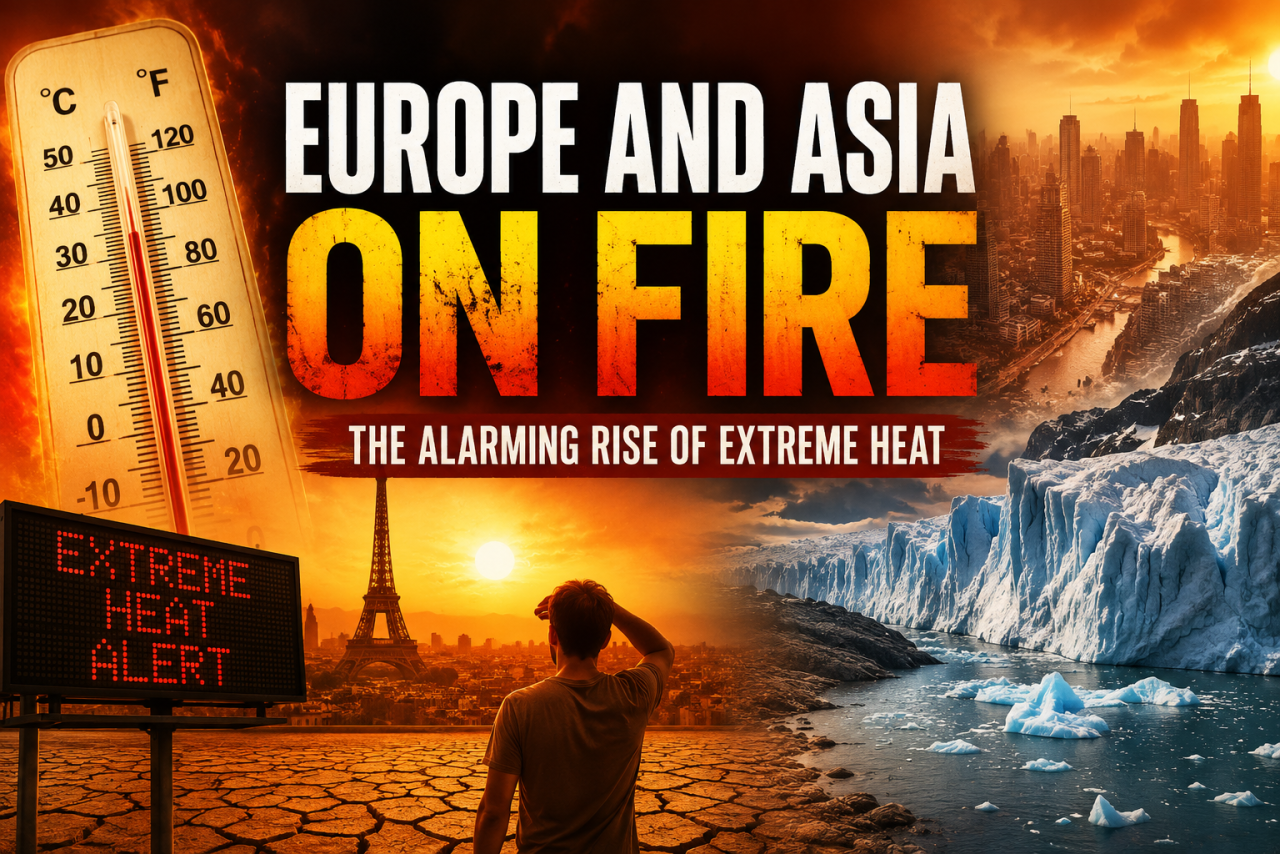
The global average surface temperature between January and September 2026 was approximately 1.47°C above pre-industrial levels. This puts the world dangerously close to the 1.5°C threshold established under the Paris Agreement.
The WMO expects temperatures to rise further before the year ends, partly because of the developing El Niño weather pattern. Strengthening since August, El Niño is expected to reach its peak around December.
WMO Secretary-General Celeste Saulo explained that the latest assessment covers data only until September and therefore does not capture the full influence of El Niño.
She also clarified an important scientific distinction. El Niño does not create additional heat but releases heat stored in the oceans. With ocean temperatures already at record levels, more stored heat is available to influence global temperatures.
For India, these warnings have immediate consequences. Longer heatwaves, unpredictable monsoons, extreme rainfall and recurring floods in river systems such as the Kosi and the Ganga are local expressions of the same global climate crisis.
Turkey Wants COP31 to Become an Implementation Summit
Turkey, the host country, holds the COP presidency, while Australia is serving as president of the negotiations.
COP31 President Murat Kurum, who is also Turkey's Minister for Environment, Urbanisation and Climate Change, used his opening address to call for an "implementation COP".
His message was straightforward: the world does not need more climate promises as much as it needs to fulfil existing commitments.
Kurum urged negotiators to focus on closing the gap between international pledges and improvements that people can actually experience in their daily lives. He reiterated that the 1.5°C target must remain central to global climate action.
He also highlighted how climate change intersects with other global challenges, including armed conflicts, geopolitical tensions, economic uncertainty, rising debt, food insecurity and unequal access to technology and capital.
These crises cannot be addressed independently, he argued, because each one can intensify the effects of the others.
Kurum also advocated faster electrification as a practical way to reduce dependence on fossil fuels. He referred to the "35-by-35" pledge, which aims to increase electricity's share of final energy consumption to 35% by 2035.
The argument is that cleaner electricity can strengthen energy security, reduce emissions and protect communities and economies from the consequences of climate change.
Fossil Fuel Price Shocks Strengthen the Case for Renewables
UN climate change chief Simon Stiell used his address to connect climate action with the economic pressures facing ordinary households.
He pointed to the volatility in fossil fuel prices this year, arguing that dependence on conventional energy sources continues to expose economies and consumers to sudden financial shocks.
According to Stiell, renewable energy is already delivering substantial economic benefits. He cited estimates that renewables saved the world approximately $265 billion during the first half of 2026.
His argument was that clean energy is no longer simply an environmental choice. It is increasingly an economic necessity that can reduce energy costs, improve energy security and protect countries from fossil fuel price instability.
However, the transition requires investment, infrastructure and political commitment, particularly in developing economies where access to affordable capital remains a major challenge.
The Hidden Climate Crisis: Who Pays When Disasters Strike?
While climate negotiations focus on emissions and energy transitions, another problem is receiving growing attention: the inability of insurance systems to absorb the financial consequences of extreme weather.
A separate analysis published by climate policy experts this week warns that the world is facing increasingly interconnected climate risks. In many cases, another disaster strikes before communities and governments have recovered financially from the previous one.
The insurance gap is particularly worrying.
Insured losses from extreme weather events have exceeded $100 billion annually since 2020. However, this represents only a fraction of the actual economic damage.
Asia accounts for approximately 30% of global disaster-related losses but only around 5% of insured losses.
The analysis estimates that of the roughly $65 billion in losses recorded in 2025, around 92% remained uninsured.
That money does not simply disappear from the balance sheet. The burden shifts to families, small businesses, local communities and government budgets.
For developing countries, the consequences can be devastating.
Disaster-related losses average approximately 0.3% of global GDP. However, the figure rises to around 1.2% for landlocked developing countries and 2.1% for small island states.
The scale of the damage becomes clearer through individual examples. One storm caused losses in Vanuatu equivalent to approximately 59% of its GDP. Hurricane Maria's damage to Dominica exceeded twice the size of the country's economy.
Such disasters can erase years of development, leaving governments struggling to rebuild essential infrastructure while managing existing debt and financial pressures.
Nepal's Floods Expose the Funding Gap
Nepal offers a recent example of how repeated climate disasters can overwhelm a developing economy.
Two destructive floods struck the same river system within 14 months, killing hundreds of people and leaving behind a reconstruction bill running into billions of dollars.
Nepal subsequently sought $20 million from the global Loss and Damage Fund. However, this amount represents only a small portion of the country's overall recovery requirements.
The concern is that countries seeking financial assistance after climate disasters may not receive adequate support.
As international aid budgets face pressure and competing global priorities demand attention, vulnerable nations risk being left to manage the consequences of disasters largely on their own.
This raises a fundamental question for COP31: can the international climate finance system deliver meaningful support to countries that suffer the most despite contributing relatively little to global emissions?
Practical Solutions Already Exist
The climate insurance analysis does not merely highlight the problem. It identifies several measures that governments, insurers and regulators can adopt to reduce financial vulnerability.
1. Make insurance pricing reflect actual risks
Insurance premiums need to reflect the real level of climate exposure. However, when premiums rise, governments and regulators often face pressure to intervene.
The alternative can be equally damaging. Insurers may withdraw from high-risk locations altogether, leaving households and businesses without financial protection.
A more sustainable approach would combine realistic risk pricing with targeted assistance for vulnerable communities.
2. Build climate resilience before disasters strike
Preventing damage is often less expensive than rebuilding after a disaster.
The analysis highlights Alabama's Fortified roof standard in the United States, which encourages stronger construction practices.
When Hurricane Sally struck in 2020, homes built to the Fortified standard reportedly suffered little or no damage. Insurance premiums for these properties fell by 35% to 45%, while their market values increased by approximately 7%.
The example demonstrates how better construction standards can protect lives while reducing financial exposure.
3. Share climate-risk data
Insurers, governments, engineers and infrastructure developers need better access to reliable climate-risk information.
Sharing such data can help engineers identify vulnerabilities and design safer buildings, roads, bridges and public infrastructure before construction begins.
4. Use public policy to transform markets
India's experience with energy-efficient appliances demonstrates how government mandates and public procurement can accelerate market-wide changes.
Similar policy interventions could encourage climate-resilient housing, safer infrastructure and stronger construction standards.
5. Expand pooled funding and early-warning systems
Public institutions, philanthropic organisations and private insurers can work together to create pooled financial mechanisms that support vulnerable communities.
Early-warning systems must also reach people who are most exposed to floods, cyclones and extreme heat. These warnings should be accompanied by financial protection mechanisms so that vulnerable households are not left to bear the entire cost of recovery.
Why COP31 Matters for India
The scientific warning and the insurance crisis are two sides of the same problem.
The WMO findings show that the physical risks of climate change are intensifying. The insurance analysis demonstrates that the financial systems designed to absorb these risks remain deeply inadequate.
The UN Environment Programme's September assessment adds another layer of concern. It estimated that current policies could lead to approximately 2.6°C of global warming by 2100. Even if existing national climate pledges are fully implemented, warming could peak at around 1.8°C.
Such a trajectory would put enormous pressure on insurance markets, financial institutions and public finances.
For India, the stakes are particularly high.
Millions of people live in regions exposed to floods, cyclones, droughts and extreme heat. Agricultural communities are vulnerable to changing rainfall patterns, while urban centres face rising temperatures, water stress and drainage failures.
The country needs more than international climate commitments. It needs stronger building standards, affordable insurance, climate-resilient infrastructure and early-warning systems that reach the last village.
These measures do not have to wait for the outcome of an international summit.
India must also ensure that climate adaptation receives the same policy attention as renewable energy expansion and emissions reduction. Protecting vulnerable populations from unavoidable climate impacts is becoming an essential part of economic planning.
The Real Test Begins After the Summit
COP31 has opened at a time when the consequences of climate change are no longer distant predictions. Record temperatures, destructive floods, extreme weather and rising economic losses are already affecting millions of people.
The summit's success will not be measured by the number of speeches, declarations or fresh financial commitments. It will depend on whether governments translate existing promises into action and whether vulnerable countries receive the resources needed to protect their people.
The planet is already sending its warning. The bigger failure would be for governments, financial institutions and insurers to continue treating every disaster as an isolated emergency.
The real challenge in Antalya is to ensure that the next climate disaster does not leave another generation paying a bill that the world knew was coming.
The world is running out of time to contain global warming, but it is also running short of money to deal with its consequences. That contradiction is at the centre of COP31, which opened in Antalya, Turkey, on November 9, bringing together representatives from nearly every country for two weeks of climate negotiations.
Scheduled to continue until November 20, the UN climate summit is expected to focus less on announcing fresh promises and more on delivering commitments already made under the Paris Agreement.
The opening day brought two important warnings. The World Meteorological Organization (WMO) reported that global temperatures remain dangerously high, while a separate analysis by climate policy experts highlighted another growing crisis: the enormous financial losses caused by climate disasters and the lack of insurance to cover them.
Together, the findings raise an uncomfortable question. As climate risks increase, who will pay for the damage?
A Record-Hot Decade and the 1.5°C Warning
The WMO released its State of the Climate Update for COP31 on the summit's opening day. Its findings underline the speed at which global temperatures are rising.
Each of the past 12 years has ranked among the warmest ever recorded. The years 2023, 2024, 2025 and 2026 have featured prominently in the record-breaking temperature trend.
The global average surface temperature between January and September 2026 was approximately 1.47°C above pre-industrial levels. This puts the world dangerously close to the 1.5°C threshold established under the Paris Agreement.
The WMO expects temperatures to rise further before the year ends, partly because of the developing El Niño weather pattern. Strengthening since August, El Niño is expected to reach its peak around December.
WMO Secretary-General Celeste Saulo explained that the latest assessment covers data only until September and therefore does not capture the full influence of El Niño.
She also clarified an important scientific distinction. El Niño does not create additional heat but releases heat stored in the oceans. With ocean temperatures already at record levels, more stored heat is available to influence global temperatures.
For India, these warnings have immediate consequences. Longer heatwaves, unpredictable monsoons, extreme rainfall and recurring floods in river systems such as the Kosi and the Ganga are local expressions of the same global climate crisis.
Turkey Wants COP31 to Become an Implementation Summit
Turkey, the host country, holds the COP presidency, while Australia is serving as president of the negotiations.
COP31 President Murat Kurum, who is also Turkey's Minister for Environment, Urbanisation and Climate Change, used his opening address to call for an "implementation COP".
His message was straightforward: the world does not need more climate promises as much as it needs to fulfil existing commitments.
Kurum urged negotiators to focus on closing the gap between international pledges and improvements that people can actually experience in their daily lives. He reiterated that the 1.5°C target must remain central to global climate action.
He also highlighted how climate change intersects with other global challenges, including armed conflicts, geopolitical tensions, economic uncertainty, rising debt, food insecurity and unequal access to technology and capital.
These crises cannot be addressed independently, he argued, because each one can intensify the effects of the others.
Kurum also advocated faster electrification as a practical way to reduce dependence on fossil fuels. He referred to the "35-by-35" pledge, which aims to increase electricity's share of final energy consumption to 35% by 2035.
The argument is that cleaner electricity can strengthen energy security, reduce emissions and protect communities and economies from the consequences of climate change.
Fossil Fuel Price Shocks Strengthen the Case for Renewables
UN climate change chief Simon Stiell used his address to connect climate action with the economic pressures facing ordinary households.
He pointed to the volatility in fossil fuel prices this year, arguing that dependence on conventional energy sources continues to expose economies and consumers to sudden financial shocks.
According to Stiell, renewable energy is already delivering substantial economic benefits. He cited estimates that renewables saved the world approximately $265 billion during the first half of 2026.
His argument was that clean energy is no longer simply an environmental choice. It is increasingly an economic necessity that can reduce energy costs, improve energy security and protect countries from fossil fuel price instability.
However, the transition requires investment, infrastructure and political commitment, particularly in developing economies where access to affordable capital remains a major challenge.
The Hidden Climate Crisis: Who Pays When Disasters Strike?
While climate negotiations focus on emissions and energy transitions, another problem is receiving growing attention: the inability of insurance systems to absorb the financial consequences of extreme weather.
A separate analysis published by climate policy experts this week warns that the world is facing increasingly interconnected climate risks. In many cases, another disaster strikes before communities and governments have recovered financially from the previous one.
The insurance gap is particularly worrying.
Insured losses from extreme weather events have exceeded $100 billion annually since 2020. However, this represents only a fraction of the actual economic damage.
Asia accounts for approximately 30% of global disaster-related losses but only around 5% of insured losses.
The analysis estimates that of the roughly $65 billion in losses recorded in 2025, around 92% remained uninsured.
That money does not simply disappear from the balance sheet. The burden shifts to families, small businesses, local communities and government budgets.
For developing countries, the consequences can be devastating.
Disaster-related losses average approximately 0.3% of global GDP. However, the figure rises to around 1.2% for landlocked developing countries and 2.1% for small island states.
The scale of the damage becomes clearer through individual examples. One storm caused losses in Vanuatu equivalent to approximately 59% of its GDP. Hurricane Maria's damage to Dominica exceeded twice the size of the country's economy.
Such disasters can erase years of development, leaving governments struggling to rebuild essential infrastructure while managing existing debt and financial pressures.
Nepal's Floods Expose the Funding Gap
Nepal offers a recent example of how repeated climate disasters can overwhelm a developing economy.
Two destructive floods struck the same river system within 14 months, killing hundreds of people and leaving behind a reconstruction bill running into billions of dollars.
Nepal subsequently sought $20 million from the global Loss and Damage Fund. However, this amount represents only a small portion of the country's overall recovery requirements.
The concern is that countries seeking financial assistance after climate disasters may not receive adequate support.
As international aid budgets face pressure and competing global priorities demand attention, vulnerable nations risk being left to manage the consequences of disasters largely on their own.
This raises a fundamental question for COP31: can the international climate finance system deliver meaningful support to countries that suffer the most despite contributing relatively little to global emissions?
Practical Solutions Already Exist
The climate insurance analysis does not merely highlight the problem. It identifies several measures that governments, insurers and regulators can adopt to reduce financial vulnerability.
1. Make insurance pricing reflect actual risks
Insurance premiums need to reflect the real level of climate exposure. However, when premiums rise, governments and regulators often face pressure to intervene.
The alternative can be equally damaging. Insurers may withdraw from high-risk locations altogether, leaving households and businesses without financial protection.
A more sustainable approach would combine realistic risk pricing with targeted assistance for vulnerable communities.
2. Build climate resilience before disasters strike
Preventing damage is often less expensive than rebuilding after a disaster.
The analysis highlights Alabama's Fortified roof standard in the United States, which encourages stronger construction practices.
When Hurricane Sally struck in 2020, homes built to the Fortified standard reportedly suffered little or no damage. Insurance premiums for these properties fell by 35% to 45%, while their market values increased by approximately 7%.
The example demonstrates how better construction standards can protect lives while reducing financial exposure.
3. Share climate-risk data
Insurers, governments, engineers and infrastructure developers need better access to reliable climate-risk information.
Sharing such data can help engineers identify vulnerabilities and design safer buildings, roads, bridges and public infrastructure before construction begins.
4. Use public policy to transform markets
India's experience with energy-efficient appliances demonstrates how government mandates and public procurement can accelerate market-wide changes.
Similar policy interventions could encourage climate-resilient housing, safer infrastructure and stronger construction standards.
5. Expand pooled funding and early-warning systems
Public institutions, philanthropic organisations and private insurers can work together to create pooled financial mechanisms that support vulnerable communities.
Early-warning systems must also reach people who are most exposed to floods, cyclones and extreme heat. These warnings should be accompanied by financial protection mechanisms so that vulnerable households are not left to bear the entire cost of recovery.
Why COP31 Matters for India
The scientific warning and the insurance crisis are two sides of the same problem.
The WMO findings show that the physical risks of climate change are intensifying. The insurance analysis demonstrates that the financial systems designed to absorb these risks remain deeply inadequate.
The UN Environment Programme's September assessment adds another layer of concern. It estimated that current policies could lead to approximately 2.6°C of global warming by 2100. Even if existing national climate pledges are fully implemented, warming could peak at around 1.8°C.
Such a trajectory would put enormous pressure on insurance markets, financial institutions and public finances.
For India, the stakes are particularly high.
Millions of people live in regions exposed to floods, cyclones, droughts and extreme heat. Agricultural communities are vulnerable to changing rainfall patterns, while urban centres face rising temperatures, water stress and drainage failures.
The country needs more than international climate commitments. It needs stronger building standards, affordable insurance, climate-resilient infrastructure and early-warning systems that reach the last village.
These measures do not have to wait for the outcome of an international summit.
India must also ensure that climate adaptation receives the same policy attention as renewable energy expansion and emissions reduction. Protecting vulnerable populations from unavoidable climate impacts is becoming an essential part of economic planning.
The Real Test Begins After the Summit
COP31 has opened at a time when the consequences of climate change are no longer distant predictions. Record temperatures, destructive floods, extreme weather and rising economic losses are already affecting millions of people.
The summit's success will not be measured by the number of speeches, declarations or fresh financial commitments. It will depend on whether governments translate existing promises into action and whether vulnerable countries receive the resources needed to protect their people.
The planet is already sending its warning. The bigger failure would be for governments, financial institutions and insurers to continue treating every disaster as an isolated emergency.
The real challenge in Antalya is to ensure that the next climate disaster does not leave another generation paying a bill that the world knew was coming.



















Leave a Comment