
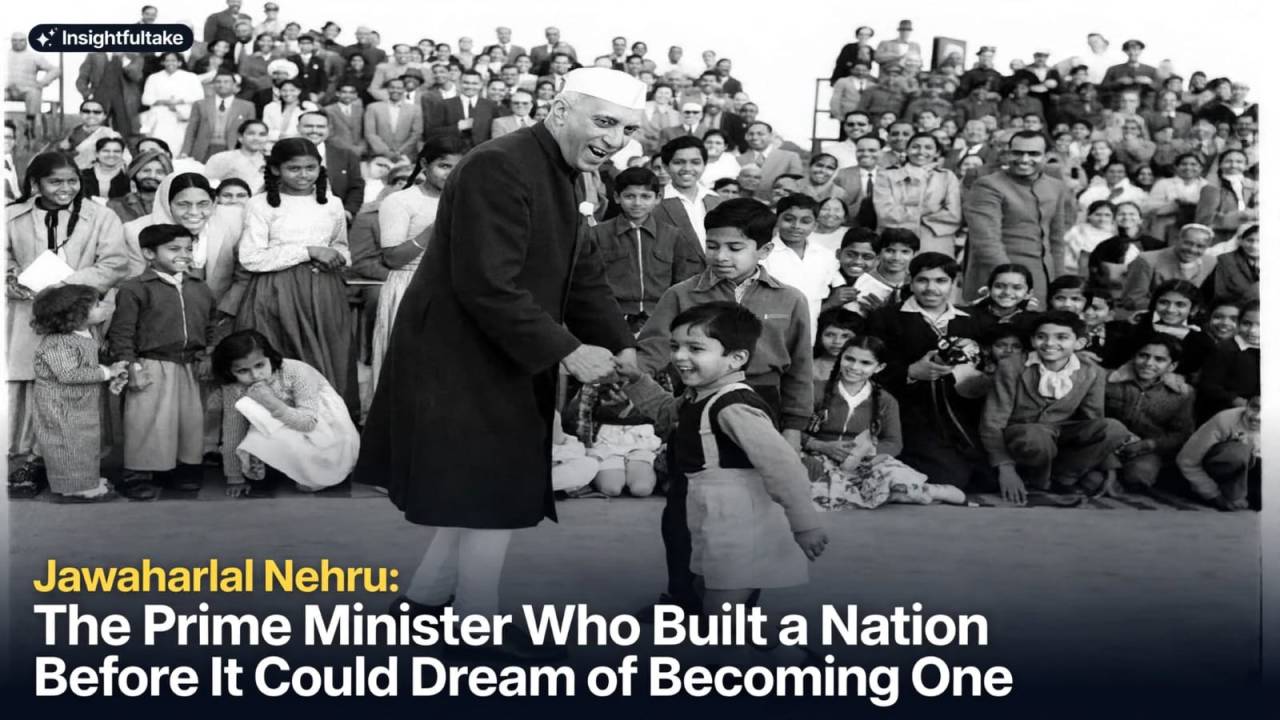
On Children's Day, India must remember more than the man who loved children. It must remember the Prime Minister who inherited a country devastated by colonialism and set out to build a nation capable of standing on its own feet.
On November 14, India celebrates Children's Day to mark the birth anniversary of Jawaharlal Nehru, the country's first Prime Minister. Children learn about his affection for them, his distinctive rose, his letters and his belief that the future of India rested in young minds. Yet, somewhere along the way, a much larger story about Nehru has become obscured by political arguments.
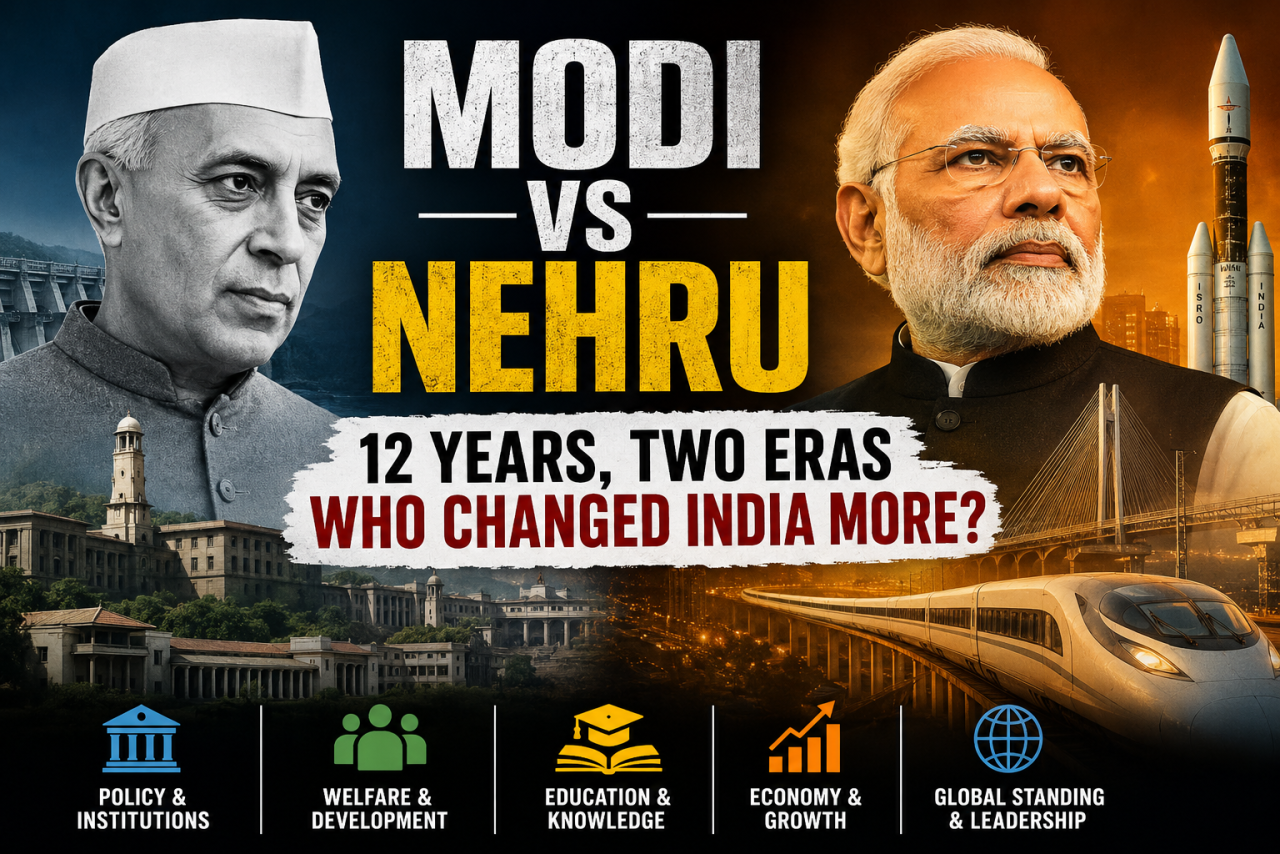
For more than a decade, particularly under Narendra Modi's leadership, India's political discourse has increasingly sought to question, diminish and discredit Nehru's legacy. His decisions have been repeatedly invoked as explanations for the country's present difficulties, while his contributions to building independent India have often received considerably less attention.
Criticism of Nehru is legitimate. No democratic leader should be beyond scrutiny. But criticism becomes historical distortion when a leader's failures are remembered while the circumstances he inherited, the institutions he established and the possibilities he created are pushed aside.
Perhaps the most important question about Nehru is not whether he made mistakes. He did. The more important question is this: What kind of India did he inherit in 1947, and what kind of country did he leave behind in 1964?
The answer explains why his contribution deserves a prominent place in the history of modern India.
He inherited independence, not prosperity
India became independent on August 15, 1947, but freedom did not automatically bring food, education, employment or economic security.
The country was emerging from nearly two centuries of colonial exploitation. Partition had torn apart communities, displaced millions and left behind a humanitarian catastrophe. Agricultural productivity was poor, industrial development was limited, literacy was extremely low and public health infrastructure was inadequate. Food shortages, unemployment, disease and enormous regional inequalities defined the lives of ordinary Indians.
There was another challenge that is often overlooked. India was attempting something that many observers considered almost impossible: establishing a functioning democracy in a country where a vast majority of its population was poor, illiterate and socially disadvantaged.
Nehru did not have the luxury of governing an established industrial economy. He had to help construct the foundations of one.
He could have concentrated political power, postponed democratic participation or justified authoritarian rule in the name of development. Instead, he placed his faith in parliamentary democracy, constitutional institutions and the ability of ordinary Indians to participate in determining their country's future.
The first general election of 1951-52 was an extraordinary undertaking. More than 173 million voters were enrolled. Nearly 45 per cent of them were women. Universal adult franchise was not introduced gradually after decades of economic development. It was embraced at the very beginning of independent India's democratic journey.
This was one of Nehru's most consequential political commitments. He trusted people whom history had denied education, dignity and political power.
India did not first become prosperous and then become democratic. It attempted to become democratic while struggling with poverty. That distinction matters.
Building institutions where poverty had left empty spaces
Nehru understood something that many political leaders fail to appreciate: nations are not built through speeches, slogans or the popularity of their rulers. They are built through institutions that continue to serve people long after their founders are gone.
His government invested in higher education, scientific research, engineering, medicine and industrial infrastructure.
The Indian Institute of Technology at Kharagpur was established in 1951. The All India Institute of Medical Sciences was established in 1956. The subsequent IITs at Bombay, Madras, Kanpur and Delhi emerged during his premiership. The first two Indian Institutes of Management, at Calcutta and Ahmedabad, were also established in the early 1960s.
These institutions were not conceived merely to produce graduates. They were intended to create India's own pool of scientists, doctors, engineers, researchers and managers.
Consider the significance of this decision. A country struggling with hunger and illiteracy was investing in advanced scientific education. A nation that had depended on colonial industrial structures was preparing to develop its own technological capabilities.
Nehru's support for Homi Jehangir Bhabha and the establishment of the Atomic Energy Commission in 1948 reflected this long-term thinking. His government encouraged nuclear research, scientific laboratories and technical education at a time when India had very limited resources.
The Council of Scientific and Industrial Research expanded its national laboratory network. Scientific institutions received political support and a degree of importance that was unusual for a newly independent, impoverished country.
Today, when India celebrates its achievements in space research, nuclear technology, medicine, engineering and information technology, it is worth remembering that many institutional foundations were laid during the first seventeen years of independence.
Nehru was not responsible for every subsequent achievement. Generations of scientists, administrators, teachers and political leaders contributed to them. But he helped create the environment in which such achievements became possible.
Steel plants, dams and the confidence of a new nation
Nehru's economic vision was rooted in the belief that political independence would remain incomplete without economic strength.
He supported a mixed economy in which public-sector enterprises would lead the development of strategic industries while private businesses would also contribute.
The establishment of major steel plants at Bhilai, Rourkela and Durgapur represented this ambition. Steel was not simply another industrial commodity. It was essential for building railways, bridges, factories, machinery and infrastructure.
Similarly, large multipurpose river projects were viewed as instruments of national development. Bhakra-Nangal, Hirakud and other major projects represented the country's ambition to expand irrigation, generate electricity and support industrial growth.
Nehru famously described large dams as the temples of modern India. The phrase reflected his conviction that scientific progress, industrialisation and public infrastructure could transform the lives of millions.
His government also established the Planning Commission in 1950 and introduced Five-Year Plans to direct national resources towards agriculture, irrigation, power, industry and social development.
This economic model had serious shortcomings. Excessive state control, bureaucratic procedures and licensing restrictions eventually became obstacles to entrepreneurship and economic growth. Agricultural development did not receive the consistent priority it required in the early years.
But historical assessment must distinguish between the limitations of a development model and the necessity of creating an industrial base in a country that had inherited widespread economic deprivation.
India needed steel, electricity, engineering capacity, irrigation and technical education. Nehru understood that without these foundations, political freedom would have little meaning for an impoverished population.
His greatest experiment was democracy itself
Perhaps Nehru's most extraordinary contribution was not economic or scientific. It was political.
India was an extraordinarily diverse country, divided by language, religion, caste, region and economic circumstances. Partition had demonstrated the devastating consequences of religious polarisation.
Nehru believed that India could survive and prosper only if its citizens felt that the country belonged equally to them.
He defended secularism not as a rejection of religion, but as a principle that prevented the state from becoming the instrument of any one religious community.
He also supported a plural political culture in which disagreement was not automatically treated as disloyalty.
His relationship with the opposition was not always perfect, and his government did not always live up to its democratic ideals. The dismissal of the elected Kerala government in 1959 remains an important example of the contradictions in his democratic record.
Nevertheless, he helped establish a political tradition in which elections, parliamentary debate, constitutional government and institutional accountability became central to the legitimacy of the Indian state.
It is difficult to appreciate how remarkable this was without remembering that many newly independent countries around the world subsequently experienced military coups, dictatorships and the collapse of democratic institutions.
India faced its own political crises, but its parliamentary system survived its formative years.
That achievement cannot be separated from Nehru's leadership.
A voice that refused to make India a subordinate power
Nehru also gave independent India an international identity.
The Cold War had divided the world into rival American and Soviet camps. For a newly independent country struggling with poverty, dependence on either superpower could have compromised its freedom to make independent decisions.
Nehru championed non-alignment, insisting that India should judge international questions on their merits rather than automatically follow a powerful bloc.
Along with leaders such as Egypt's Gamal Abdel Nasser, Indonesia's Sukarno and Yugoslavia's Josip Broz Tito, he helped shape the international movement that would formally emerge as the Non-Aligned Movement in 1961.
His foreign policy was not without mistakes. The 1962 Chinese invasion exposed serious weaknesses in India's strategic assessment and defence preparedness. It was a devastating setback to his international standing and his vision of Asian solidarity.
But even this failure must be understood within a larger historical assessment. Nehru wanted India to emerge as an independent voice in world affairs, not as a country whose foreign policy was dictated by Washington, Moscow or any other capital.
He gave India a diplomatic identity when it had very little economic or military power to command international attention.
The mistakes cannot erase the foundations
Nehru's record deserves criticism on several fronts. His handling of China, the Kashmir question, his excessive confidence in state-led economic planning and certain democratic decisions remain legitimate subjects of historical debate.
His government's failure to anticipate the scale of Chinese aggression in 1962 was particularly consequential. It exposed the dangers of relying too heavily on diplomatic assurances without adequate military preparedness.
The economic model also created inefficiencies that later governments had to confront. Nehru's belief in state-led industrialisation was important for the circumstances of the time, but the excessive controls that developed around it eventually required substantial reform.
Yet a fair historical assessment cannot turn these shortcomings into an argument for dismissing his entire contribution.
The attempt to reduce Nehru to a collection of failures ignores the extraordinary circumstances in which he governed. It also overlooks the fact that institutions created or strengthened during his premiership continued to serve governments of different political ideologies.
India's subsequent governments, including those that politically distance themselves from Nehru, continue to depend on the universities, scientific institutions, industrial infrastructure, constitutional arrangements and diplomatic foundations that emerged during the early decades of independence.
A country cannot erase its foundations simply because its present political leadership wishes to construct a different narrative of its past.
Children's Day should also be a day of historical honesty
There is a particular irony in celebrating Nehru's birthday as Children's Day while allowing political hostility to shape how younger generations encounter his history.
Nehru believed that children deserved more than affection. They deserved education, opportunity, scientific curiosity and a country that would not imprison their ambitions within the circumstances of their birth.
His emphasis on education was connected to a larger vision of social transformation. He wanted an India in which a child born into poverty could aspire to become a scientist, engineer, doctor, writer or national leader.
That vision remains unfinished. Millions of children still face unequal access to quality education, nutrition and opportunity. India has made enormous progress, but the distance between constitutional promises and everyday realities remains considerable.
Perhaps this is the most meaningful way to remember Nehru: not by placing his portrait in classrooms or repeating familiar quotations, but by asking whether India is still working towards the future he imagined.
Nehru was not a perfect Prime Minister. But he was a Prime Minister who understood the difference between ruling a country and building one.
He did not inherit an India ready to compete with the developed world. He inherited a country struggling to feed its people, educate its children and establish its place among independent nations.
He helped build its scientific institutions, industrial foundations, democratic traditions and international identity. He gave a poor and newly independent country the confidence to think beyond its immediate survival.
His greatest legacy may well be that he attempted to make India capable of imagining a future larger than its past.
Political governments will come and go. Their slogans will change, their priorities will shift and their versions of history will compete for public acceptance. But institutions, ideas and historical contributions cannot be permanently erased by political campaigns.
On November 14, India should remember the man beyond the rose, the children and the familiar photographs.
It should remember the Prime Minister who understood that nation-building is a generational responsibility, not an election-cycle exercise.
Jawaharlal Nehru did not build a prosperous India in seventeen years. He helped build the foundations on which a prosperous India could one day stand. And that is a contribution no honest account of modern Indian history can afford to forget.





















Leave a Comment