
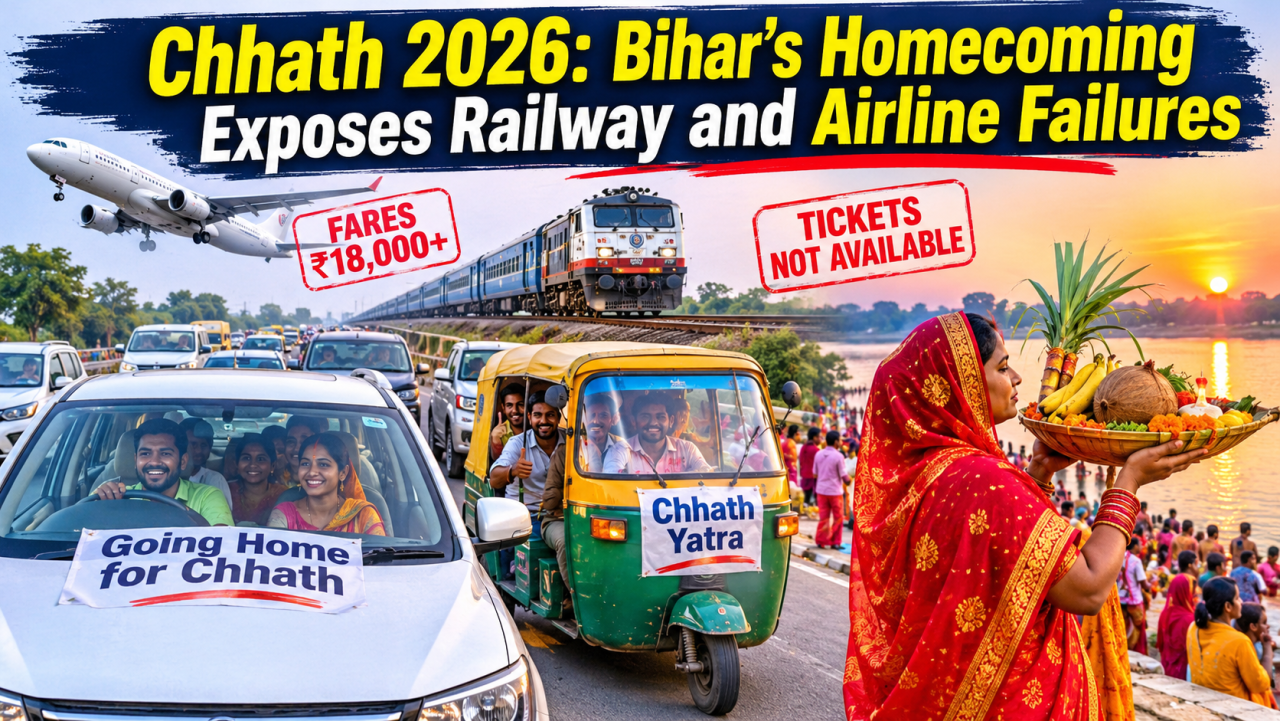
When flights became unaffordable and trains ran short of seats, Biharis took cars and even auto-rickshaws home for Chhath, exposing the failure of India's transport system.
Consider the journey of four young men who travelled approximately 2,200 kilometres from Bengaluru to Motihari in an auto-rickshaw. They were determined to celebrate Chhath with their families, and the difficulty of securing train tickets and the high cost of flights pushed them towards an extraordinary alternative. Their journey attracted attention, but it also raised an uncomfortable question about India's public transport infrastructure.
Another group of three young men reportedly travelled around 1,200 kilometres from Delhi to Madhubani in an auto-rickshaw, completing the journey in approximately 38 hours. Some people found these journeys entertaining; others questioned their safety. Both reactions are understandable. An auto-rickshaw is hardly designed for an interstate journey of this length.
But perhaps the more important question is why anyone should have to contemplate such a journey in the first place.
The passengers were not travelling for adventure tourism. They were trying to reach home for a festival.
The aviation sector offered little comfort either. On November 13, reported fares on the Delhi-Patna route ranged from approximately ₹15,367 to ₹30,385. Bengaluru-Patna fares went as high as ₹36,244, while some Mumbai-Patna options cost more than ₹27,000. These were booking-platform prices at a particular point in time, not fixed fares for every passenger, but they illustrate the financial burden of festive travel.
Apparently, the airlines had discovered that the shortest distance between two cities could also be the most expensive.
The Railway's Annual Festival Surprise
The railways cannot claim that it did nothing. Indian Railways announced 106 Bihar-bound special trains for the Diwali-Chhath rush, including Vande Bharat services. East Central Railway also announced additional special services across several routes.
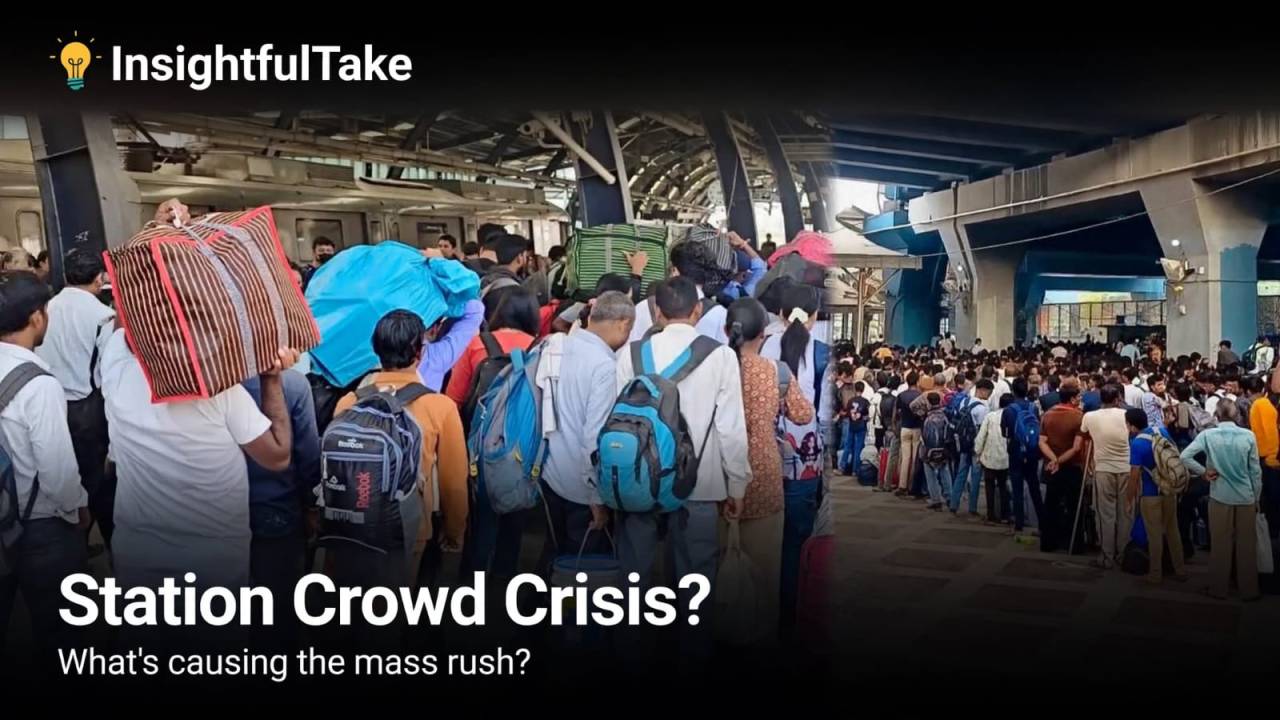
It is a substantial logistical effort. Yet the continuing pressure on regular trains and the struggle for confirmed tickets suggest that additional services are still not enough to meet the demand.
For many passengers, the familiar festive experience remains unchanged: crowded platforms, long waiting lists, uncertainty over confirmation and the anxiety of making arrangements at the last minute.
The railway system deserves credit for adding capacity. But it also deserves a more uncomfortable question: why does the demand for travel to Bihar during Chhath continue to overwhelm the system year after year?
A festival whose dates are known well in advance should not repeatedly turn into a national transport emergency.
And then came the buses. Bihar announced 155 special interstate buses for the festive period, connecting the state with Delhi, Haryana, Jharkhand, Uttar Pradesh and West Bengal. Delhi also arranged additional services, including 77 buses for Bihar-bound passengers from Anand Vihar.
The irony is hard to miss. When the festival arrives, governments, transport departments, railway officials and airlines suddenly discover just how many Biharis want to go home.
Perhaps they should not have to rediscover this every year.
The Bihari Jugaad
Now consider the economics of travelling by road.
Suppose a family or group of four shares a car. If the combined expenditure on fuel, tolls and food comes to ₹18,000, the cost works out to ₹4,500 per person.
Compare that with a one-way flight ticket costing ₹18,000. The road journey suddenly looks financially attractive, particularly when passengers can carry their luggage, festival essentials and gifts without worrying about airline baggage limits.
There is another advantage. The car can take passengers directly to their village or doorstep, avoiding the additional expense and inconvenience of reaching a railway station and arranging local transport.
Of course, this calculation depends on the vehicle, distance, fuel efficiency and number of passengers. Driving for 1,200 or 2,200 kilometres also involves fatigue, road risks and considerable time. It is not a practical substitute for a safe, affordable rail or air network.
But the willingness of people to make such calculations tells us something important. Passengers are actively looking for alternatives when conventional transport becomes unaffordable or inaccessible.
Bihar Is No Longer Just a State of Migrant Workers
There is another stereotype worth questioning.
Biharis are often discussed through the lens of migration, poverty and the search for employment elsewhere. Millions have built their livelihoods in Delhi, Mumbai, Bengaluru, Hyderabad and other cities. They work in factories, offices, construction sites, educational institutions, technology companies and businesses.
Many have bought cars, established businesses and built comfortable lives outside their home state.
Their economic circumstances are diverse. Not everyone can afford a car or an expensive flight. Many still depend on ordinary trains and buses. But reducing the entire community to the image of an economically helpless migrant is both inaccurate and outdated.
The Chhath homecoming demonstrates the scale of Bihar's social and economic connections with the rest of India.
These travellers are not simply passengers. They are workers, professionals, entrepreneurs and families who contribute to the economies of the cities in which they live.
Yet when it comes to travelling home for their most important festival, they often have to organise their own solutions.
The Real Loser Is Public Convenience
It would be easy to celebrate the extraordinary auto-rickshaw journeys as examples of Bihari determination and ingenuity. There is certainly something admirable about the emotional strength that drives people to travel such distances to be with their families.
But romanticising the struggle would be a mistake.
An auto-rickshaw travelling 2,200 kilometres is a remarkable human-interest story. It is not a transport policy success story.
Airlines must answer questions about extraordinary festive fare increases and whether passengers have sufficient affordable choices. The railways need better demand forecasting, more regular capacity and improved passenger management during predictable seasonal peaks. Governments must develop reliable interstate bus networks rather than relying on emergency arrangements every November.
Bihar also needs stronger connectivity, better infrastructure and more economic opportunities so that travelling home does not become an annual logistical battle.
Chhath is not an unexpected event. Its calendar is known. The migration patterns are well established. The rush is predictable.
What remains unpredictable is whether an ordinary family will find an affordable and dignified way to reach home.
The Festival Cannot Be Put on a Waiting List
For a Bihari, Chhath is not merely another holiday. It is an emotional return to one's roots.
It means thekua prepared at home, the fragrance of freshly cleaned courtyards, relatives gathering after months or years, folk songs echoing through neighbourhoods and the sight of devotees offering arghya to the setting and rising sun.
It means returning to the village, meeting parents, touching elders' feet and standing beside the family at the ghat.
No airline can sell that experience as an add-on. No railway reservation system can measure its emotional value.
The railways may put a passenger on a waiting list. Airlines may put a heavy price on a seat. But neither can put a price on the determination of someone who simply wants to celebrate Chhath at home.
This year, Biharis demonstrated that when conventional transport fails to meet their needs, they can find alternatives, even extraordinary ones.
There is humour in the sight of an auto-rickshaw travelling from Bengaluru to Motihari. There is ingenuity in four people sharing the cost of a long road journey. And there is an unmistakable message in thousands of families organising their own travel arrangements.
But the final question is not whether Biharis can reach home despite the odds.
It is why, after so many years of predictable festive migration, the country's transport system still makes reaching home such a challenge.
The Bihari found a jugaad. The airlines and railways should find a better answer.
Jai Chhathi Maiya. Jai Bihar!














Leave a Comment