
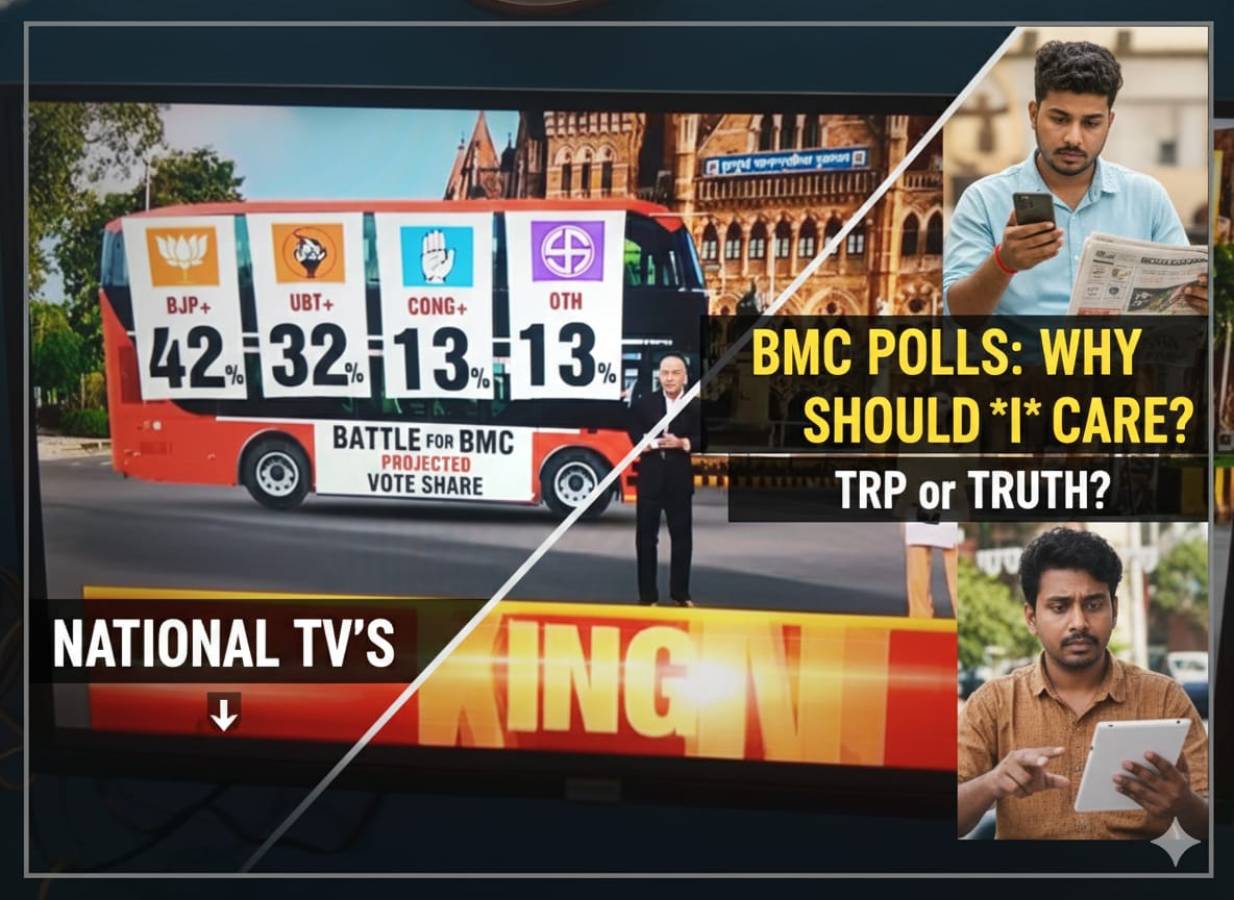
As BMC election results come in today, a civic contest meant for Mumbai alone has once again captured national political attention.
The Brihanmumbai Municipal Corporation (BMC) is unlike any other civic body in India. With an annual budget exceeding ₹70,000 crore, it controls more money than several small Indian states. Yet, at its core, the BMC is still a local government meant to manage basic civic services such as roads, water supply, sanitation, and public health. Despite this, its elections are treated as a national political event. When national television channels broadcast exit polls of Mumbai’s corporators to viewers in Assam, Punjab, or Kerala, it marks a clear “nationalization” of what should remain a local democratic exercise.
For an average viewer in Lucknow or Patna, the condition of garbage collection or drainage in a Mumbai ward has little direct relevance. These are local issues that affect Mumbai residents alone. Still, television studios frame the BMC elections as a “Semi-Final” before national elections or a “Battle for the Soul of India.” This exaggerated framing exists because Mumbai is seen as the financial heartbeat of the country. Control over the BMC is not just about civic administration. It is about access to massive financial resources and the political visibility that comes with governing India’s most powerful city—often referred to as the “Urbs Prima in Indis,” or the first city of India.
TV News as a PR Extension?
The criticism that television news has started functioning like a public relations arm of political parties is not entirely unfounded. The style and tone of BMC coverage during prime time clearly show how news is often packaged to generate political mileage rather than public understanding.
Instead of focusing on real civic concerns—such as Mumbai’s aging infrastructure, unsafe buildings, overcrowded public transport, or the city’s annual struggle with monsoon flooding—coverage frequently shifts to dramatic political narratives. Studio debates revolve around the rivalry between the Thackeray cousins or the Bharatiya Janata Party’s attempt to break the Shiv Sena’s long-standing control over the civic body. The actual performance of corporators or the quality of urban governance receives far less attention.
Another major feature is the growing exit poll industry. Exit polls are highly unreliable, especially in local elections, yet they dominate television screens. Often presented as “breaking news,” these polls are used to create early momentum. By declaring a likely winner even before counting begins, channels help build a sense of inevitability. This benefits the projected winner and psychologically weakens the opposition, regardless of the final result.
There is also a deeper structural reason behind this coverage. Large media houses depend heavily on government advertisements and corporate sponsorships. When a national channel dedicates excessive airtime to a regional election like the BMC polls, it often aligns with the interests of national parties eager to display dominance and influence across the country.
Why the Rest of India Is Watching
If BMC-related news is largely irrelevant to a farmer in Bihar or a worker in Odisha, why do channels keep pushing it? The answer lies in the economics of Television Rating Points (TRPs).
Mumbai has a natural pull. Its celebrity culture, corporate power, and political drama attract attention nationwide. High-stakes contests in the city promise higher viewership, which directly translates into advertising revenue.
The BMC results are also treated as a political indicator. They are seen as a test for alliances such as the “Mahayuti” and the “MVA.” Many viewers tune in not because they care about Mumbai’s footpaths or water pipelines, but because they want clues about future Assembly elections and broader political trends.
Finally, such coverage fills a content vacuum. Serious discussions on policy, governance, and long-term economic planning require time, research, and expertise. In contrast, “horse-race” journalism—who is winning and who is losing—is easy to produce and easy to consume.
The Cost of Distorted Priorities
When national television behaves like a local Mumbai channel, the cost is significant. While prime-time debates obsess over BMC exit polls, critical national issues are pushed aside. The agrarian crisis in central India, rising unemployment, regional conflicts in the Northeast, and social welfare challenges are reduced to short tickers—or ignored altogether.
This PR-driven model of journalism turns citizens into passive spectators. Politics is presented like a sporting event, where personalities matter more than policies. By focusing on the “who” instead of the “what,” the media slowly abandons its responsibility as the Fourth Estate.
Conclusion: A Mirror to Democracy
As results are discussed and debates grow louder, the media frenzy around the BMC will only intensify. This obsession reflects a larger truth about Indian politics—it has become a form of mass entertainment. But for a democracy to remain healthy, one question must be asked repeatedly: when news turns into promotion, who is left to speak truth to power?
By Gautam Jha
Managing Editor
















Leave a Comment