
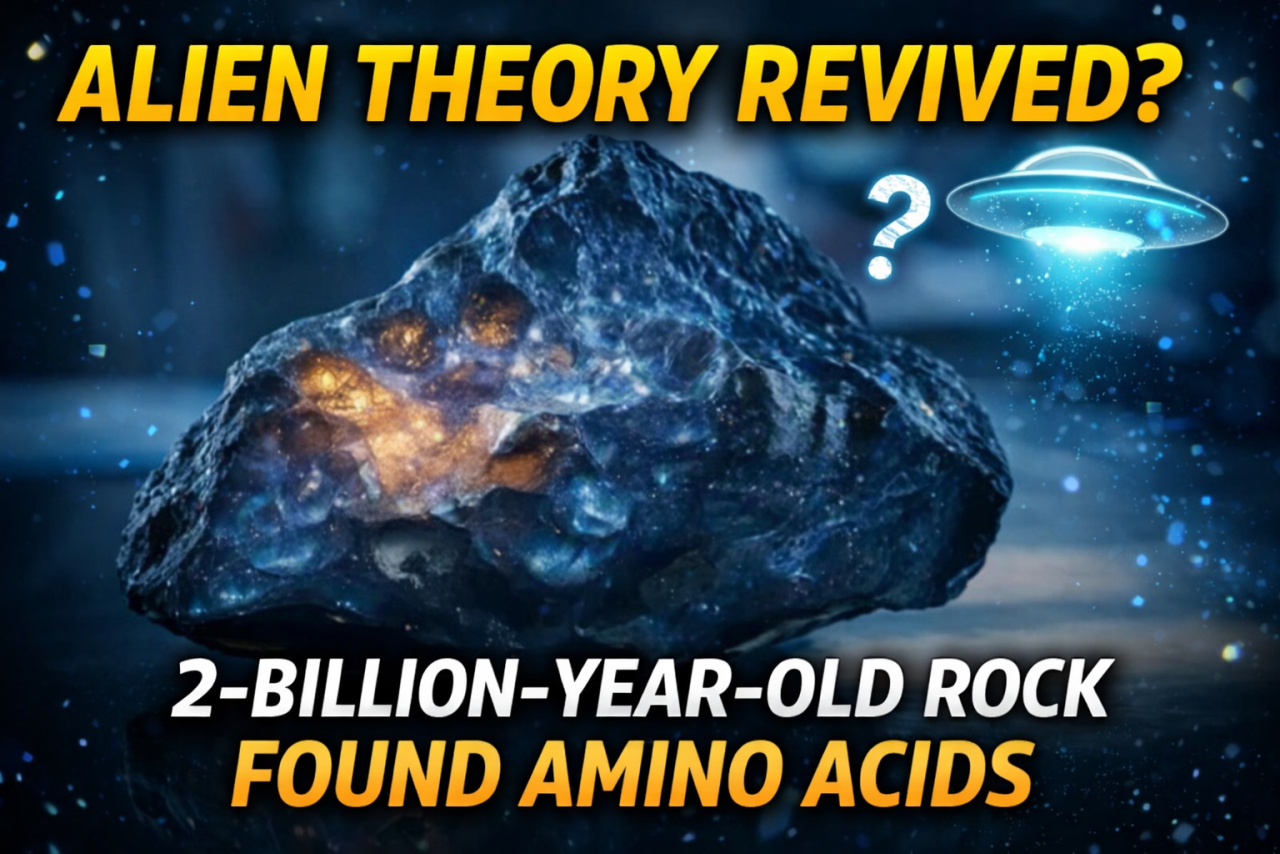
Before life had a name on Earth, its ingredients may have already been drifting through space—sealed inside an ancient asteroid waiting to be opened.
In January 2025, scientists analyzing samples returned by OSIRIS-REx confirmed something extraordinary: fragments from the asteroid Bennu contain 14 of the 20 amino acids used by life on Earth, along with chemical precursors to DNA and RNA. These molecules were found locked inside pristine, carbon-rich rock formed in the infancy of the solar system—long before Earth became habitable.
The discovery does not prove that aliens seeded our planet. But it dramatically strengthens one of the most provocative ideas in science: panspermia—the hypothesis that life’s building blocks were delivered from space rather than synthesized entirely on Earth.
A Relic from Before Earth
Bennu is often described as a time capsule. Formed over 4.5 billion years ago from the debris of early planetary formation, it preserves materials that predate Earth’s oceans, atmosphere, and continents. The samples collected by OSIRIS-REx in 2020 and returned to Earth in 2023 were sealed from contamination, allowing researchers to study organic compounds in nearly untouched form.
Within these grains, scientists identified amino acids—molecules that combine to form proteins—as well as nitrogen-bearing compounds associated with nucleobases, the molecular “letters” of DNA and RNA. Some isotopic signatures suggest these compounds formed in extremely cold environments, likely in interstellar space or the outer solar system.
In short, the chemistry of life appears not to be uniquely terrestrial.
Reviving Panspermia
The idea of panspermia is not new. Philosophers speculated about cosmic life seeds centuries ago. In the 20th century, scientists like Fred Hoyle and Chandra Wickramasinghe argued that microorganisms—or at least organic molecules—might travel between worlds via comets and asteroids.
Critics long countered that organic molecules are too fragile to survive radiation, vacuum exposure, fiery atmospheric entry, and impact shock. Yet laboratory simulations and space missions have steadily weakened that objection. Experiments show amino acids can endure vacuum and ultraviolet radiation when shielded inside rock. Meteorites found on Earth, such as the famous Murchison meteorite, have already been shown to contain a rich inventory of organic molecules.
Bennu’s samples take that evidence further. Unlike meteorites that may have been altered by Earth’s environment, these materials were retrieved directly from an asteroid and preserved under controlled conditions. Their molecular diversity suggests that prebiotic chemistry is not rare or accidental—it may be a natural byproduct of planetary formation.
Not Aliens—But Ingredients
It is crucial to clarify what this means. The Bennu samples do not contain living organisms. They do not demonstrate that microbes drift between stars. Panspermia in its strongest form—the transfer of fully formed life—is still speculative.
What Bennu supports is a softer version: molecular panspermia. The early Earth, roughly 4 billion years ago, was bombarded by asteroids and comets during the Late Heavy Bombardment. If even a fraction of those impactors resembled Bennu, they could have delivered vast quantities of amino acids and nucleobase precursors to the planet’s surface.
Imagine Earth cooling from a molten state. Oceans condense. Lightning cracks through a methane-rich sky. Meanwhile, carbonaceous asteroids rain down, releasing stable organic compounds into warm, reactive environments. Instead of building life entirely from scratch, Earth may have assembled biology from a cosmic starter kit.
A Universe Seeded with Potential
The philosophical implications are profound. If the chemistry of life arises naturally in cold molecular clouds and is preserved in asteroids, then the raw materials for biology may be widespread across the galaxy. Planets orbiting distant stars could receive similar deliveries. The emergence of life, rather than being an improbable miracle, might be chemically encouraged wherever conditions permit.
This does not mean life is everywhere. The leap from amino acids to self-replicating cells remains enormous and poorly understood. But Bennu narrows the gap between cosmic chemistry and terrestrial biology.
The 2-billion-year-old rock—ancient beyond imagination—does not tell us that we are descendants of aliens. It tells us something subtler and perhaps more astonishing: that the universe itself is chemically predisposed toward life. Earth may not be the birthplace of biology’s ingredients, but the workshop where they were assembled.
And if that is true, then the question shifts. The mystery is no longer whether life’s building blocks exist beyond Earth. The new question is how many worlds have already put them to use.
























Leave a Comment