
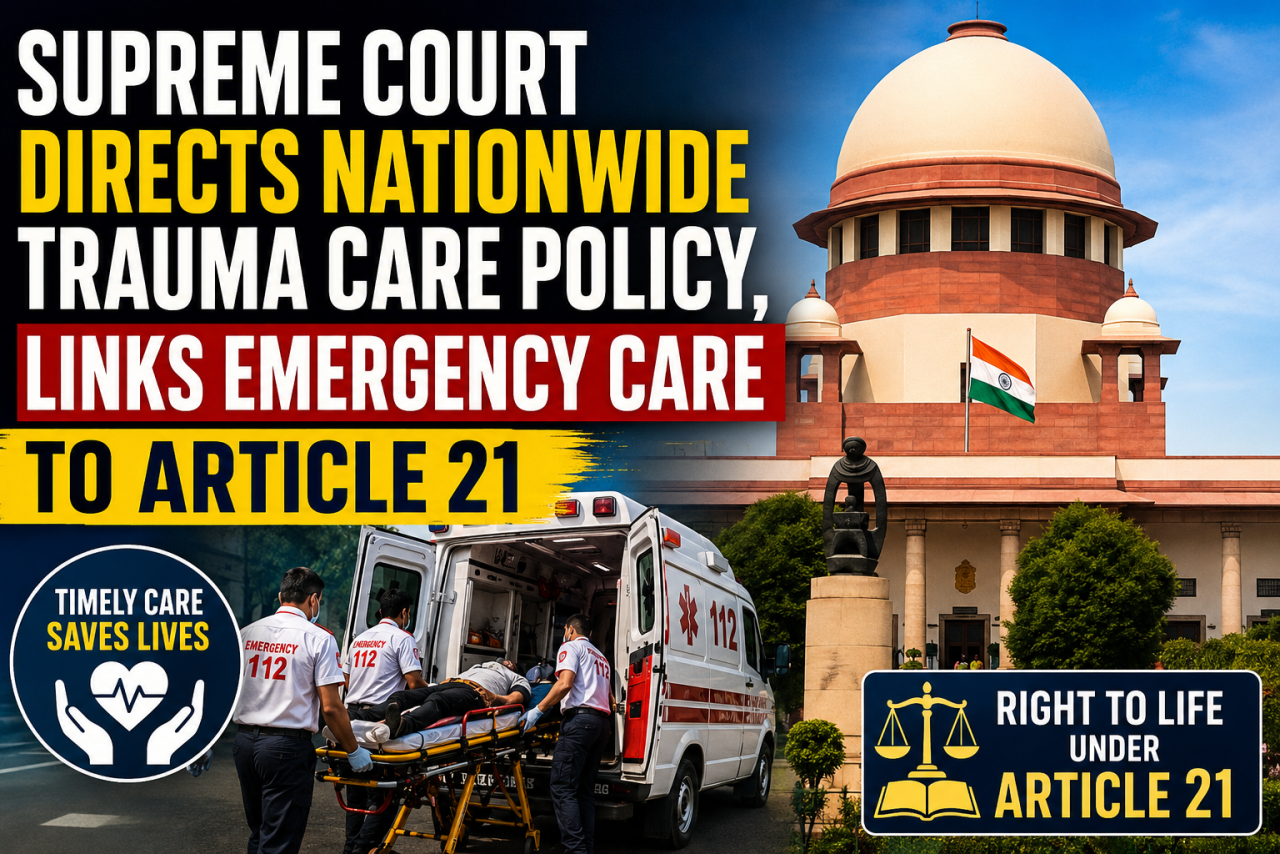
When every second can mean the difference between life and death, the Supreme Court has delivered a landmark message: timely trauma care is a constitutional right, not a privilege.
For millions of Indians, especially those living in rural and underserved regions, access to timely medical care during emergencies has often depended more on luck than on a reliable healthcare system. In a significant step toward strengthening emergency healthcare infrastructure, the Supreme Court of India has directed all States and Union Territories to adopt a uniform trauma care policy within three months, while reaffirming that access to timely trauma care is an integral component of the Right to Life guaranteed under Article 21 of the Constitution.
The directive came from a bench comprising Justices J.K. Maheshwari and A.S. Chandurkar, which emphasized the urgent need for a coordinated national framework to address trauma and emergency medical response. The Court observed that saving lives during emergencies requires a systematic approach involving public awareness, standardized protocols, trained personnel, and swift medical intervention.
Why the Judgment Matters
Accidents remain one of India's most pressing public health challenges. According to data cited before the Court, nearly 4,67,000 accidental deaths were recorded in a recent year, with approximately 1,77,000 fatalities resulting from road accidents alone.
Many of these deaths occur not because injuries are unsurvivable, but because victims fail to receive timely medical assistance. Delays in transportation, lack of emergency response coordination, inadequate trauma facilities, and public hesitation in assisting victims often turn survivable injuries into fatal outcomes.
Recognizing these systemic shortcomings, the Court underscored that emergency medical care cannot be viewed merely as a healthcare service. Instead, it is closely linked to the constitutional obligation of the State to protect life and ensure dignity for every citizen.
A Uniform National Approach
The Supreme Court directed States and Union Territories to formulate and adopt a uniform trauma care policy within three months. The objective is to create a coordinated emergency response mechanism capable of delivering timely assistance to accident victims regardless of their location.
The Court stressed the need for systemic interventions, including improved trauma care infrastructure, enhanced public awareness, standardized emergency procedures, and widespread first-aid training.
According to the bench, a robust and uniform trauma care system can significantly reduce preventable deaths and improve survival outcomes following accidents and other medical emergencies.
Integration of Emergency Services
An important aspect of the Court's directive concerns the integration of emergency response systems. States and Union Territories have been asked to coordinate police, fire, and ambulance services through a common emergency response mechanism linked to the national helpline number 112.
The move is intended to reduce confusion during emergencies and ensure that citizens can access multiple emergency services through a single point of contact. Such integration is expected to improve response times and facilitate better coordination among different agencies involved in rescue and medical assistance.
Protection for Good Samaritans
The Court also highlighted the importance of encouraging citizens to assist accident victims without fear of legal complications or harassment. Good Samaritan protections, which shield individuals who help injured persons in emergencies, were identified as a crucial component of an effective trauma care framework.
By strengthening awareness and implementation of these protections, authorities hope to create an environment where bystanders feel empowered to provide assistance or alert emergency services without hesitation.
Shared Responsibility of Centre and States
The judgment recognizes that healthcare delivery involves multiple levels of government. While public health is primarily a state subject, the Court stressed the need for coordinated action between the Union Government and State Governments to establish uniform standards and effective implementation mechanisms.
The bench observed that creating a comprehensive trauma care ecosystem requires cooperation across sectors, including healthcare institutions, emergency services, law enforcement agencies, and local administrations.
A Step Toward Saving Lives
The Supreme Court's intervention signals a broader recognition that emergency medical care is not merely an administrative concern but a constitutional obligation. By linking trauma care to Article 21 and directing the adoption of a nationwide policy framework, the Court has sought to address longstanding gaps in India's emergency response system.
For ordinary citizens, the judgment offers hope that access to timely emergency medical care will increasingly become a guaranteed public service rather than an uncertain privilege.
For millions of Indians, especially those living in rural and underserved regions, access to timely medical care during emergencies has often depended more on luck than on a reliable healthcare system. In a significant step toward strengthening emergency healthcare infrastructure, the Supreme Court of India has directed all States and Union Territories to adopt a uniform trauma care policy within three months, while reaffirming that access to timely trauma care is an integral component of the Right to Life guaranteed under Article 21 of the Constitution.
The directive came from a bench comprising Justices J.K. Maheshwari and A.S. Chandurkar, which emphasized the urgent need for a coordinated national framework to address trauma and emergency medical response. The Court observed that saving lives during emergencies requires a systematic approach involving public awareness, standardized protocols, trained personnel, and swift medical intervention.
Why the Judgment Matters
Accidents remain one of India's most pressing public health challenges. According to data cited before the Court, nearly 4,67,000 accidental deaths were recorded in a recent year, with approximately 1,77,000 fatalities resulting from road accidents alone.
Many of these deaths occur not because injuries are unsurvivable, but because victims fail to receive timely medical assistance. Delays in transportation, lack of emergency response coordination, inadequate trauma facilities, and public hesitation in assisting victims often turn survivable injuries into fatal outcomes.
Recognizing these systemic shortcomings, the Court underscored that emergency medical care cannot be viewed merely as a healthcare service. Instead, it is closely linked to the constitutional obligation of the State to protect life and ensure dignity for every citizen.
A Uniform National Approach
The Supreme Court directed States and Union Territories to formulate and adopt a uniform trauma care policy within three months. The objective is to create a coordinated emergency response mechanism capable of delivering timely assistance to accident victims regardless of their location.
The Court stressed the need for systemic interventions, including improved trauma care infrastructure, enhanced public awareness, standardized emergency procedures, and widespread first-aid training.
According to the bench, a robust and uniform trauma care system can significantly reduce preventable deaths and improve survival outcomes following accidents and other medical emergencies.
Integration of Emergency Services
An important aspect of the Court's directive concerns the integration of emergency response systems. States and Union Territories have been asked to coordinate police, fire, and ambulance services through a common emergency response mechanism linked to the national helpline number 112.
The move is intended to reduce confusion during emergencies and ensure that citizens can access multiple emergency services through a single point of contact. Such integration is expected to improve response times and facilitate better coordination among different agencies involved in rescue and medical assistance.
Protection for Good Samaritans
The Court also highlighted the importance of encouraging citizens to assist accident victims without fear of legal complications or harassment. Good Samaritan protections, which shield individuals who help injured persons in emergencies, were identified as a crucial component of an effective trauma care framework.
By strengthening awareness and implementation of these protections, authorities hope to create an environment where bystanders feel empowered to provide assistance or alert emergency services without hesitation.
Shared Responsibility of Centre and States
The judgment recognizes that healthcare delivery involves multiple levels of government. While public health is primarily a state subject, the Court stressed the need for coordinated action between the Union Government and State Governments to establish uniform standards and effective implementation mechanisms.
The bench observed that creating a comprehensive trauma care ecosystem requires cooperation across sectors, including healthcare institutions, emergency services, law enforcement agencies, and local administrations.
A Step Toward Saving Lives
The Supreme Court's intervention signals a broader recognition that emergency medical care is not merely an administrative concern but a constitutional obligation. By linking trauma care to Article 21 and directing the adoption of a nationwide policy framework, the Court has sought to address longstanding gaps in India's emergency response system.
For ordinary citizens, the judgment offers hope that access to timely emergency medical care will increasingly become a guaranteed public service rather than an uncertain privilege.























Leave a Comment