
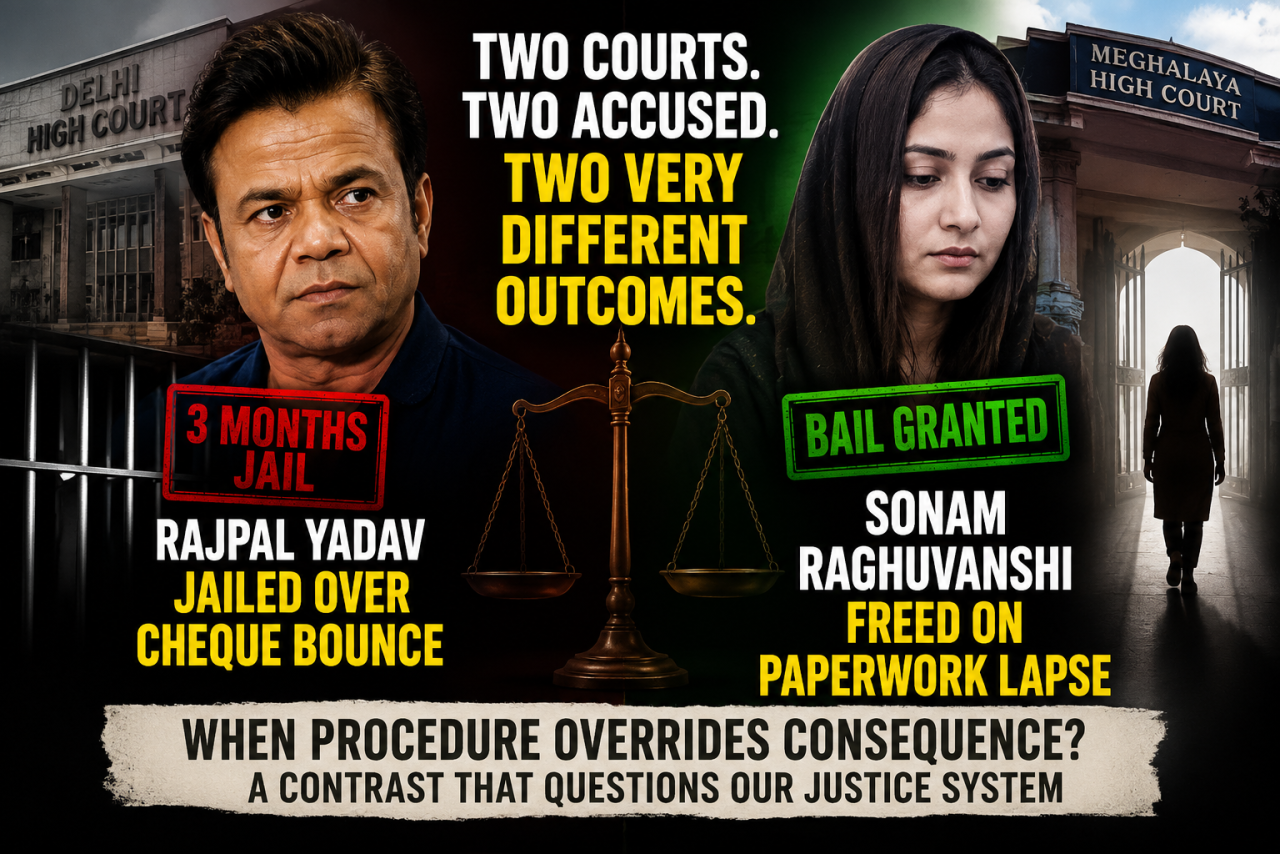
One actor jailed over unpaid cheques, one murder accused freed on procedure. These two court orders raise difficult questions about justice.
Two courtrooms. Two very different accused. Two outcomes that expose an uncomfortable pattern in how Indian courts weigh procedure against consequence.
On Friday (July 10, 2026), the Delhi High Court sentenced Bollywood actor Rajpal Yadav to three months in prison across seven cheque bounce cases, upholding a trial court conviction from 2018. Justice Swarana Kanta Sharma's bench also directed Yadav to pay ₹1.05 crore in compensation in each case to the complainant, Murli Projects Private Limited, along with ₹25,000 to the state. The court suspended the jail term for two months to let Yadav appeal, but the message in its 108-page order was unambiguous. Repeated promises to repay, without follow-through, would no longer buy him time.
The facts are straightforward. Yadav had taken a ₹5 crore loan in 2010 for producing the film Ata Pata Lapata, with a commitment to return ₹8 crore. He did not. The court noted he had, at one point, told the bench in open proceedings that he would rather "go to jail five more times" than repay the complainant. Even his own delay in challenging the original conviction, five years, was held against him, since he could not show sufficient cause for it.
Contrast this with what has been unfolding in the Sonam Raghuvanshi case. Raghuvanshi is the prime accused in the alleged murder of her husband, Raja, during their honeymoon in Meghalaya in May 2025. Investigators allege she conspired with hired assailants to kill him for financial gain, a far graver charge than defaulting on a film loan. Yet both the trial court and the Meghalaya High Court granted her bail, not because the evidence against her was weak, but because the police had failed to properly communicate the grounds of her arrest in writing at the time she was taken into custody. The High Court called this lapse a "total non-application of judicious mind" by the arresting agency.
The Meghalaya government has since approached the Supreme Court, which briefly stayed the bail order over "prima facie reservations," before allowing her to remain free while the matter is examined further. The case continues.
Placed side by side, the two orders are not identical in law. One is a final conviction after due trial, while the other is an interim bail decision in a case still under trial. But the contrast still raises an important question. A cheque default, however deliberate, is a civil-commercial wrong that Parliament chose to criminalise mainly to protect the credibility of banking instruments. A honeymoon murder is among the gravest offences on the statute book. Yet it was the accused in the murder case who walked free on a technical arrest-memo lapse, while the actor facing financial default charges was sent to prison despite his eventual willingness, if belated, to negotiate a settlement.
This is not proof of any coordinated design between the executive and the judiciary. There is no evidence that either case was influenced by who these individuals are or what they represent. But the disparity does point to a structural issue that Indian legal commentators have flagged for years. Bail jurisprudence in serious offences increasingly turns on whether arrest paperwork was completed correctly, while sentencing in financial default cases under Section 138 of the Negotiable Instruments Act can move swiftly and firmly once a court concludes that a litigant has exhausted its patience with repeated excuses.
For ordinary litigants without celebrity status or access to top-tier legal counsel, the lesson cuts both ways. Courts can and do act firmly against those who treat repeated adjournments as a litigation strategy. At the same time, when reviewing arrest procedure in violent crime cases, courts have shown they may set aside the weight of the underlying allegation if there is a significant procedural defect in the arrest process. Whether that balance ultimately serves justice, or simply rewards whichever side presents the stronger procedural argument, is the larger debate India's legal system must confront, not because of who these two accused are, but because of what their cases reveal about how differently delay and due process can shape judicial outcomes.
Two courtrooms. Two very different accused. Two outcomes that expose an uncomfortable pattern in how Indian courts weigh procedure against consequence.
On Friday (July 10, 2026), the Delhi High Court sentenced Bollywood actor Rajpal Yadav to three months in prison across seven cheque bounce cases, upholding a trial court conviction from 2018. Justice Swarana Kanta Sharma's bench also directed Yadav to pay ₹1.05 crore in compensation in each case to the complainant, Murli Projects Private Limited, along with ₹25,000 to the state. The court suspended the jail term for two months to let Yadav appeal, but the message in its 108-page order was unambiguous. Repeated promises to repay, without follow-through, would no longer buy him time.
The facts are straightforward. Yadav had taken a ₹5 crore loan in 2010 for producing the film Ata Pata Lapata, with a commitment to return ₹8 crore. He did not. The court noted he had, at one point, told the bench in open proceedings that he would rather "go to jail five more times" than repay the complainant. Even his own delay in challenging the original conviction, five years, was held against him, since he could not show sufficient cause for it.
Contrast this with what has been unfolding in the Sonam Raghuvanshi case. Raghuvanshi is the prime accused in the alleged murder of her husband, Raja, during their honeymoon in Meghalaya in May 2025. Investigators allege she conspired with hired assailants to kill him for financial gain, a far graver charge than defaulting on a film loan. Yet both the trial court and the Meghalaya High Court granted her bail, not because the evidence against her was weak, but because the police had failed to properly communicate the grounds of her arrest in writing at the time she was taken into custody. The High Court called this lapse a "total non-application of judicious mind" by the arresting agency.
The Meghalaya government has since approached the Supreme Court, which briefly stayed the bail order over "prima facie reservations," before allowing her to remain free while the matter is examined further. The case continues.
Placed side by side, the two orders are not identical in law. One is a final conviction after due trial, while the other is an interim bail decision in a case still under trial. But the contrast still raises an important question. A cheque default, however deliberate, is a civil-commercial wrong that Parliament chose to criminalise mainly to protect the credibility of banking instruments. A honeymoon murder is among the gravest offences on the statute book. Yet it was the accused in the murder case who walked free on a technical arrest-memo lapse, while the actor facing financial default charges was sent to prison despite his eventual willingness, if belated, to negotiate a settlement.
This is not proof of any coordinated design between the executive and the judiciary. There is no evidence that either case was influenced by who these individuals are or what they represent. But the disparity does point to a structural issue that Indian legal commentators have flagged for years. Bail jurisprudence in serious offences increasingly turns on whether arrest paperwork was completed correctly, while sentencing in financial default cases under Section 138 of the Negotiable Instruments Act can move swiftly and firmly once a court concludes that a litigant has exhausted its patience with repeated excuses.
For ordinary litigants without celebrity status or access to top-tier legal counsel, the lesson cuts both ways. Courts can and do act firmly against those who treat repeated adjournments as a litigation strategy. At the same time, when reviewing arrest procedure in violent crime cases, courts have shown they may set aside the weight of the underlying allegation if there is a significant procedural defect in the arrest process. Whether that balance ultimately serves justice, or simply rewards whichever side presents the stronger procedural argument, is the larger debate India's legal system must confront, not because of who these two accused are, but because of what their cases reveal about how differently delay and due process can shape judicial outcomes.




















Leave a Comment