
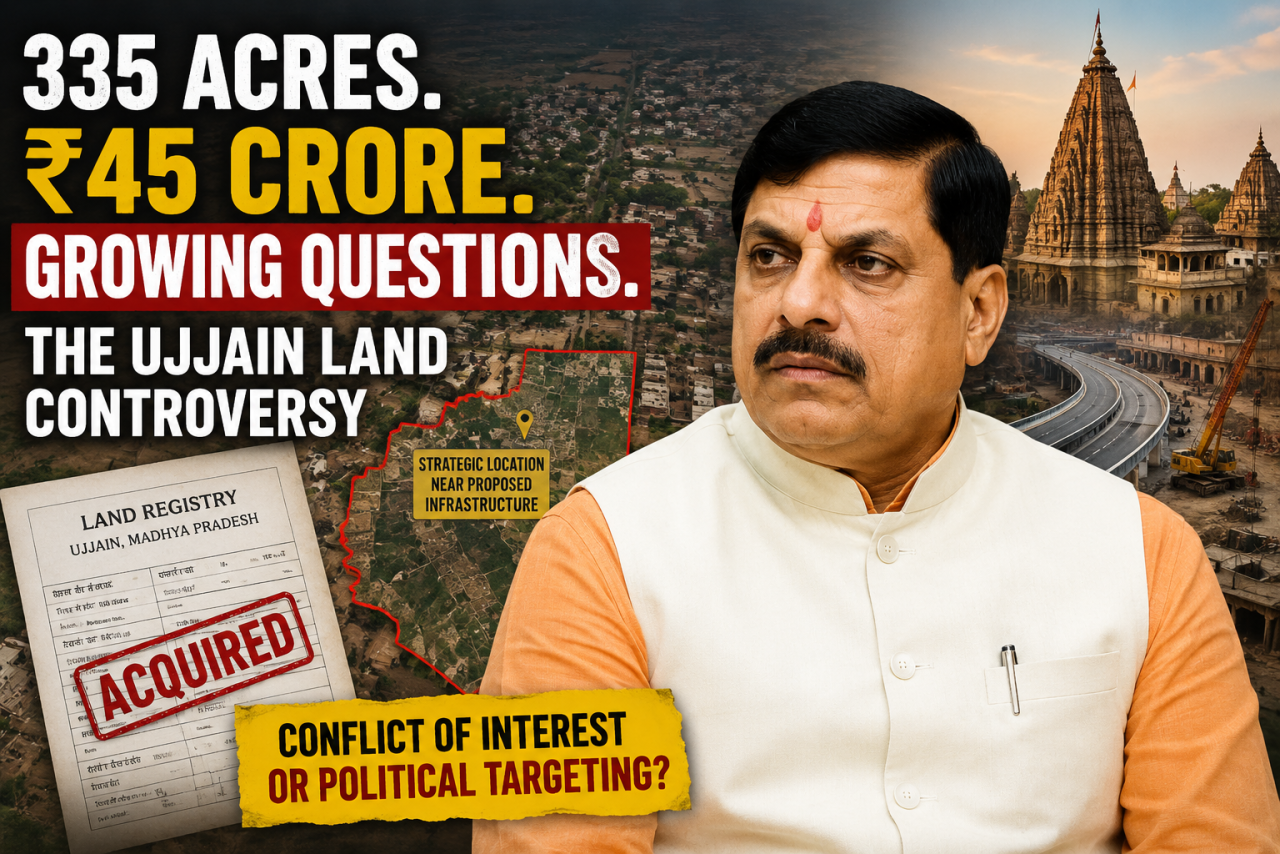
Hundreds of acres, strategic locations, and rising political pressure—questions over land acquisitions linked to Mohan Yadav's family are shaping a major governance debate.
A political controversy has been gathering momentum in Madhya Pradesh, placing Chief Minister Mohan Yadav and his extended family under an uncomfortable spotlight. At the centre of the debate are land acquisitions in and around Ujjain, a city whose economic and strategic importance is expected to grow significantly in the coming years due to planned infrastructure projects and preparations for the 2028 Simhastha Kumbh Mela.
The issue entered the public domain following an investigative report by The Indian Express, which examined land holdings linked to members of the Chief Minister's family. According to the report, relatives and associated entities connected to the family collectively own or control an estimated 335 acres of land spread across roughly 245 plots in the Ujjain region.
A Surge in Land Purchases
According to the investigation, approximately 168 acres across 137 plots were acquired between late 2023 and 2025, a period that coincides with Mohan Yadav's tenure as Chief Minister, which began in December 2023.
The report estimates the value of these acquisitions at around ₹45 crore. It also notes that a substantial portion of the land is located near areas identified for major infrastructure development under the Ujjain Master Plan 2035. Several parcels are reportedly situated close to proposed highways, ring roads, and zones expected to benefit from government investment linked to preparations for the 2028 Simhastha Kumbh Mela.
The proximity of these purchases to future development corridors has become the focal point of political criticism. Opposition leaders argue that such overlap raises questions about potential conflicts of interest, even if no direct evidence of wrongdoing has yet been established.
Congress Escalates the Attack
The Congress party has seized on the issue, demanding accountability and a formal investigation.
State Congress president Jitu Patwari and senior leader KC Venugopal have described the matter as a serious governance concern, arguing that public confidence requires a transparent examination of the transactions. The party has called for Mohan Yadav's resignation and demanded an inquiry supervised by a sitting Supreme Court judge.
Congress leaders have also questioned why central investigative agencies have not shown interest in the matter, arguing that similar allegations involving opposition leaders have often attracted swift scrutiny.
At the heart of the opposition's argument is the concern that family members may have benefited from land purchases in areas expected to appreciate because of government-led development initiatives. Whether that constitutes a legal violation remains unproven, but the political questions have become increasingly difficult for the government to ignore.
BJP's Defence
The Bharatiya Janata Party has strongly rejected the allegations, describing them as politically motivated and unsupported by evidence.
State BJP president Hemant Khandelwal has pointed out that the land holdings declared by Mohan Yadav and his wife in official election disclosures have remained unchanged. Party leaders also emphasise that Yadav was involved in the real estate business long before becoming Chief Minister and that property transactions linked to family members should not automatically be attributed to him.
The BJP further argues that acquisitions carried out by relatives or independent corporate entities cannot be treated as evidence of misconduct by a constitutional office-holder unless a direct connection is established.
Party spokespersons have also accused Congress of attempting to manufacture a controversy around an OBC leader for political gain ahead of future electoral contests.
The Political Undercurrent
Adding another layer to the controversy are suggestions that the information may not have surfaced solely through opposition efforts.
Some political observers, including Samajwadi Party leader Akhilesh Yadav, have hinted that internal rivalries within the BJP could be contributing to the issue's visibility. Similar claims have surfaced in political circles, with speculation that detailed land records may have emerged through factional competition within the state's ruling establishment.
No evidence has publicly substantiated these claims. Nevertheless, the speculation highlights the extent to which the controversy has evolved beyond a simple dispute between the ruling party and the opposition.
A Question of Governance
The larger issue extends beyond the fortunes of any individual politician.
Modern democratic systems depend not only on compliance with the law but also on maintaining public confidence that official decisions are insulated from private interests. Infrastructure projects, zoning changes, religious tourism initiatives, and large public investments often create significant increases in land values. As a result, acquisitions made in areas slated for future development inevitably attract scrutiny when they involve individuals connected to political power.
At present, no court has found wrongdoing, and no investigation has established that any law was violated. Equally, the questions raised by the reported pattern of acquisitions have not been conclusively answered.
That is why calls for an independent inquiry continue to resonate across political lines. If the transactions were entirely legitimate, a transparent investigation could help put the matter to rest. If irregularities exist, the public deserves to know.
Until an impartial examination establishes the facts, the controversy surrounding land acquisitions in Ujjain is likely to remain a significant test of transparency, accountability, and public trust in Madhya Pradesh's government.
A political controversy has been gathering momentum in Madhya Pradesh, placing Chief Minister Mohan Yadav and his extended family under an uncomfortable spotlight. At the centre of the debate are land acquisitions in and around Ujjain, a city whose economic and strategic importance is expected to grow significantly in the coming years due to planned infrastructure projects and preparations for the 2028 Simhastha Kumbh Mela.
The issue entered the public domain following an investigative report by The Indian Express, which examined land holdings linked to members of the Chief Minister's family. According to the report, relatives and associated entities connected to the family collectively own or control an estimated 335 acres of land spread across roughly 245 plots in the Ujjain region.
A Surge in Land Purchases
According to the investigation, approximately 168 acres across 137 plots were acquired between late 2023 and 2025, a period that coincides with Mohan Yadav's tenure as Chief Minister, which began in December 2023.
The report estimates the value of these acquisitions at around ₹45 crore. It also notes that a substantial portion of the land is located near areas identified for major infrastructure development under the Ujjain Master Plan 2035. Several parcels are reportedly situated close to proposed highways, ring roads, and zones expected to benefit from government investment linked to preparations for the 2028 Simhastha Kumbh Mela.
The proximity of these purchases to future development corridors has become the focal point of political criticism. Opposition leaders argue that such overlap raises questions about potential conflicts of interest, even if no direct evidence of wrongdoing has yet been established.
Congress Escalates the Attack
The Congress party has seized on the issue, demanding accountability and a formal investigation.
State Congress president Jitu Patwari and senior leader KC Venugopal have described the matter as a serious governance concern, arguing that public confidence requires a transparent examination of the transactions. The party has called for Mohan Yadav's resignation and demanded an inquiry supervised by a sitting Supreme Court judge.
Congress leaders have also questioned why central investigative agencies have not shown interest in the matter, arguing that similar allegations involving opposition leaders have often attracted swift scrutiny.
At the heart of the opposition's argument is the concern that family members may have benefited from land purchases in areas expected to appreciate because of government-led development initiatives. Whether that constitutes a legal violation remains unproven, but the political questions have become increasingly difficult for the government to ignore.
BJP's Defence
The Bharatiya Janata Party has strongly rejected the allegations, describing them as politically motivated and unsupported by evidence.
State BJP president Hemant Khandelwal has pointed out that the land holdings declared by Mohan Yadav and his wife in official election disclosures have remained unchanged. Party leaders also emphasise that Yadav was involved in the real estate business long before becoming Chief Minister and that property transactions linked to family members should not automatically be attributed to him.
The BJP further argues that acquisitions carried out by relatives or independent corporate entities cannot be treated as evidence of misconduct by a constitutional office-holder unless a direct connection is established.
Party spokespersons have also accused Congress of attempting to manufacture a controversy around an OBC leader for political gain ahead of future electoral contests.
The Political Undercurrent
Adding another layer to the controversy are suggestions that the information may not have surfaced solely through opposition efforts.
Some political observers, including Samajwadi Party leader Akhilesh Yadav, have hinted that internal rivalries within the BJP could be contributing to the issue's visibility. Similar claims have surfaced in political circles, with speculation that detailed land records may have emerged through factional competition within the state's ruling establishment.
No evidence has publicly substantiated these claims. Nevertheless, the speculation highlights the extent to which the controversy has evolved beyond a simple dispute between the ruling party and the opposition.
A Question of Governance
The larger issue extends beyond the fortunes of any individual politician.
Modern democratic systems depend not only on compliance with the law but also on maintaining public confidence that official decisions are insulated from private interests. Infrastructure projects, zoning changes, religious tourism initiatives, and large public investments often create significant increases in land values. As a result, acquisitions made in areas slated for future development inevitably attract scrutiny when they involve individuals connected to political power.
At present, no court has found wrongdoing, and no investigation has established that any law was violated. Equally, the questions raised by the reported pattern of acquisitions have not been conclusively answered.
That is why calls for an independent inquiry continue to resonate across political lines. If the transactions were entirely legitimate, a transparent investigation could help put the matter to rest. If irregularities exist, the public deserves to know.
Until an impartial examination establishes the facts, the controversy surrounding land acquisitions in Ujjain is likely to remain a significant test of transparency, accountability, and public trust in Madhya Pradesh's government.




















Leave a Comment