

A Parliamentary report from 2018 is being shared as if it reflects the current state of India's flagship urban schemes. The figures are genuine, but the context is seven years old.
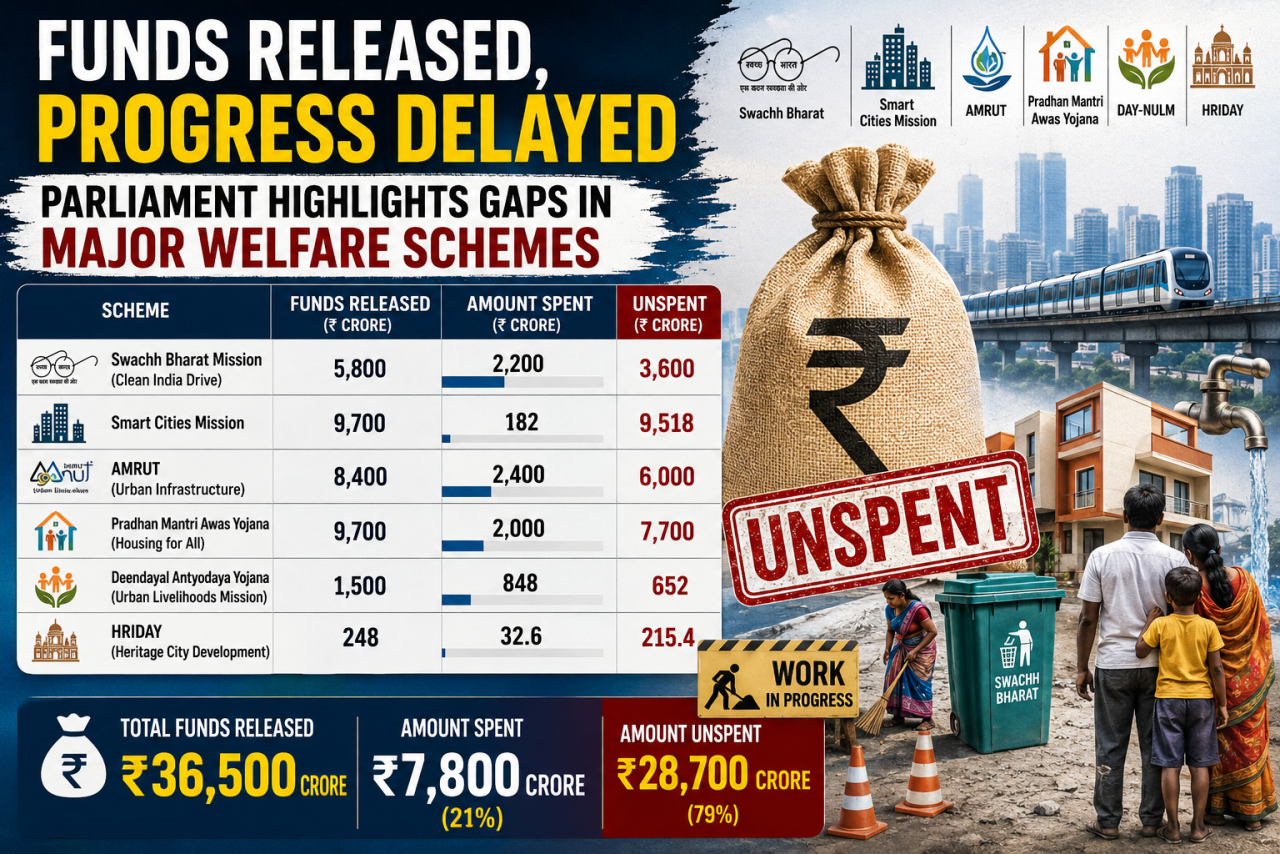
A set of numbers has been doing the rounds on social media again, with visuals claiming that six of the Centre's biggest urban infrastructure missions have barely spent the money allocated to them. The figures themselves are genuine, but they originate from a Parliamentary Standing Committee report tabled in 2018, not from a recent audit. Shared without that context, an old finding can easily appear to be breaking news. Here is what the report actually said, and how the report has evolved since.
The Committee and Its Findings
The Standing Committee on Urban Development, chaired at the time by Biju Janata Dal MP Pinaki Misra, examined the Ministry of Housing and Urban Affairs' Demand for Grants for 2018-19. It reviewed six flagship schemes: the Smart Cities Mission, the Swachh Bharat Mission (Urban), the Atal Mission for Rejuvenation and Urban Transformation (AMRUT), the Heritage City Development and Augmentation Yojana (HRIDAY), the Pradhan Mantri Awas Yojana (Urban), and the National Urban Livelihoods Mission.
The committee found that against a combined release of roughly ₹36,194 crore since the launch of these programmes, only about ₹7,851 crore had been reported as utilised on the ground, amounting to nearly 22 percent. It described the pace of implementation as worrying and cautioned that, if the trend continued, the schemes' objectives would remain "a distant dream."
AMRUT's utilisation stood at less than 29 percent, while smaller programmes such as HRIDAY, aimed at preserving the character of India's heritage cities, recorded even lower levels of expenditure.
The Ministry, then headed by Hardeep Singh Puri, disputed the interpretation of the figures. It argued that expenditure is officially recorded only after projects are completed and certified, meaning that funds committed to ongoing works do not immediately appear in utilisation data. The Ministry also highlighted structural challenges, including land acquisition, municipal coordination, tendering processes and state-level implementation delays, all of which can slow the conversion of central allocations into completed infrastructure.
What's Changed Since 2018
The 2018 observations were not an isolated warning. In subsequent years, Parliamentary Standing Committees continued to raise concerns over delays in project execution and the pace of fund utilisation across several urban missions.
More recent committee reviews of AMRUT and AMRUT 2.0 have noted that only around one-third of the committed central assistance for water supply and sewerage projects had been released, while fewer than one in five approved sewerage and septage projects had been completed.
At the same time, the overall picture has evolved. Swachh Bharat Mission (Urban) has reported thousands of cities achieving Open Defecation Free certification. PMAY-Urban has sanctioned lakhs of houses, and allocations for urban development programmes have increased significantly compared with 2018. PMAY-Urban now accounts for the largest share of the Ministry's budget.
Independent legislative trackers, including PRS Legislative Research, have also noted improvements in fund utilisation for several schemes over the years, although implementation challenges continue. Meanwhile, the Smart Cities Mission has moved towards completion with mixed outcomes across its original 100-city target.
Why Context Matters
None of this diminishes the importance of Parliament's criticism. Standing Committees, which include Members of Parliament from both the ruling coalition and the opposition, exist to scrutinise government performance and regularly highlight delays, implementation gaps and administrative bottlenecks. Their findings deserve careful public attention.
However, presenting a seven-year-old committee observation as if it reflects the current state of these schemes risks misleading readers. It allows critics to portray outdated figures as today's reality, while also giving governments an opportunity to dismiss legitimate current concerns simply because the viral data lacks context.
The more meaningful question is the one Parliament continues to examine every year: how much money is allocated, how much is released, how much is actually utilised, and how efficiently public spending translates into functioning homes, water supply systems, sanitation facilities and urban infrastructure. That remains an evolving story, and one best understood through current evidence rather than a recycled snapshot from 2018.
A set of numbers has been doing the rounds on social media again, with visuals claiming that six of the Centre's biggest urban infrastructure missions have barely spent the money allocated to them. The figures themselves are genuine, but they originate from a Parliamentary Standing Committee report tabled in 2018, not from a recent audit. Shared without that context, an old finding can easily appear to be breaking news. Here is what the report actually said, and how the report has evolved since.
The Committee and Its Findings
The Standing Committee on Urban Development, chaired at the time by Biju Janata Dal MP Pinaki Misra, examined the Ministry of Housing and Urban Affairs' Demand for Grants for 2018-19. It reviewed six flagship schemes: the Smart Cities Mission, the Swachh Bharat Mission (Urban), the Atal Mission for Rejuvenation and Urban Transformation (AMRUT), the Heritage City Development and Augmentation Yojana (HRIDAY), the Pradhan Mantri Awas Yojana (Urban), and the National Urban Livelihoods Mission.
The committee found that against a combined release of roughly ₹36,194 crore since the launch of these programmes, only about ₹7,851 crore had been reported as utilised on the ground, amounting to nearly 22 percent. It described the pace of implementation as worrying and cautioned that, if the trend continued, the schemes' objectives would remain "a distant dream."
AMRUT's utilisation stood at less than 29 percent, while smaller programmes such as HRIDAY, aimed at preserving the character of India's heritage cities, recorded even lower levels of expenditure.
The Ministry, then headed by Hardeep Singh Puri, disputed the interpretation of the figures. It argued that expenditure is officially recorded only after projects are completed and certified, meaning that funds committed to ongoing works do not immediately appear in utilisation data. The Ministry also highlighted structural challenges, including land acquisition, municipal coordination, tendering processes and state-level implementation delays, all of which can slow the conversion of central allocations into completed infrastructure.
What's Changed Since 2018
The 2018 observations were not an isolated warning. In subsequent years, Parliamentary Standing Committees continued to raise concerns over delays in project execution and the pace of fund utilisation across several urban missions.
More recent committee reviews of AMRUT and AMRUT 2.0 have noted that only around one-third of the committed central assistance for water supply and sewerage projects had been released, while fewer than one in five approved sewerage and septage projects had been completed.
At the same time, the overall picture has evolved. Swachh Bharat Mission (Urban) has reported thousands of cities achieving Open Defecation Free certification. PMAY-Urban has sanctioned lakhs of houses, and allocations for urban development programmes have increased significantly compared with 2018. PMAY-Urban now accounts for the largest share of the Ministry's budget.
Independent legislative trackers, including PRS Legislative Research, have also noted improvements in fund utilisation for several schemes over the years, although implementation challenges continue. Meanwhile, the Smart Cities Mission has moved towards completion with mixed outcomes across its original 100-city target.
Why Context Matters
None of this diminishes the importance of Parliament's criticism. Standing Committees, which include Members of Parliament from both the ruling coalition and the opposition, exist to scrutinise government performance and regularly highlight delays, implementation gaps and administrative bottlenecks. Their findings deserve careful public attention.
However, presenting a seven-year-old committee observation as if it reflects the current state of these schemes risks misleading readers. It allows critics to portray outdated figures as today's reality, while also giving governments an opportunity to dismiss legitimate current concerns simply because the viral data lacks context.
The more meaningful question is the one Parliament continues to examine every year: how much money is allocated, how much is released, how much is actually utilised, and how efficiently public spending translates into functioning homes, water supply systems, sanitation facilities and urban infrastructure. That remains an evolving story, and one best understood through current evidence rather than a recycled snapshot from 2018.






















Leave a Comment