
Three age groups, safer platform design and tougher accountability offer India a possible model for protecting children online.
The European Union has proposed a new framework to protect children from the risks of social media. Instead of treating every user below 18 in the same way, the plan divides children and teenagers into age groups and places different restrictions on each.
For India, which is still developing its approach to children's social media use, the European proposal offers useful points for comparison.
Three Rules for Three Age Groups
European Commission President Ursula von der Leyen has proposed a three-level system.
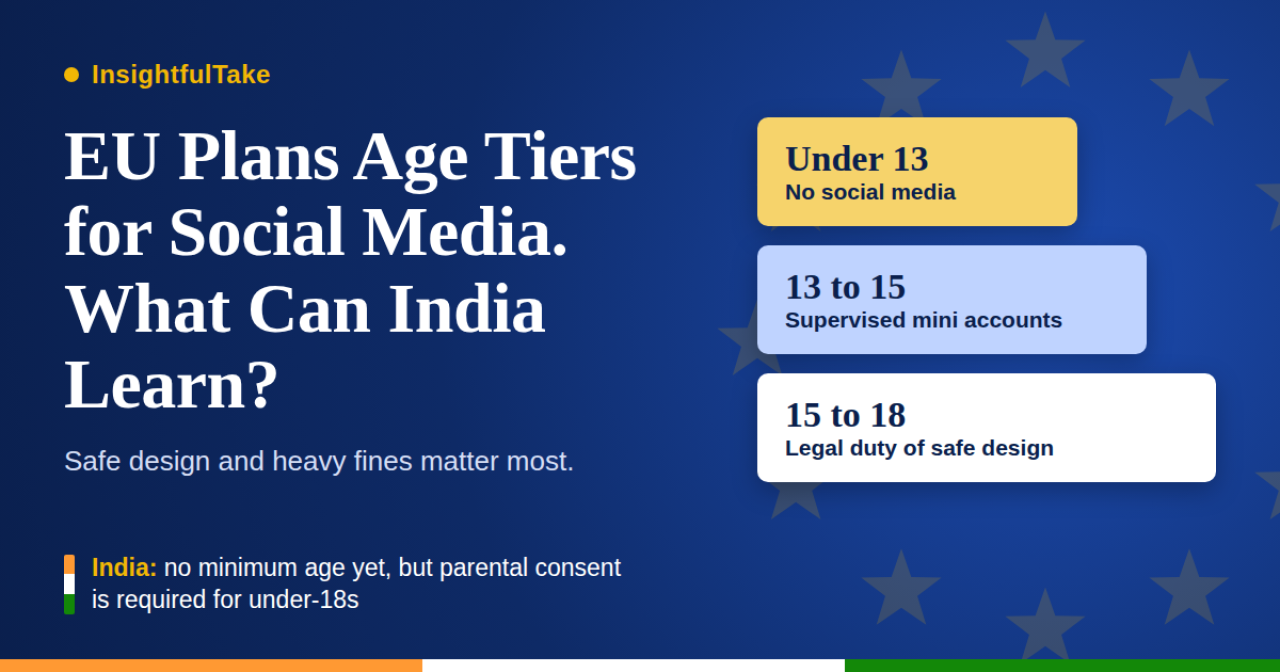
Children below 13 would not be allowed to use social media. Those aged 13 to 15 could use limited "mini accounts" under parental supervision. Users aged 15 to 18 would be allowed greater access, but platforms would have to follow a legal duty of "safe design."
The approach recognises that a 13-year-old and a 17-year-old do not have the same level of maturity or online needs.
The EU also wants technology companies to take greater responsibility for the way their platforms are designed. Proposed penalties could reach 6% of a company's annual turnover for serious violations.
However, the proposal still has to go through the EU's legislative process. Its final form could change, and implementation may take time.
Why an Age Ban Alone May Not Work
Australia provides an important example. The country introduced a ban on social media accounts for children under 16 in December 2025. However, its online safety regulator has reported that many children in the age group still have accounts.
This shows one of the central problems with age-based restrictions. Children can lie about their age, use another person's account or find other ways around verification systems.
There is another problem. Even teenagers who are legally allowed to use social media can be exposed to features designed to keep them online for longer. Endless scrolling, autoplay and frequent notifications can encourage excessive use.
That is why the EU's focus on platform design is important. Protecting children may require changes to the products themselves, not just a higher age limit.
The EU is also considering an age-verification system designed to confirm a user's age without revealing their identity. Its success will depend on whether it can work across millions of users while protecting privacy.
Where Does India Stand?
India does not currently have a national minimum age for accessing social media.
The Digital Personal Data Protection Act, however, treats anyone below 18 as a child for data-protection purposes. Platforms must obtain verifiable parental consent before processing a child's personal data.
The framework also places restrictions on tracking, behavioural monitoring and targeted advertising involving children. These provisions are intended to reduce the commercial use of children's personal information.
But data protection and access to social media are not the same thing. A platform may allow a child to use a service without collecting certain personal data. This leaves an important question about whether India's existing framework can effectively control access to social media itself.
The government has also been examining age-based restrictions and discussing the issue with technology platforms. As of mid-2026, no nationwide ban on social media for children has been notified.
What India Can Learn
1. Age does not have to be a single number
India's data-protection framework broadly treats everyone below 18 as a child. The EU proposal takes a more gradual approach.
Younger children would face stronger restrictions, while older teenagers would receive greater freedom with additional safeguards.
Such a system could allow India to protect younger children without treating a 17-year-old in exactly the same way as a 10-year-old.
2. Platform design matters
Australia's experience suggests that age restrictions can be difficult to enforce on their own.
India could also consider rules requiring platforms to reduce features that may encourage excessive use by young people. These could include autoplay, endless feeds and late-night notifications.
Such measures would protect children even when age verification fails.
3. Enforcement will decide the outcome
A law is useful only when companies can be held responsible for following it.
India's framework requires parental consent in certain situations, but questions remain about how platforms should reliably verify a child's age and a parent's identity without creating new privacy risks.
This is where the EU's proposed age-verification approach could offer lessons. India would need to find a balance between protecting children and preventing unnecessary collection of personal information.
India's data-protection framework also provides for substantial financial penalties for violations involving children's data.
India's Bigger Challenge
India has a huge young internet population. Many children access the internet through a parent's phone or a shared family device. This makes age verification more difficult.
Parental supervision is another challenge. Digital awareness varies greatly between families. In some cases, "parental consent" could become nothing more than clicking a button.
Any system designed for India must therefore work across very different social and economic settings, from a village in Bihar to a household in Delhi.
The Question India Must Answer
The EU proposal is still under consideration, and Australia's experience shows that an age ban cannot solve every problem.
India does not need to copy either model. It can study what has worked, what has failed and where enforcement has proved difficult.
A practical approach could combine strict enforcement of children's data-protection rules with stronger safety standards for platform design and independent oversight.
The central issue is not simply whether children should be allowed online. It is whether social media companies should be required to design their platforms differently when their users are children.
The European Union has proposed a new framework to protect children from the risks of social media. Instead of treating every user below 18 in the same way, the plan divides children and teenagers into age groups and places different restrictions on each.
For India, which is still developing its approach to children's social media use, the European proposal offers useful points for comparison.
Three Rules for Three Age Groups
European Commission President Ursula von der Leyen has proposed a three-level system.
Children below 13 would not be allowed to use social media. Those aged 13 to 15 could use limited "mini accounts" under parental supervision. Users aged 15 to 18 would be allowed greater access, but platforms would have to follow a legal duty of "safe design."
The approach recognises that a 13-year-old and a 17-year-old do not have the same level of maturity or online needs.
The EU also wants technology companies to take greater responsibility for the way their platforms are designed. Proposed penalties could reach 6% of a company's annual turnover for serious violations.
However, the proposal still has to go through the EU's legislative process. Its final form could change, and implementation may take time.
Why an Age Ban Alone May Not Work
Australia provides an important example. The country introduced a ban on social media accounts for children under 16 in December 2025. However, its online safety regulator has reported that many children in the age group still have accounts.
This shows one of the central problems with age-based restrictions. Children can lie about their age, use another person's account or find other ways around verification systems.
There is another problem. Even teenagers who are legally allowed to use social media can be exposed to features designed to keep them online for longer. Endless scrolling, autoplay and frequent notifications can encourage excessive use.
That is why the EU's focus on platform design is important. Protecting children may require changes to the products themselves, not just a higher age limit.
The EU is also considering an age-verification system designed to confirm a user's age without revealing their identity. Its success will depend on whether it can work across millions of users while protecting privacy.
Where Does India Stand?
India does not currently have a national minimum age for accessing social media.
The Digital Personal Data Protection Act, however, treats anyone below 18 as a child for data-protection purposes. Platforms must obtain verifiable parental consent before processing a child's personal data.
The framework also places restrictions on tracking, behavioural monitoring and targeted advertising involving children. These provisions are intended to reduce the commercial use of children's personal information.
But data protection and access to social media are not the same thing. A platform may allow a child to use a service without collecting certain personal data. This leaves an important question about whether India's existing framework can effectively control access to social media itself.
The government has also been examining age-based restrictions and discussing the issue with technology platforms. As of mid-2026, no nationwide ban on social media for children has been notified.
What India Can Learn
1. Age does not have to be a single number
India's data-protection framework broadly treats everyone below 18 as a child. The EU proposal takes a more gradual approach.
Younger children would face stronger restrictions, while older teenagers would receive greater freedom with additional safeguards.
Such a system could allow India to protect younger children without treating a 17-year-old in exactly the same way as a 10-year-old.
2. Platform design matters
Australia's experience suggests that age restrictions can be difficult to enforce on their own.
India could also consider rules requiring platforms to reduce features that may encourage excessive use by young people. These could include autoplay, endless feeds and late-night notifications.
Such measures would protect children even when age verification fails.
3. Enforcement will decide the outcome
A law is useful only when companies can be held responsible for following it.
India's framework requires parental consent in certain situations, but questions remain about how platforms should reliably verify a child's age and a parent's identity without creating new privacy risks.
This is where the EU's proposed age-verification approach could offer lessons. India would need to find a balance between protecting children and preventing unnecessary collection of personal information.
India's data-protection framework also provides for substantial financial penalties for violations involving children's data.
India's Bigger Challenge
India has a huge young internet population. Many children access the internet through a parent's phone or a shared family device. This makes age verification more difficult.
Parental supervision is another challenge. Digital awareness varies greatly between families. In some cases, "parental consent" could become nothing more than clicking a button.
Any system designed for India must therefore work across very different social and economic settings, from a village in Bihar to a household in Delhi.
The Question India Must Answer
The EU proposal is still under consideration, and Australia's experience shows that an age ban cannot solve every problem.
India does not need to copy either model. It can study what has worked, what has failed and where enforcement has proved difficult.
A practical approach could combine strict enforcement of children's data-protection rules with stronger safety standards for platform design and independent oversight.
The central issue is not simply whether children should be allowed online. It is whether social media companies should be required to design their platforms differently when their users are children.



















Leave a Comment