
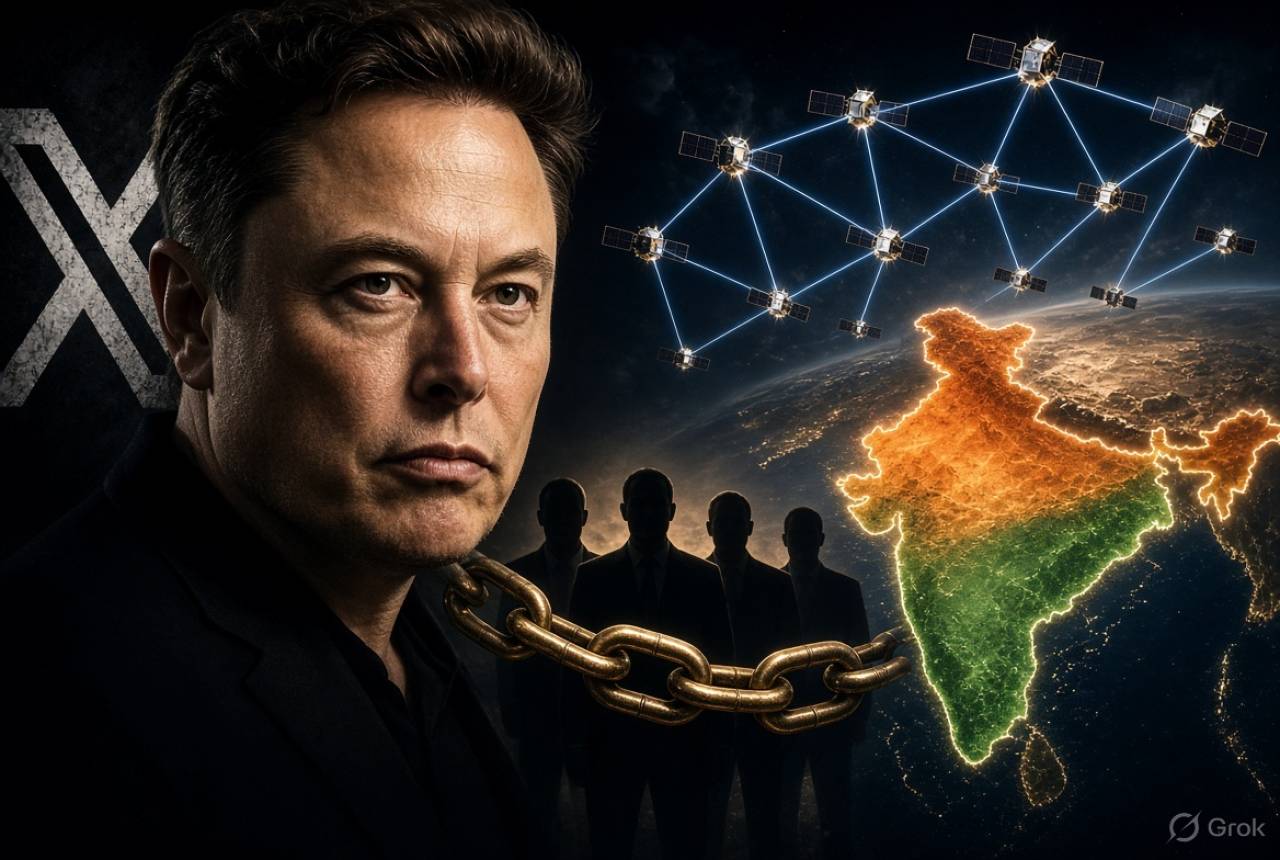
Elon Musk says powerful Indian business interests are blocking Starlink. The government denies bias, but satellite internet services are still waiting for final approvals.
Elon Musk has accused powerful Indian business interests of blocking Starlink’s entry into the country, alleging that established players want to protect their market dominance. The Indian government has rejected claims of discrimination, insisting that all satellite internet providers must meet the same regulatory requirements.
The public exchange has brought renewed attention to the hurdles facing Starlink, the satellite internet service owned by Musk’s SpaceX. Despite obtaining a basic licence to provide satellite communication services in India, the company is still waiting for the remaining approvals needed to begin commercial operations.
Starlink Awaits Final Government Approvals
Starlink is among three companies that have received Global Mobile Personal Communications by Satellite (GMPCS) licences from the Indian government. The other two are Eutelsat OneWeb and Jio Satellite Communications, backed by Reliance Industries.
However, none of the three has been cleared to begin commercial services. They still need spectrum allocation and the completion of security assessments before they can start operating.
These requirements have become central to the dispute. While Musk argues that Starlink has waited long enough, the government maintains that the process applies equally to all three companies.
Musk Points to Ambani and Market Dominance
Musk first raised the issue on X, responding to a post arguing that India needed Starlink to improve internet access in underserved regions.
He accused unnamed business interests of blocking the service to protect their “monopolistic chokehold” on the Indian people. He described the alleged obstruction as “a crime against the people of India” and invited users to guess who was responsible.
The following day, Musk sharpened his criticism. He pointed out that Starlink operates in more than 165 countries and said the company had spent five years trying to meet Indian laws and government requirements.
“So why still no license?” he asked.
He then raised a direct question about Mukesh Ambani, chairman of Reliance Industries and the driving force behind Jio, one of India's largest telecom operators and a competitor in the satellite communications market.
“Is Ambani the real boss of India?” Musk asked.
The remark turned a dispute over regulatory approvals into a wider debate about the influence of powerful business groups on Indian policymaking.
Rahul Gandhi, Leader of the Opposition in the Lok Sabha, joined the exchange. “Welcome to India, Elon. Wait till you discover the other guy,” he posted.
Musk responded, “Thank you, Rahul. This is indeed troubling.”
The brief exchange gave the controversy a political dimension, with questions about market competition and the government's handling of foreign companies moving into the spotlight.
Government Rejects Claims of Discrimination
India's Ministry of Communications rejected suggestions that the regulatory framework was designed to favour domestic companies.
In an official statement, the ministry described claims of discrimination as “baseless and misconceived.” It said the government had established a fair and non-discriminatory authorisation system for telecommunications services, including satellite communications.
The ministry also pointed out that Starlink, Eutelsat OneWeb and Jio Satellite Communications had received licences on equal terms. All three still needed to complete security assessments and obtain spectrum before launching their services.
“Security assessment as part of this process is currently under way in respect of all the three licensees,” the statement said.
The ministry added that the companies were at “broadly the same regulatory stage.”
Officials did not name Musk or Ambani. Their response focused on the government's position that no satellite operator was being given preferential treatment.
The statement addresses the formal rules governing the companies. It does not, by itself, settle the wider question of whether the pace of approvals is appropriate or whether competition among established telecom operators is influencing the debate.
Starlink Says Its Indian Infrastructure Is Ready
Behind the public exchange lies a more practical question about how soon Starlink can begin serving Indian customers.
Lauren Dreyer, SpaceX's vice-president of Starlink Business Operations, told the India Mobile Congress in New Delhi that the company had developed its Indian operations around the country's security requirements.
According to Dreyer, Starlink has established 20 gateway sites equipped with hundreds of antennas and is prepared to begin service once the necessary approvals are granted.
“We are ready to serve in India, once India is ready,” she said.
She also said the company had been working with Indian regulators, telecom operators and industry stakeholders for five years.
Starlink's technology could help address the last-mile connectivity problem, particularly in locations where conventional infrastructure is expensive or difficult to build. Satellite broadband can connect users without requiring fibre-optic cables or mobile towers to reach every village and remote settlement.
But a ready network does not automatically translate into permission to operate. The outstanding regulatory requirements remain a barrier to commercial launch.
Airtel Partnership Offers a Local Route to Market
Starlink has also secured a commercial partnership with Bharti Airtel.
In March 2025, the two companies announced an agreement to explore bringing Starlink services to Airtel customers. The proposed cooperation included the possibility of distributing Starlink equipment through Airtel stores and offering satellite connectivity to business customers.
The companies also planned to explore ways to connect rural communities, schools and healthcare facilities. Airtel's existing network could support the broader connectivity offering.
The partnership gives Starlink a potential distribution channel and a major local telecom partner. However, it does not replace the government approvals required for commercial operations.
The agreement also illustrates the complicated nature of the Indian telecom market. Airtel can cooperate with Starlink in satellite connectivity while continuing to compete with other operators across the wider communications industry.
Spectrum and Security Remain the Key Hurdles
Satellite broadband requires careful coordination of radio frequencies. Spectrum must be allocated in a way that prevents interference with existing services and allows different satellite operators to function effectively.
Security assessments are another important part of the process. Authorities need to examine issues involving network control, data protection and compliance with Indian law. Foreign investment and other applicable regulatory requirements may also affect the timeline.
These concerns are not exclusive to Starlink. Eutelsat OneWeb and Jio Satellite Communications must also satisfy the relevant conditions before launching their services.
The government argues that these checks are necessary in a sector connected to national security and critical infrastructure. Critics, meanwhile, question whether regulatory delays could protect established market positions, even when the rules are formally the same for every company.
The distinction matters. Equal rules do not necessarily guarantee a quick process, but delays alone do not establish that a company is being deliberately obstructed.
What the Delay Means for Rural India
The debate has consequences beyond Musk, Ambani and the telecom industry.
India has expanded mobile connectivity significantly, but reliable high-speed internet remains difficult to access in some remote villages, hilly regions and forested areas. Satellite broadband could help bridge these gaps, particularly where laying fibre or building conventional network infrastructure is expensive.
Schools could use better connectivity for digital learning. Healthcare centres could improve access to online consultations and medical information. Small businesses could reach customers and services that remain difficult to access through unreliable connections.
Satellite services could also support communications during emergencies, although their usefulness would depend on local coverage, equipment, affordability and power availability.
For these communities, the central question is not which billionaire wins a public argument. It is whether new technology can deliver reliable internet at a price that people and institutions can afford.
Every additional delay postpones that possibility. At the same time, satellite broadband must operate within a regulatory framework that addresses legitimate technical and security concerns.
A Test of India's Telecom Policy
India faces a difficult balancing act. Domestic companies such as Reliance Jio have invested heavily in telecommunications infrastructure, while foreign technology firms can bring additional investment, new capabilities and alternative services.
Protecting national security and ensuring fair competition are both legitimate policy objectives. The challenge is to pursue them without allowing regulatory uncertainty to discourage investment or limit consumer choice.
Musk's decision to make his accusations publicly has increased pressure on the government. His comments may resonate with those concerned about the influence of powerful business groups, but his allegations do not independently establish that Indian companies have deliberately blocked Starlink.
The government, for its part, has explained that all three licensed satellite operators remain subject to outstanding approvals. The next important development will be whether those approvals are completed and on what timeline.
For now, Starlink remains unable to offer commercial services in India despite its licence, planned infrastructure and partnership with Airtel. Eutelsat OneWeb and Jio Satellite Communications face their own remaining regulatory requirements.
Can India maintain rigorous oversight of a strategically important sector while ensuring that the approval process is timely, transparent and genuinely fair to all competitors?
The answer will matter not only to Musk and India's telecom giants, but also to millions of potential users who still lack dependable internet access.
Elon Musk has accused powerful Indian business interests of blocking Starlink’s entry into the country, alleging that established players want to protect their market dominance. The Indian government has rejected claims of discrimination, insisting that all satellite internet providers must meet the same regulatory requirements.
The public exchange has brought renewed attention to the hurdles facing Starlink, the satellite internet service owned by Musk’s SpaceX. Despite obtaining a basic licence to provide satellite communication services in India, the company is still waiting for the remaining approvals needed to begin commercial operations.
Starlink Awaits Final Government Approvals
Starlink is among three companies that have received Global Mobile Personal Communications by Satellite (GMPCS) licences from the Indian government. The other two are Eutelsat OneWeb and Jio Satellite Communications, backed by Reliance Industries.
However, none of the three has been cleared to begin commercial services. They still need spectrum allocation and the completion of security assessments before they can start operating.
These requirements have become central to the dispute. While Musk argues that Starlink has waited long enough, the government maintains that the process applies equally to all three companies.
Musk Points to Ambani and Market Dominance
Musk first raised the issue on X, responding to a post arguing that India needed Starlink to improve internet access in underserved regions.
He accused unnamed business interests of blocking the service to protect their “monopolistic chokehold” on the Indian people. He described the alleged obstruction as “a crime against the people of India” and invited users to guess who was responsible.
The following day, Musk sharpened his criticism. He pointed out that Starlink operates in more than 165 countries and said the company had spent five years trying to meet Indian laws and government requirements.
“So why still no license?” he asked.
He then raised a direct question about Mukesh Ambani, chairman of Reliance Industries and the driving force behind Jio, one of India's largest telecom operators and a competitor in the satellite communications market.
“Is Ambani the real boss of India?” Musk asked.
The remark turned a dispute over regulatory approvals into a wider debate about the influence of powerful business groups on Indian policymaking.
Rahul Gandhi, Leader of the Opposition in the Lok Sabha, joined the exchange. “Welcome to India, Elon. Wait till you discover the other guy,” he posted.
Musk responded, “Thank you, Rahul. This is indeed troubling.”
The brief exchange gave the controversy a political dimension, with questions about market competition and the government's handling of foreign companies moving into the spotlight.
Government Rejects Claims of Discrimination
India's Ministry of Communications rejected suggestions that the regulatory framework was designed to favour domestic companies.
In an official statement, the ministry described claims of discrimination as “baseless and misconceived.” It said the government had established a fair and non-discriminatory authorisation system for telecommunications services, including satellite communications.
The ministry also pointed out that Starlink, Eutelsat OneWeb and Jio Satellite Communications had received licences on equal terms. All three still needed to complete security assessments and obtain spectrum before launching their services.
“Security assessment as part of this process is currently under way in respect of all the three licensees,” the statement said.
The ministry added that the companies were at “broadly the same regulatory stage.”
Officials did not name Musk or Ambani. Their response focused on the government's position that no satellite operator was being given preferential treatment.
The statement addresses the formal rules governing the companies. It does not, by itself, settle the wider question of whether the pace of approvals is appropriate or whether competition among established telecom operators is influencing the debate.
Starlink Says Its Indian Infrastructure Is Ready
Behind the public exchange lies a more practical question about how soon Starlink can begin serving Indian customers.
Lauren Dreyer, SpaceX's vice-president of Starlink Business Operations, told the India Mobile Congress in New Delhi that the company had developed its Indian operations around the country's security requirements.
According to Dreyer, Starlink has established 20 gateway sites equipped with hundreds of antennas and is prepared to begin service once the necessary approvals are granted.
“We are ready to serve in India, once India is ready,” she said.
She also said the company had been working with Indian regulators, telecom operators and industry stakeholders for five years.
Starlink's technology could help address the last-mile connectivity problem, particularly in locations where conventional infrastructure is expensive or difficult to build. Satellite broadband can connect users without requiring fibre-optic cables or mobile towers to reach every village and remote settlement.
But a ready network does not automatically translate into permission to operate. The outstanding regulatory requirements remain a barrier to commercial launch.
Airtel Partnership Offers a Local Route to Market
Starlink has also secured a commercial partnership with Bharti Airtel.
In March 2025, the two companies announced an agreement to explore bringing Starlink services to Airtel customers. The proposed cooperation included the possibility of distributing Starlink equipment through Airtel stores and offering satellite connectivity to business customers.
The companies also planned to explore ways to connect rural communities, schools and healthcare facilities. Airtel's existing network could support the broader connectivity offering.
The partnership gives Starlink a potential distribution channel and a major local telecom partner. However, it does not replace the government approvals required for commercial operations.
The agreement also illustrates the complicated nature of the Indian telecom market. Airtel can cooperate with Starlink in satellite connectivity while continuing to compete with other operators across the wider communications industry.
Spectrum and Security Remain the Key Hurdles
Satellite broadband requires careful coordination of radio frequencies. Spectrum must be allocated in a way that prevents interference with existing services and allows different satellite operators to function effectively.
Security assessments are another important part of the process. Authorities need to examine issues involving network control, data protection and compliance with Indian law. Foreign investment and other applicable regulatory requirements may also affect the timeline.
These concerns are not exclusive to Starlink. Eutelsat OneWeb and Jio Satellite Communications must also satisfy the relevant conditions before launching their services.
The government argues that these checks are necessary in a sector connected to national security and critical infrastructure. Critics, meanwhile, question whether regulatory delays could protect established market positions, even when the rules are formally the same for every company.
The distinction matters. Equal rules do not necessarily guarantee a quick process, but delays alone do not establish that a company is being deliberately obstructed.
What the Delay Means for Rural India
The debate has consequences beyond Musk, Ambani and the telecom industry.
India has expanded mobile connectivity significantly, but reliable high-speed internet remains difficult to access in some remote villages, hilly regions and forested areas. Satellite broadband could help bridge these gaps, particularly where laying fibre or building conventional network infrastructure is expensive.
Schools could use better connectivity for digital learning. Healthcare centres could improve access to online consultations and medical information. Small businesses could reach customers and services that remain difficult to access through unreliable connections.
Satellite services could also support communications during emergencies, although their usefulness would depend on local coverage, equipment, affordability and power availability.
For these communities, the central question is not which billionaire wins a public argument. It is whether new technology can deliver reliable internet at a price that people and institutions can afford.
Every additional delay postpones that possibility. At the same time, satellite broadband must operate within a regulatory framework that addresses legitimate technical and security concerns.
A Test of India's Telecom Policy
India faces a difficult balancing act. Domestic companies such as Reliance Jio have invested heavily in telecommunications infrastructure, while foreign technology firms can bring additional investment, new capabilities and alternative services.
Protecting national security and ensuring fair competition are both legitimate policy objectives. The challenge is to pursue them without allowing regulatory uncertainty to discourage investment or limit consumer choice.
Musk's decision to make his accusations publicly has increased pressure on the government. His comments may resonate with those concerned about the influence of powerful business groups, but his allegations do not independently establish that Indian companies have deliberately blocked Starlink.
The government, for its part, has explained that all three licensed satellite operators remain subject to outstanding approvals. The next important development will be whether those approvals are completed and on what timeline.
For now, Starlink remains unable to offer commercial services in India despite its licence, planned infrastructure and partnership with Airtel. Eutelsat OneWeb and Jio Satellite Communications face their own remaining regulatory requirements.
Can India maintain rigorous oversight of a strategically important sector while ensuring that the approval process is timely, transparent and genuinely fair to all competitors?
The answer will matter not only to Musk and India's telecom giants, but also to millions of potential users who still lack dependable internet access.

























Leave a Comment