
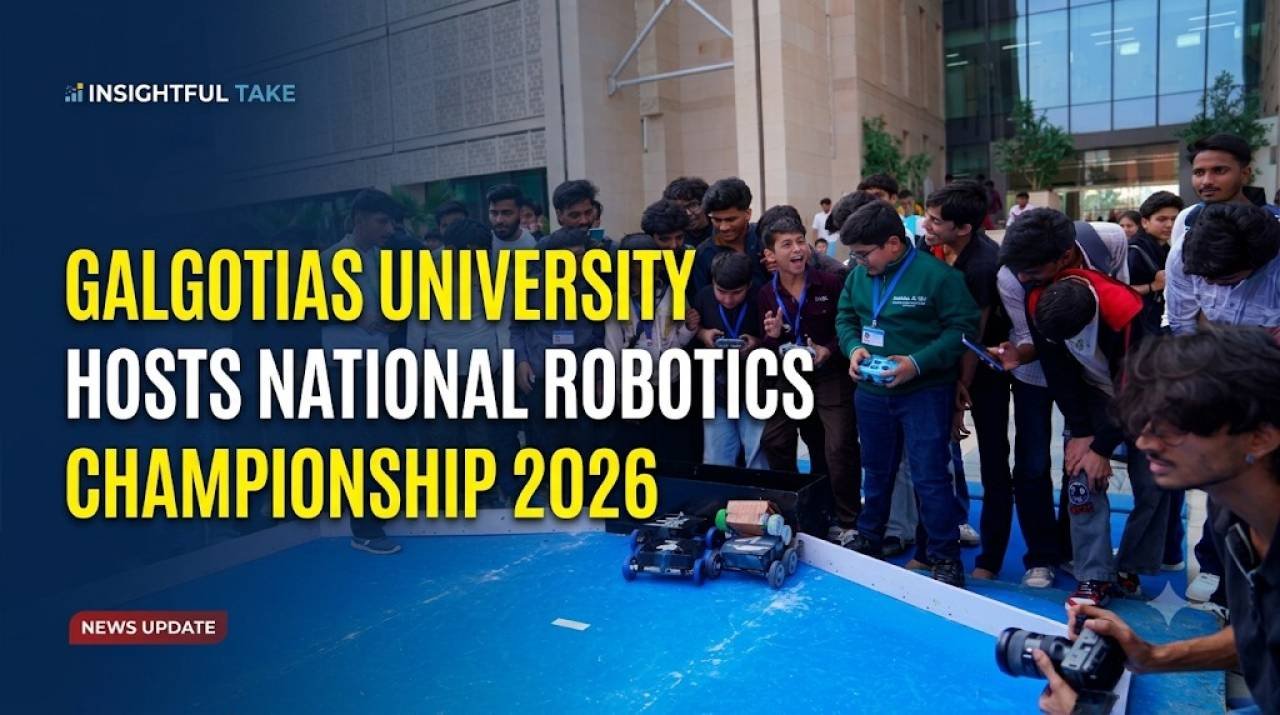
Former DRDO Director General Hari Babu Srivastava inaugurates the two-day event as student teams compete in robotics, autonomous navigation and drone challenges
Student-built robots and drones took centre stage at Galgotias University as the institution hosted the National Robotics Championship 2026 on November 20 and 21. Teams from across India competed in four technical challenges, testing their abilities in mechanical engineering, autonomous navigation, machine control and drone operations.
The two-day championship was organised in collaboration with the All India Council for Robotics & Automation (AICRA) and the World Robotics & Automation Organization (WORSO). It formed part of TechnoXian's World Robotics Championship 10.0, a national-level competition platform designed to bring young robotics enthusiasts and engineering talent together.
Professor Hari Babu Srivastava, former Distinguished Scientist and Director General of the Defence Research and Development Organisation (DRDO), Ministry of Defence, Government of India, inaugurated the championship.
The event brought practical engineering challenges into a competitive environment, allowing students to demonstrate their technical knowledge through machines they had designed, assembled and operated themselves.
Four Challenges Test Different Dimensions of Robotics
The championship featured four principal competitions: SumoBot, Maze Solver, RoboRace and FPV Drone. Each tested a different aspect of robotics and automation, requiring participants to combine engineering concepts with practical problem-solving.
SumoBot focused on mechanical design, balance, movement and control. Participants had to build robots capable of competing in physical confrontations, where the effectiveness of a machine depended on its construction, stability and ability to respond to an opponent.
The Maze Solver challenge placed greater emphasis on algorithms and autonomous navigation. Robots had to interpret their surroundings, identify routes and negotiate a maze without relying entirely on direct human control. Such exercises are closely connected to the development of autonomous systems used in industrial automation, logistics and intelligent transportation.
RoboRace tested speed, stability and precision. The competition required teams to develop machines capable of navigating a designated course while maintaining control and performance.
The FPV Drone challenge introduced another dimension of engineering, testing flight control and real-time decision-making. First-person-view drone operations require coordination, technical understanding and the ability to respond quickly to changing conditions.
Together, these competitions offered participants an opportunity to apply concepts from mechanical engineering, electronics, programming and automation in practical settings.
Independent Standards and Competitive Evaluation
AICRA, which promotes robotics, automation and artificial intelligence in India, founded the TechnoXian championship series. WORSO establishes the competition standards under which participating teams are evaluated.
According to the organisers, competing teams build and operate their own machines, while their performance is assessed against the prescribed competition standards.
The collaboration between Galgotias University and AICRA builds on a Memorandum of Understanding between the two organisations. The partnership aims to create opportunities for students and young innovators to participate in technical competitions and gain exposure to emerging technologies.
The use of defined competition standards also makes the championship more than a demonstration of technical projects. Participants have to prove that their machines can perform under specified conditions, with their engineering decisions reflected in the results.
Learning Beyond the Classroom
One of the central aspects of robotics competitions is the opportunity to learn through experimentation. Unlike conventional classroom exercises, where students often work with established methods and expected outcomes, competitive engineering requires them to respond to unpredictable situations.
A robot that performs well during testing may encounter mechanical or programming problems during an actual competition. A navigation system may fail to identify a route, a machine may lose stability, or a drone may require immediate adjustments to its flight controls.
Such situations demand quick diagnosis and practical solutions.
Participants in the championship had to work against time and competing teams. Between rounds, they could repair components, modify wiring and adjust their machines in response to performance problems.
These experiences help students understand the relationship between theoretical knowledge and engineering applications. They also encourage teamwork, technical communication, analytical thinking and the ability to learn from failure.
The emphasis on building and testing machines is particularly relevant as engineering education increasingly incorporates artificial intelligence, robotics, automation and other emerging technologies.
India's Growing Focus on Deep-Tech Capabilities
Robotics and autonomous systems are becoming increasingly important across manufacturing, defence, healthcare, agriculture, transportation and logistics. Drones are being used in areas ranging from infrastructure inspection and agricultural monitoring to surveillance and emergency response.
India's ambitions in these sectors require a skilled workforce capable of designing, developing and improving indigenous technologies. While academic programmes provide the theoretical foundation, students also need opportunities to work with actual systems and understand the technical challenges involved in developing them.
Competitions such as the National Robotics Championship provide one avenue for this exposure. They bring students from different institutions into a shared environment where they can test their ideas, assess their technical capabilities and learn from competing teams.
Commenting on the championship, Dr Dhruv Galgotia, Chief Executive Officer of Galgotias University, said that India needed engineers who could develop advanced technologies rather than simply use existing systems.
He emphasised the importance of giving students opportunities to design, build and test machines themselves. According to him, competing against teams from across the country helps young engineers develop problem-solving abilities and improve their technical work under pressure.
He also said the university intended to continue creating platforms where competition could encourage innovation and technical excellence.
Universities and the Future of Practical Engineering Education
The National Robotics Championship reflects a wider shift in the expectations placed on higher education institutions. Engineering graduates are increasingly expected to demonstrate practical capabilities alongside academic qualifications.
For universities, this means creating opportunities for students to participate in research projects, technical competitions, industry collaborations and innovation programmes. Such platforms can help students understand how engineering concepts translate into working products and systems.
Galgotias University has been expanding its academic offerings across engineering, artificial intelligence, computer science, semiconductors and other emerging disciplines. Its partnerships with industry organisations and technology companies form part of its broader effort to strengthen technology-oriented education.
The university reports a student community of more than 50,000 learners and a global alumni network exceeding 100,000 graduates. It also states that its students secured more than 5,500 job offers from over 1,250 recruiters in 2026.
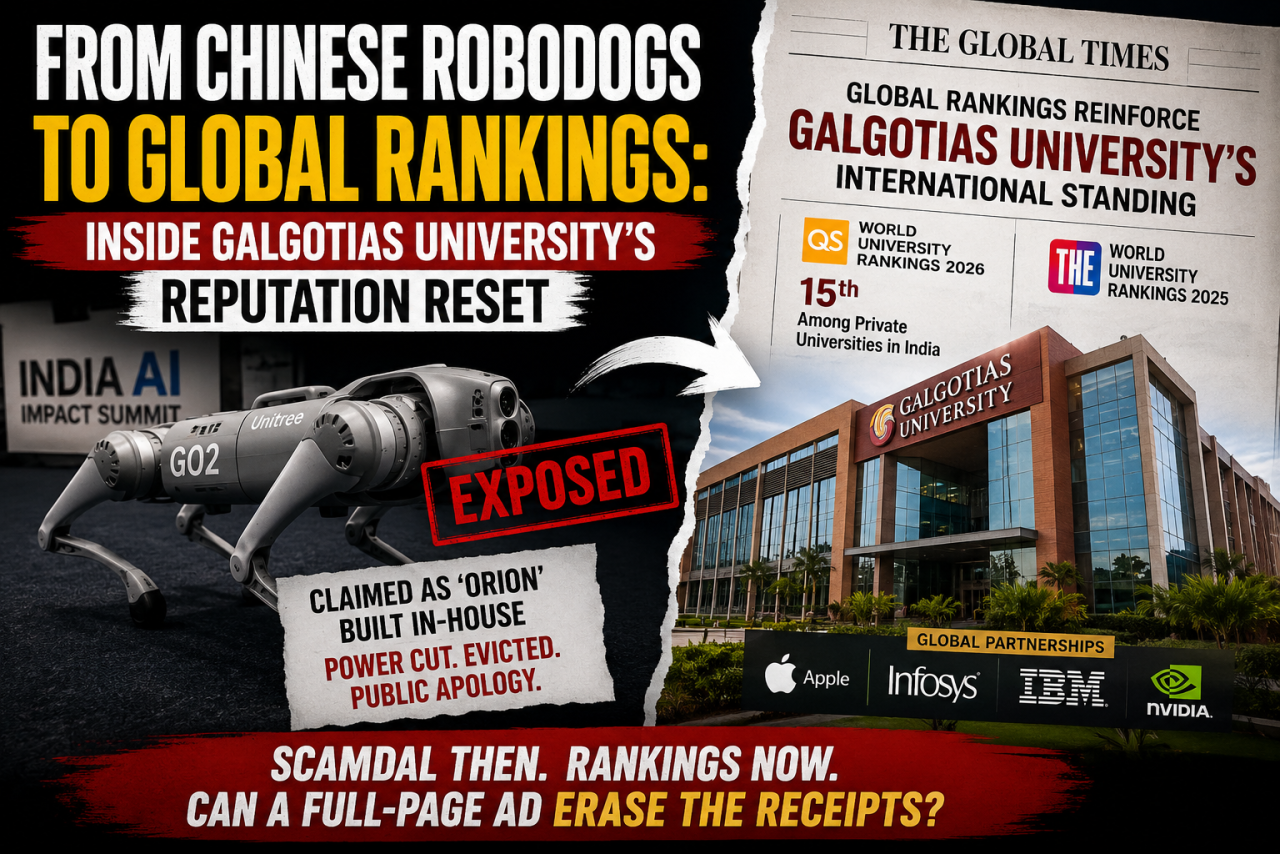
In the QS World University Rankings 2027, the institution was placed in the 1201-1400 global band. It was also placed in the 1001-1200 global band in the Times Higher Education World University Rankings 2027. The university holds NAAC A+ accreditation.
However, institutional rankings and placement figures represent only part of the broader picture of technical education. The ability to encourage independent thinking, practical experimentation and innovation remains equally important in preparing students for technology-driven industries.
The National Robotics Championship offered participating teams an opportunity to demonstrate these capabilities in a competitive setting. By bringing together student-built robots, autonomous systems and drone technology, the event highlighted the growing importance of hands-on learning in India's engineering education landscape.
As robotics and automation become increasingly relevant to the country's industrial and technological ambitions, opportunities for students to design, build and test their own systems will remain an important part of developing the next generation of engineers.
























Leave a Comment