
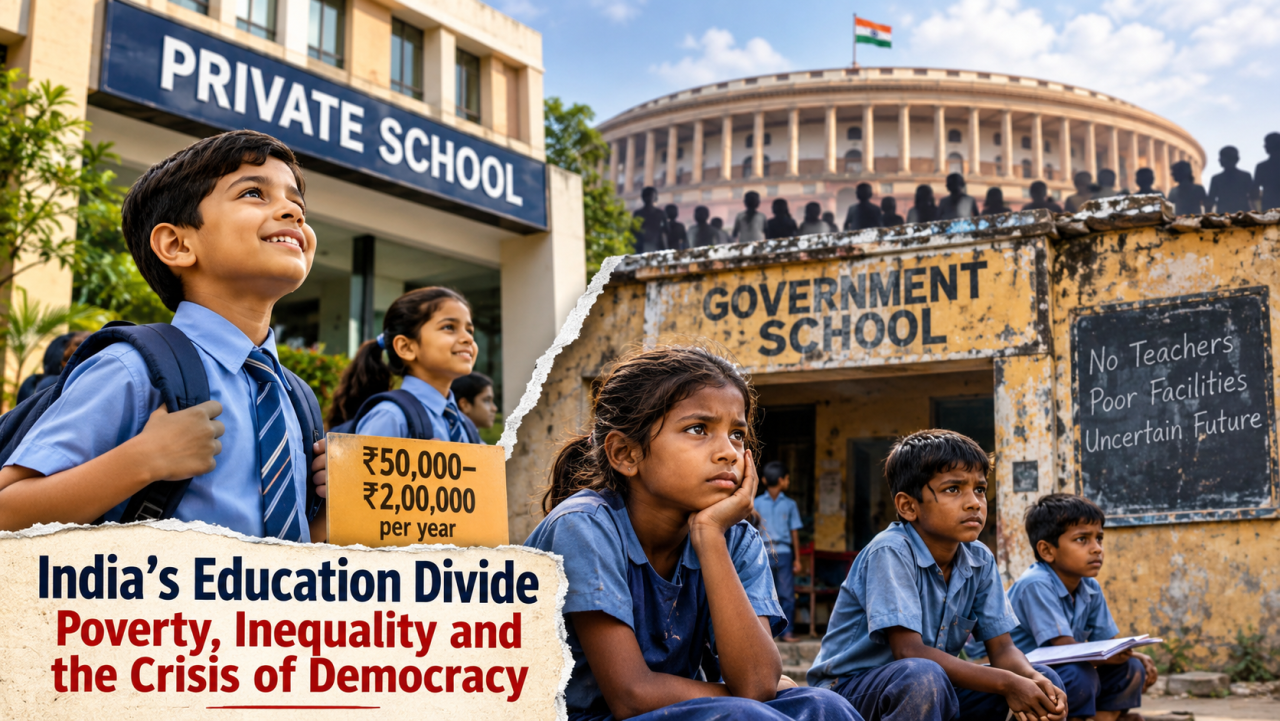
When quality education becomes a privilege rather than a right, democracy struggles to deliver equal opportunity to every citizen.
India takes pride in being the world's largest democracy, but the promise of equal opportunity remains distant for millions of its citizens. A child born into a wealthy family has access to expensive schools, private tuition, digital learning and professional guidance. A child born into a poor Dalit, Adivasi or economically disadvantaged family often has to depend on an under-resourced government school, where the quality of education can determine the limits of future opportunities.
This divide is not simply about differences between private and government schools. It reflects a deeper structural problem in Indian democracy, where economic privilege frequently determines educational opportunity, and educational inequality eventually reproduces economic and social inequality.
The country is expanding welfare support, but it has yet to guarantee equally strong foundations for social mobility.
The growing divide between public and private education
India has one of the world's largest school education systems. According to the Economic Survey 2025-26, the country has approximately 24.69 crore students across 14.71 lakh schools, supported by more than one crore teachers.
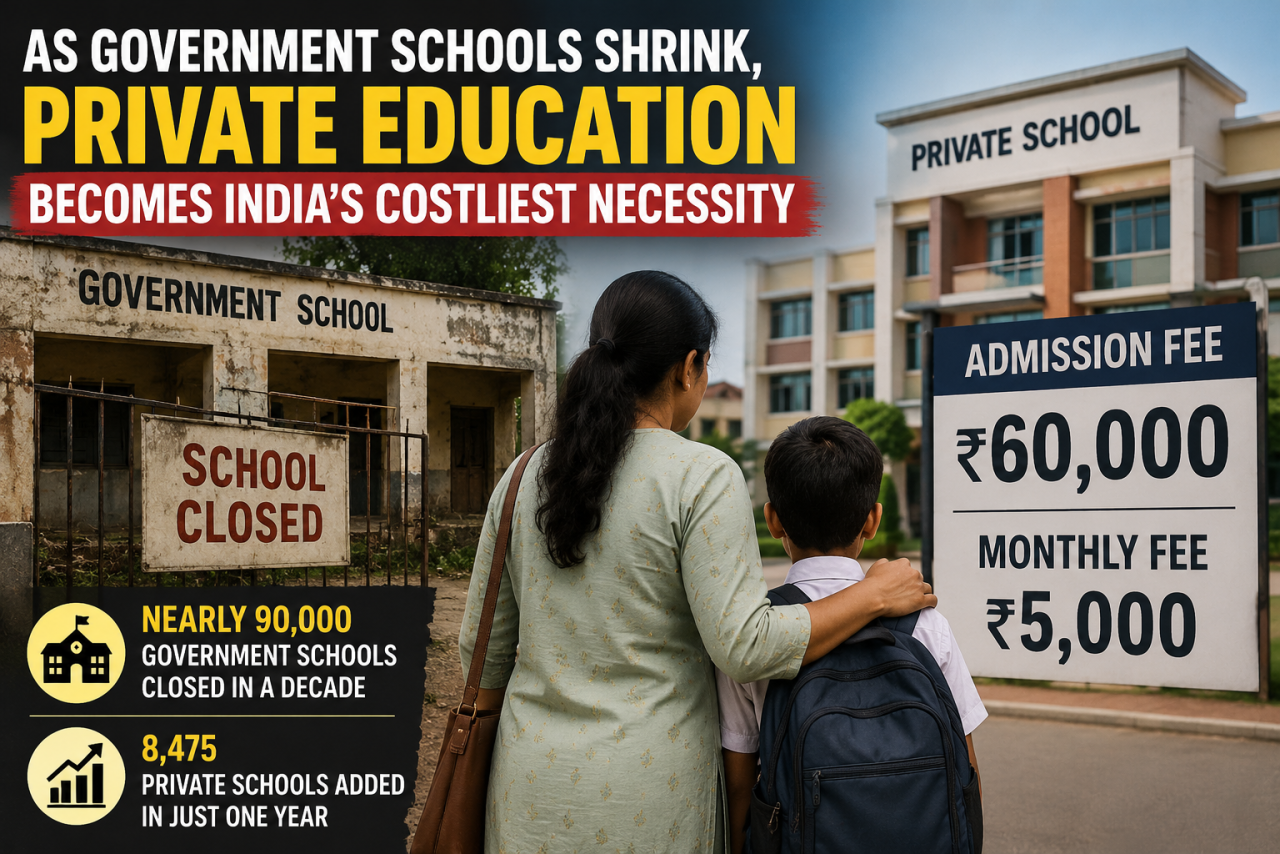
Government schools constitute nearly 69 per cent of all schools but account for only about 49.25 per cent of student enrolment. Private unaided schools, meanwhile, account for approximately 38.8 per cent of enrolment. The changing distribution reflects a growing preference for private education, despite its substantially higher cost.
A 2026 analysis by PRS Legislative Research, drawing on NSSO data, notes that private school education costs approximately ten times as much as government schooling. For a family earning a modest monthly income, private education can consume a disproportionate share of household earnings.
The result is an unequal education market. Wealthier families can purchase better learning environments, smaller classrooms, English-language instruction and additional academic support. Poor families must either accept whatever public education is available or stretch their limited resources to pay private school fees.
The problem is not that every private school offers quality education or that every government school performs poorly. Several government institutions have demonstrated impressive results. However, the persistent difference in learning outcomes between public and private schools reveals the scale of the challenge.
The NITI Aayog's assessment of ASER 2024 data shows that private school students continue to perform better than their government-school counterparts in reading and mathematics across different grade levels. The difference in learning outcomes has persisted over the years.
Government schools are shrinking, but the need for public education remains
The declining number of government schools raises another concern.
NITI Aayog's 2026 assessment of UDISE+ data shows that government schools declined from approximately 11.07 lakh in 2014-15 to 10.13 lakh in 2024-25. Overall school enrolment also fell from 26.95 crore to 24.69 crore during the same period.
Demographic changes, declining fertility and school consolidation partly explain these figures. Therefore, every reduction in school numbers cannot automatically be described as the destruction of public education.
Yet the figures also expose serious weaknesses. The NITI assessment identifies nearly 7,993 schools with zero enrolment and highlights the continued existence of single-teacher schools and classrooms where teachers handle multiple grades simultaneously.
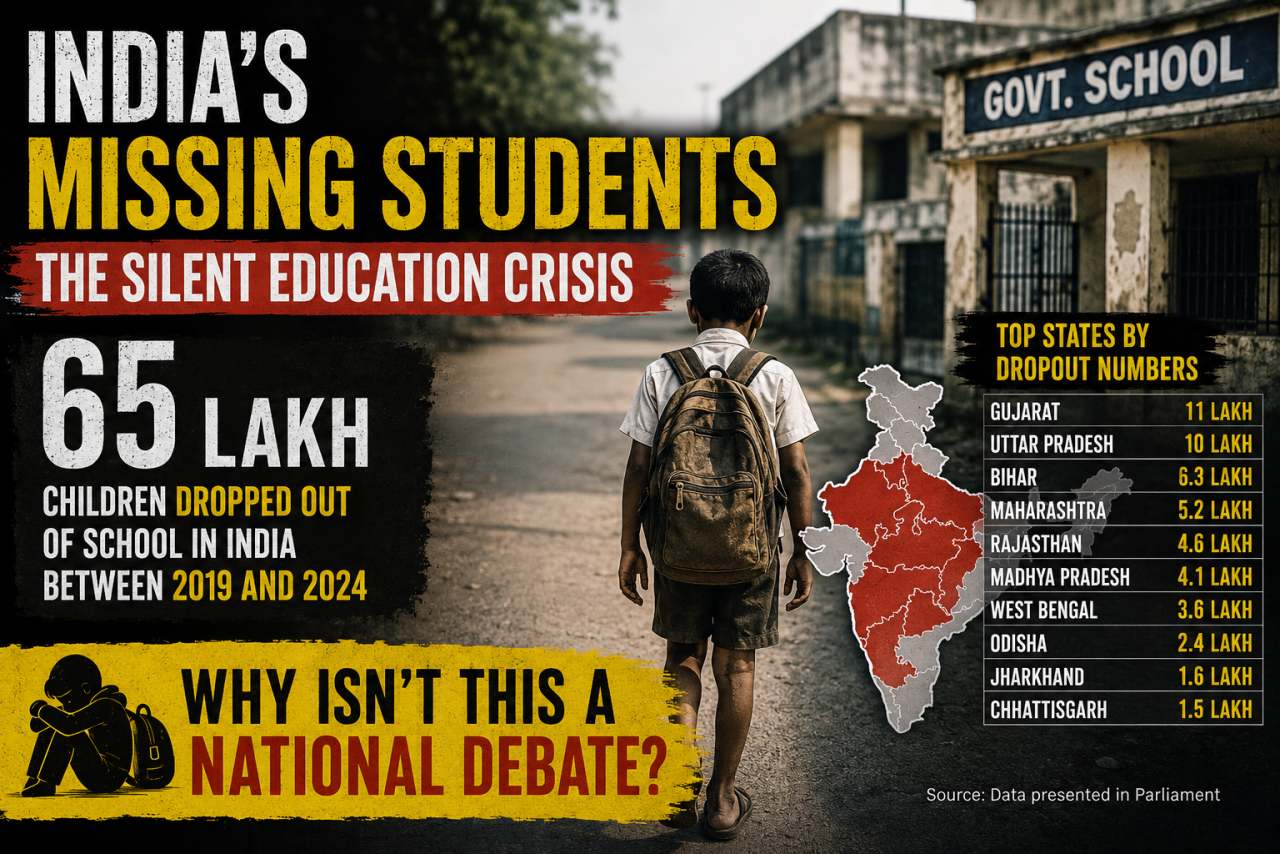
For children in remote villages, tribal regions and economically weaker settlements, the closure or consolidation of a nearby school can mean longer journeys, additional expenses and greater chances of dropping out.
A school building alone does not guarantee education. Children need qualified teachers, functioning classrooms, laboratories, libraries, sanitation, digital facilities and an environment that encourages learning.
When these basic requirements remain inadequate, government schooling risks becoming an institution that provides access on paper without delivering equal educational opportunity in practice.
Welfare is necessary, but it cannot replace empowerment
India's food security programme has played an important role in protecting vulnerable households from hunger. Under the National Food Security Act, subsidised foodgrain coverage extends to up to 75 per cent of the rural population and 50 per cent of the urban population.
The scale of public expenditure is considerable. The Union Budget's 2026-27 expenditure statement provides approximately ₹2.28 lakh crore for food subsidy.
There is nothing inherently wrong with such expenditure. Food security is essential in a country where poverty, unemployment, low wages and economic insecurity continue to affect millions. Free ration can protect children from hunger and help families meet other essential expenses.
However, food assistance and economic empowerment are two different objectives.
A family receiving free ration today also needs access to quality education, healthcare, vocational training, decent employment and opportunities to build assets tomorrow. Without these foundations, welfare can reduce immediate hardship without necessarily changing the economic circumstances that produce it.
The distinction is between helping people survive and enabling them to progress.
Political parties across the spectrum have increasingly made welfare announcements central to electoral competition. Subsidised electricity, free transport, cash transfers, foodgrain distribution and other benefits can provide genuine relief. But the political debate must also address whether these programmes are accompanied by investments that reduce long-term dependence.
Citizens should not have to choose between immediate assistance and the opportunity to escape poverty.
Why caste and social inequality make the problem deeper
For Scheduled Castes, Scheduled Tribes and other historically marginalised communities, educational inequality carries an additional historical burden.
Generations of social discrimination, landlessness, poor access to resources and limited representation have restricted opportunities for these communities. Reservations and targeted educational programmes have opened important doors, and the progress should not be dismissed.
The Ministry of Education's 2024-25 annual report records that SC enrolment in higher education increased from 46.07 lakh in 2014-15 to 69.13 lakh in 2022-23. ST enrolment rose from 16.41 lakh to 28.72 lakh during the same period.
These are significant gains. Nevertheless, increased enrolment does not automatically translate into equal learning outcomes, completion rates, professional opportunities or economic security.
A student from a disadvantaged family may enter school but struggle to receive additional academic support. Another may reach college but lack access to English-language training, internships, professional networks or the financial resources needed to complete higher education.
This is how inequality reproduces itself. The barriers are not always visible, and they do not necessarily operate through explicit discrimination. Sometimes they emerge through differences in the quality of institutions, family resources and access to opportunities.
It would be unfair to suggest that welfare beneficiaries lack political awareness or agency. Nor should SC and ST communities be portrayed as passive instruments of political parties. The real concern is a system in which economic vulnerability can make citizens more dependent on political patronage and less equipped to exercise their rights from a position of independence.
Democracy must create citizens, not permanent dependants
The Constitution promises equality of opportunity and directs the state to promote social and educational justice. Article 21A recognises education as a fundamental right for children between six and fourteen years of age. These commitments cannot be fulfilled merely by increasing school enrolment or distributing welfare benefits.
India needs a public education system that wealthy and poor parents can trust equally. Government schools must become institutions of aspiration rather than the last available option for families who cannot afford private alternatives.
This requires sustained investment in teachers, learning outcomes, school infrastructure, accountability and higher education. It also requires stronger public universities, affordable professional courses and employment opportunities that allow first-generation learners to compete on equal terms.
Welfare should remain a social safety net, but education must become the ladder through which people move beyond economic insecurity.
A democracy is not judged only by how many people receive subsidised food or how frequently political parties announce new benefits. Its real strength lies in whether a child born into poverty has a reasonable chance of becoming a scientist, teacher, entrepreneur, civil servant or independent professional.
Until that possibility becomes equally accessible, India's democratic promise will remain incomplete. A nation cannot build an equal society by feeding generations of poverty without adequately educating them to overcome it.












Leave a Comment