
Dhoni never needed a farewell match. Millions of fans had already given him one, stadium after stadium, over three unforgettable years.
MS Dhoni has retired from the IPL, but where was the farewell? No packed stadium, no emotional speech, no guard of honour and not even a final appearance in the yellow jersey. For a cricketer who gave Indian fans some of their most unforgettable sporting moments, the announcement felt surprisingly ordinary. Yet, perhaps we are looking at it the wrong way. Dhoni did not wait for one grand farewell. Over the last three years, he received it in pieces, in stadiums filled with yellow, through the cheers of rival crowds and the affection of millions who never wanted him to walk away. His goodbye had been happening all along. He simply never announced it.
Chennai Super Kings announced on Tuesday that Dhoni had retired from the IPL after eighteen seasons, hours before the retention deadline, and would move into an off-field role created for him. There was no stadium announcement or press conference. He reportedly conveyed his decision during a meeting with the franchise CEO and owner. Fans called it another "silent goodbye" and expressed disappointment that there was no formal on-field farewell.
The disappointment is understandable, but I think it misses something essential about Dhoni. He did not skip his farewell. He spread it across three years and kept the final chapter in plain sight, allowing nobody to know which moment would eventually become the last.
Go back to April 2023 at Eden Gardens. Dhoni thanked the Kolkata crowd and joked that they were "trying to give me a farewell." That was the beginning of something unusual. Every ground he visited afterwards seemed to turn yellow, and every away game became an occasion for celebration. Delhi, Kolkata, Bengaluru, Hyderabad and Mumbai each had their moment. Fans in cities that were supposed to support rival teams turned up to watch the opposition's wicketkeeper walk out to bat.
Most players receive one farewell, organised by a cricket board or franchise. Dhoni received dozens, and every one of them was organised by the fans. By the time the formal announcement arrived, the country had already said goodbye to him many times over.
Then came Chepauk on May 18, 2026. Dhoni had not played a single game that season, yet he took a lap of honour after CSK's final home match, triggering fresh retirement speculation. His wife Sakshi and childhood friend Chittu were spotted in the stands, and supporters interpreted their presence as a possible indication of what was coming. Cameras followed him around the ground, thousands of fans dressed in yellow stood up and cheered, and then he walked away without saying anything. There was no announcement. The speculation continued.
I believe that was the real farewell. Dhoni simply never labelled it as one. A formally announced farewell would have placed him at the centre of a ceremony. The unannounced one allowed the crowd to express everything it wanted to say while he remained in the background, where he has always appeared most comfortable.
This has been Dhoni's way of handling public attention throughout his career. In August 2020, he announced his retirement from international cricket through a short Instagram video set to an old film song. There was no farewell series, emotional press conference or elaborate announcement. That restraint was entirely characteristic of him. He was also the captain who regularly handed trophies to the youngest members of his team and then quietly moved towards the back of the photograph.
Dhoni's leadership was rarely about drawing attention to himself. He built teams by allowing other people's contributions to become the story. A grand farewell centred entirely on his achievements might have contradicted the leadership philosophy he followed for years. The brief and administrative nature of his IPL exit is consistent with the way he conducted himself on the field.
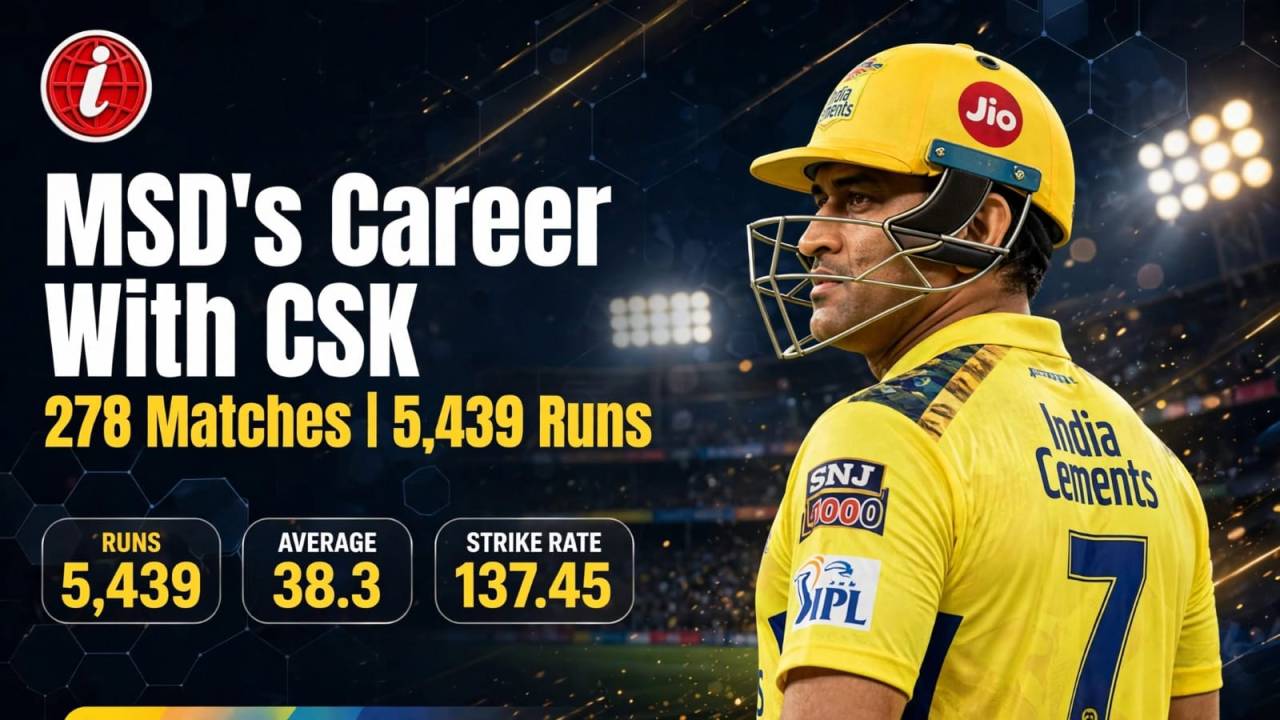
The statistics accompanying the tribute tell another part of the story. The infographic records his runs across seasons and the corresponding strike rates. The figures include a batting average of 38.30, a strike rate of 137.45, five IPL titles as captain and 5,439 runs overall. The yellow line rises, falls, spikes and eventually declines. It is an honest representation of a long career, including its peaks and quieter seasons. There is no artificial attempt to manufacture a dramatic final flourish.
For someone whose reputation was built on last-over finishes, that is perhaps the biggest surprise. The man who made the dramatic ending part of Indian cricket's vocabulary chose a quiet conclusion for himself. He understood the difference between an innings that needs a finish and a story that does not.
Another headline on the sports page captures an equally important part of his journey: "MS Dhoni, the Ranchi boy who won over Chennai." Born in 1981 in Ranchi, which was then part of Bihar, Dhoni came from a modest background. His father worked for the Indian Railways, and his own early professional life included working as a railway ticket collector. He was a small-town cricketer without an established cricketing lineage or an obvious route into India's elite sporting system. For millions of young Indians living outside metropolitan centres, his rise demonstrated that extraordinary opportunities could emerge from unexpected places.
The Chennai connection makes his story even more interesting. The city could easily have treated him as another expensive player acquired through an IPL auction. The league is built around franchises buying and selling talent, and a player from northern India joining a Tamil franchise could have remained an outsider.
Instead, Dhoni became one of Chennai's most loved sporting figures. The franchise CEO reportedly described his special quality as "how completely he became a part of Chennai." That is perhaps a more meaningful tribute than any statistic. In a league where players frequently change teams, Dhoni established a relationship with a city that went far beyond cricket.
Perhaps that explains why so many supporters are disappointed about the absence of a formal farewell. They are not simply saying goodbye to a cricketer. They are mourning the end of a relationship that brought together a city and a player who originally belonged somewhere else. Their connection was built on trust, loyalty and years of shared sporting memories.
There is, however, one important detail that makes this retirement different from a conventional sporting exit. Dhoni is not completely leaving Chennai Super Kings. From the 2027 season, he is expected to move into a mentor's role. The announcement represents a change of responsibility more than a complete departure. He spent much of his playing career behind the stumps, observing everything while speaking relatively little. Now, he can continue contributing from the dugout.
That may be the most Dhoni-like outcome possible. He has never really left the dressing room; he has simply changed where he stands in it. The farewell many supporters wanted would have marked a clean break. Instead, Dhoni has chosen a handover. His priority appears to be the team's future rather than a ceremony celebrating his past.
Indian sport has grown accustomed to emotional departures. There are farewell speeches, guard-of-honour ceremonies, packed stadiums and tearful press conferences. Dhoni offers a different example. His journey suggests that a farewell does not always need a designated date or a carefully organised event. Sometimes, it can happen gradually, through the affection of supporters and the memories created over many seasons.
The absence of a farewell match should not necessarily be seen as a failure. It leaves the final moment open to the people who made his journey special. When the next IPL season arrives and Chepauk turns yellow again, a new captain may walk out to lead the side while Dhoni watches from the dugout. The crowd will still look towards him. That may be the closing scene he prefers.
MS Dhoni did not skip his goodbye. He allowed millions of people to give it to him, in stadiums across the country and on countless ordinary match nights, without ever having to announce that the moment had arrived.


















Leave a Comment