
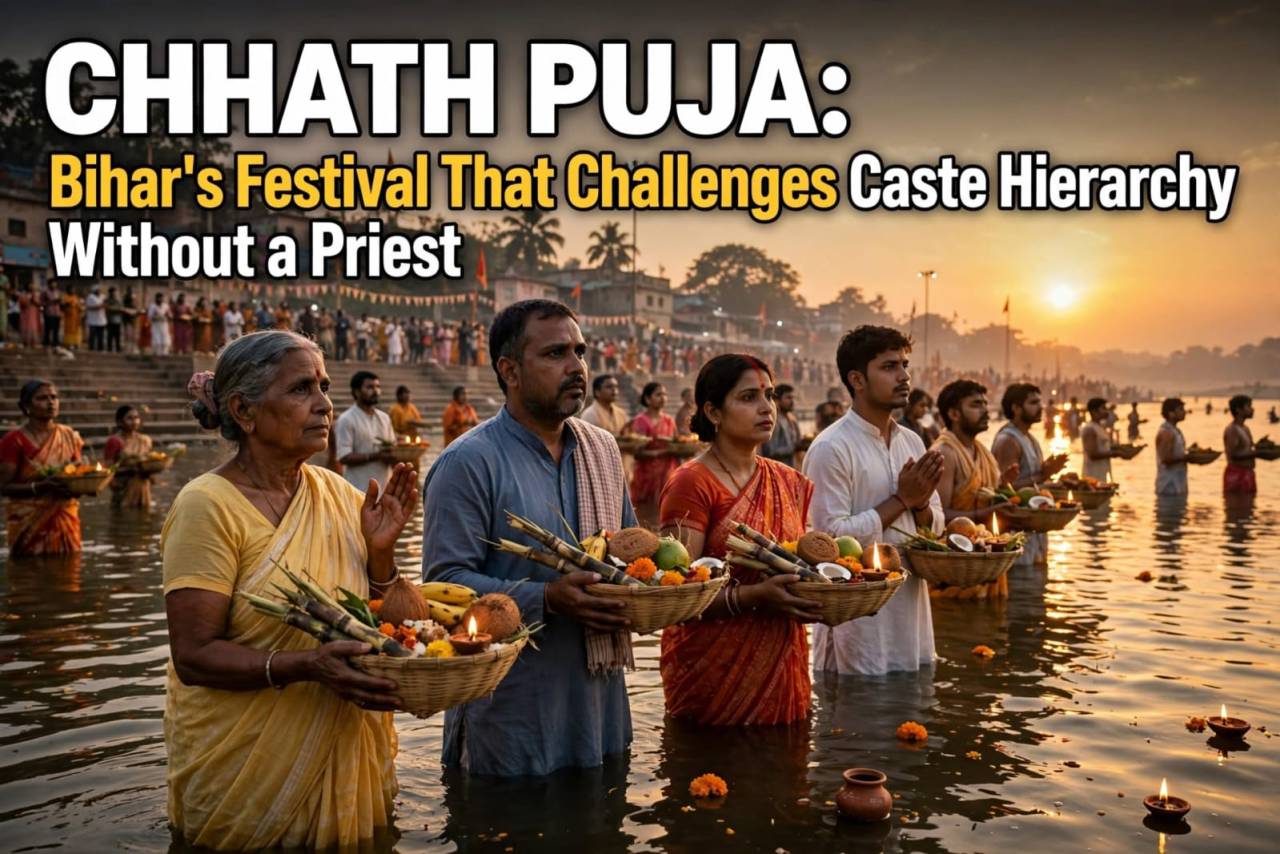
Can a festival without priests, temples or expensive rituals challenge the caste hierarchy of Bihar? Chhath Puja offers a fascinating answer.
There is a striking contradiction at the heart of Bihar's social and religious life. The state has long been associated with rigid caste hierarchies, social discrimination and deeply entrenched community divisions. Yet, every year, millions of people across Bihar come together for a festival whose central ritual appears to bypass many of the institutions that traditionally reinforce religious and social hierarchies. That festival is Chhath Puja.
Unlike many major Hindu festivals, Chhath does not depend on an elaborate temple ceremony, a Brahmin priest, Sanskrit mantras or an expensive religious arrangement. There is no elaborate idol to be installed, no priest required to mediate between the devotee and the divine, and no elaborate exchange of gifts to establish social prestige. The devotee stands in water, raises a bamboo basket of offerings and faces the Sun.
Perhaps this simplicity explains why Chhath has become more than a religious festival for Bihar. It represents a distinctive relationship between faith, nature and ordinary people.
A God Everyone Can See
The most remarkable feature of Chhath is its directness. The Sun is visible to everyone, irrespective of caste, class, wealth or religious position. Its light does not distinguish between a landlord and a landless labourer, an upper-caste household and a Dalit settlement, or a wealthy family and a migrant worker returning home.
The devotee does not need to enter a particular temple, obtain permission from a religious authority or learn complicated rituals. The essential act of worship is performed directly before nature.
The absence of a mandatory priestly intermediary is particularly significant in a society where religious authority has historically been associated with caste privilege. In Chhath, the person observing the fast becomes the principal performer of the ritual. Faith is not delegated to a professional religious intermediary.
This does not mean that Hindu traditions have no scriptural references to Sun worship. The Rig Veda contains hymns dedicated to Surya, while later religious narratives connect Chhath with figures such as Karna, Draupadi and Sita. However, the popular observance of Chhath is sustained primarily through family traditions, oral transmission, folk songs and community practices rather than compulsory scriptural recitation.
It is this accessibility that gives the festival its distinctive character.
A Festival Rooted in Nature, Not Religious Infrastructure
Chhath is fundamentally a celebration of nature. The Sun provides energy, sustains agriculture and makes life possible. Water, earth, fruits and seasonal produce are equally central to the observance.
The four-day ritual begins with Nahay-Khay, followed by Kharna. On the third day, devotees offer Sandhya Arghya to the setting Sun, and the following morning they welcome the rising Sun with Usha Arghya.
The worship of both the setting and rising Sun carries a deeper meaning. Chhath recognises not only beginnings but also endings. It acknowledges that decline and renewal are parts of the same natural cycle.
The offerings are equally revealing. Thekua, bananas, coconuts, sugarcane, seasonal fruits and other locally available produce form the traditional prasad. Bamboo baskets and earthen lamps replace expensive ceremonial arrangements.
There is no requirement to demonstrate devotion through wealth. The value of the offering lies in its purity and the discipline behind it, not its market price.
Unlike festivals where consumer spending, jewellery, clothing and expensive gifts sometimes become markers of social status, Chhath retains a largely restrained material culture. Its central offering is food from the earth, shared as prasad among family members, neighbours and visitors.
Women at the Centre of Religious Authority
Another important aspect of Chhath is the position of women.
Although men also observe the festival, women have traditionally been its principal custodians. The parvaitin, the woman observing the fast, assumes responsibility for the entire ritual. She maintains the discipline, prepares the offerings, directs household preparations and leads the prayers.
For four days, her religious authority is recognised within the family and community. She does not require a priest to validate her devotion.
This is an important departure from religious practices in which women have often occupied a secondary position in formal ritual structures. Chhath gives women a central role in preserving and transmitting religious knowledge.
The traditional songs, passed from mothers and grandmothers to younger generations, further strengthen this cultural continuity.
Does Chhath Really Erase Caste?
It would be tempting to describe Chhath as a completely caste-free festival. But that would be an exaggeration.
Caste discrimination does not disappear simply because people gather to worship the same Sun. Reports from rural Bihar and even parts of urban Patna have documented separate spaces at some ghats, caste-based divisions and unequal access to common water bodies.
An Indian Express investigation in 2022 documented instances in which Dalit devotees used separate sections of ponds, while influential and wealthier families controlled access to prominent ghats.
Such realities expose the distance between Chhath's spiritual promise and Bihar's social experience.
Yet, the festival also creates opportunities to challenge these divisions. Dalit artisans traditionally manufacture bamboo soops and baskets that become essential offerings in households across caste groups. Their craftsmanship occupies a central place in the ritual economy, even when the artisans themselves face social discrimination outside the festival.
This contradiction deserves attention. Chhath does not automatically abolish caste, but its ritual structure offers an alternative to caste-based religious authority. It creates a shared spiritual language that can challenge social exclusion.
Why Chhath Remains Special to Bihar
Chhath's popularity also comes from its emotional connection with Bihar's cultural identity. For millions of migrants living in Delhi, Mumbai, Kolkata and other cities, the festival becomes an annual connection with their villages, families, language and childhood memories.
Its folk songs, preparations, fasting traditions and gatherings at water bodies create a sense of belonging that geographical distance cannot easily weaken.
The festival also requires collective participation. Neighbours help prepare ghats, families arrange offerings, and communities organise access to water bodies. Its social character is built through participation rather than spectacle.
The Larger Message of Chhath
Perhaps Chhath's greatest significance lies in what it does not demand. It does not demand wealth to demonstrate devotion, a priest to communicate with God, or an expensive temple to establish a sacred space.
It asks for discipline, patience, cleanliness, faith and respect for nature.
Its message is especially relevant in a society where caste, money and religious authority continue to influence social relationships. The Sun does not recognise these distinctions. Whether that equality is fully practised on the riverbank remains a challenge for society itself.
Chhath may not have eliminated Bihar's caste hierarchy, but it preserves an idea that is worth defending: the relationship between an individual and the divine need not depend on social status or religious intermediaries.
Perhaps that is why Chhath is so deeply rooted in Bihar. It brings religion closer to ordinary people and reminds them that nature is the most accessible sacred space, faith does not need to be expensive, and the Sun belongs to everyone.




















Leave a Comment