
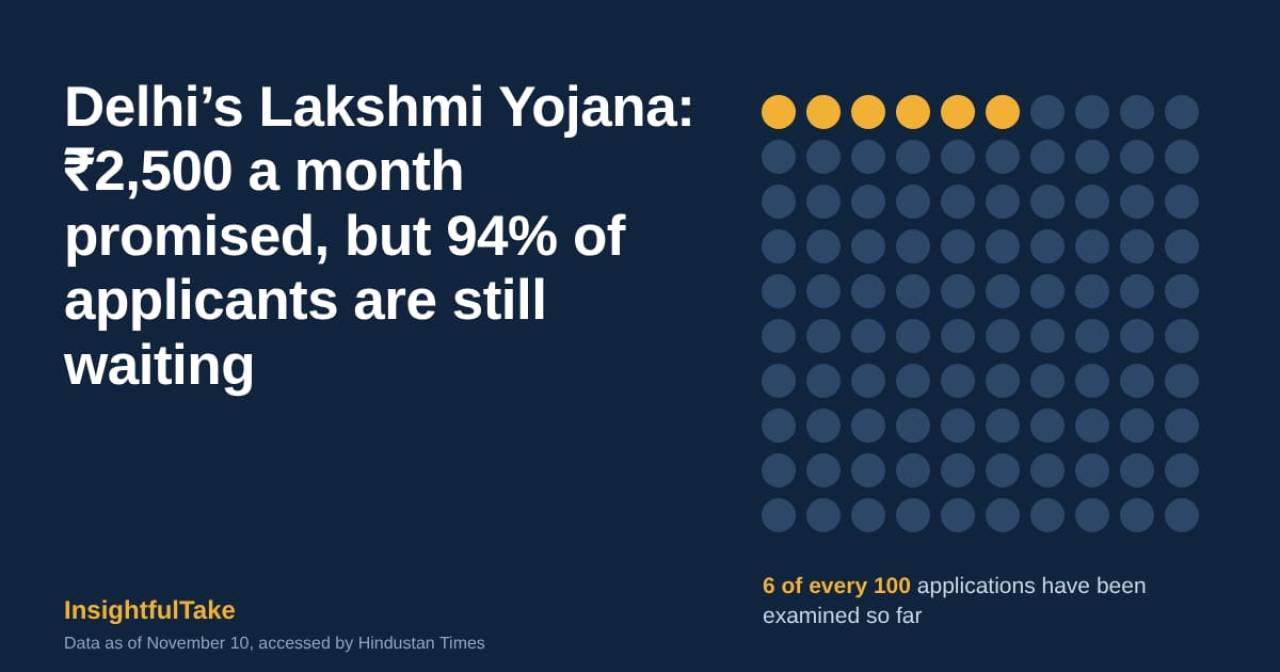
Delhi promised women ₹2,500 every month under Lakshmi Yojana. Nearly three months later, 94% of applicants are still waiting for their applications to be processed.
Nearly three months after the Delhi government launched the Lakshmi Yojana, its flagship cash assistance scheme for women, the vast majority of applicants are still waiting for their applications to be processed.
According to data accessed by Hindustan Times, the government has received 751,961 applications. As of November 10, around 704,000 applications, or nearly 94 per cent of the total, had not cleared even the first stage of scrutiny. Only 39,274 applications had been approved.
The scheme promises ₹2,500 a month to the eldest woman in a family with an annual income below ₹2.5 lakh. For households living within this income limit, the amount can make a meaningful difference. It could help pay for a cooking gas cylinder, a child's school fees or part of the monthly rent.
That is why the growing backlog matters more than the number of applications received. The real measure of the scheme will be how quickly eligible women start receiving the promised assistance.
The Missing Link
The main bottleneck is an administrative mechanism that is yet to become operational.
The first stage of verification was supposed to be handled by project management units (PMUs). These units would examine applications before forwarding them to officials for further scrutiny and approval. However, the PMUs have not yet been established.
Officials familiar with the matter told Hindustan Times that around 704,000 applications are currently awaiting this initial verification.
The government's explanation centres on a procurement problem. It says a tender to hire an agency to operate the PMUs was floated well in advance, but only one bidder submitted an offer. The finance department subsequently advised the government to invite fresh bids.
This means the tendering process must begin again while thousands of applications remain pending.
A single bid can create complications in public procurement because it leaves the government without a competitive comparison of prices and services. Retendering may therefore be justified. However, the situation also raises questions about the planning behind the scheme.
A welfare programme announced with considerable public attention, with applications opened and monthly financial assistance promised, should have had a clear administrative arrangement in place before the application process began. The absence of an operational verification system has now left applicants waiting.
Waiting for a Phone That Does Not Ring
For women who have applied, the delay is not an administrative statistic. It is an unanswered question about when the promised money will arrive.
A 40-year-old woman from Sangam Vihar, who works as a cook in Greater Kailash, told Hindustan Times that she had visited a neighbourhood cyber cafe to complete her application.
"I have not heard anything since," she said, adding that she had received no message on her phone.
She had planned to send the money to her mother in Bengal.
Her experience highlights another concern. Many applicants do not have easy access to digital services and depend on neighbourhood cyber cafes for completing online applications. Once the forms are submitted, they rely on SMS alerts or phone calls to receive updates.
When neither communication nor application tracking is available, an administrative delay becomes a source of uncertainty for households that may be counting on the assistance.
The government needs to ensure that applicants are not left guessing about the status of their applications.
What the Numbers Do and Do Not Say
The approval of 39,274 applications suggests that the scheme is not entirely stalled. Some applications have moved through the system, although the available report does not explain how they were processed when the proposed scrutiny units are yet to be established.
The government should clarify whether an alternative verification mechanism is already operating for these applications. If so, applicants deserve to know why that process cannot be extended to others or what prevents it from handling the backlog.
There is also an important distinction between pending applications and eligible beneficiaries.
Not every applicant will necessarily qualify. The annual income ceiling, family composition and the condition limiting assistance to one woman per household will determine the final beneficiary list.
Until the verification process is completed, it is difficult to establish how many applicants will ultimately receive the benefit or how much the scheme will cost the government every month.
However, these eligibility checks cannot justify leaving applications unattended for months. The government must first establish a functioning system to determine who qualifies.
What Needs to Happen Now
The immediate priority should be to complete the tendering process without further delay. The government needs to announce a clear deadline for awarding the contract and specify when the project management units will begin functioning.
It should also publish a realistic timeline for clearing the pending applications. Applicants need to know how long verification is likely to take and when they can expect a decision.
There are practical steps that could reduce the uncertainty in the meantime.
Every applicant should receive an acknowledgment confirming successful submission. A simple SMS-based facility or helpline could allow women to check whether their applications are pending, under scrutiny, approved or rejected.
The government could also examine whether existing district-level staff can handle part of the initial verification until the PMUs become operational. Such interim arrangements would help prevent the backlog from growing further.
Welfare schemes are ultimately judged by the assistance that reaches people, not by announcements or application figures.
The Lakshmi Yojana has been announced, applications have been collected and ₹2,500 a month has been promised. The real test is whether the government can turn that promise into timely financial support.





















Leave a Comment