
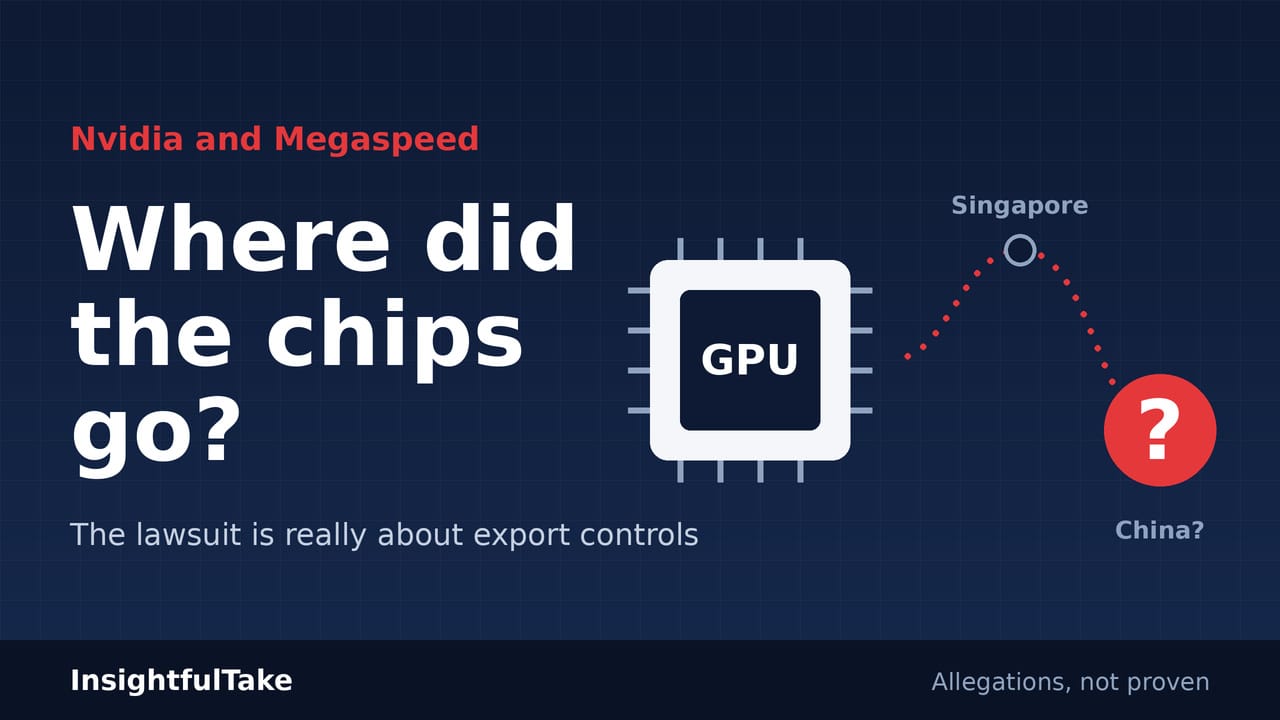
A shareholder lawsuit, a Singapore technology firm and allegations of restricted AI chip access put Nvidia's corporate disclosures and global semiconductor security under scrutiny.
A billionaire technology chief acknowledges an extramarital affair. A former executive of a Singapore-based technology company faces allegations of links to Chinese intelligence. US authorities are examining possible violations of chip export restrictions, and Nvidia's shareholders have now taken the company and its chief executive to court.
The affair has dominated the headlines, but the bigger concern is whether Nvidia chips reached Chinese buyers through overseas companies and whether the company was honest with its investors about the risks.
That is what makes the Nvidia–Megaspeed controversy bigger than a corporate scandal. It brings together national security, semiconductor trade, investor protection and the growing difficulty of controlling access to the hardware powering the AI revolution.
What Has Happened So Far?
On November 9, 2026, retail investor Mark Kistenmacher filed a proposed shareholder class-action lawsuit against Nvidia and its chief executive, Jensen Huang, in the US District Court for the Northern District of California.
The complaint accuses the company and Huang of misleading investors through public statements about his reported relationship with Alice Huang, a former executive associated with Singapore-based Megaspeed. The two are not related.
The proposed class covers investors who purchased Nvidia securities between October 9, 2025, when The New York Times first reported that the two had socialised in Taiwan, and November 8, 2026, when Nvidia announced that it was investigating reports that Huang had been targeted by a foreign intelligence operation.
Huang has acknowledged being unfaithful to his wife and apologised to his family and employees. He has also said he will cooperate with the investigation. US President Donald Trump has confirmed that the FBI is looking into the matter, although he has indicated that Huang told him he was unaware of any possible espionage connection.
Nvidia's independent directors have appointed the law firm Wachtell, Lipton, Rosen & Katz to conduct an independent investigation.
The financial reaction has been substantial. Nvidia shares fell 4.3% on November 9, wiping approximately $190 billion off the company's market value. The stock declined further the following day.
However, a crucial distinction must be maintained: the lawsuit contains allegations, not established findings. Neither the espionage claims nor the accusations of corporate misconduct have been proven in court.
Why Megaspeed Matters More Than the Personal Controversy
At the centre of the controversy is Megaspeed, a Singapore-based technology and data-hosting company that has been linked to Nvidia's supply chain.
The company reportedly purchased more than $4.8 billion worth of Nvidia chips over two years, according to reporting by The New York Times cited by the Associated Press. It has also been described as an Nvidia Cloud Partner in the Asia-Pacific region.
The scale of its reported purchases has attracted attention because of Washington's restrictions on the export of advanced AI chips to China.
US authorities have been examining whether Megaspeed helped circumvent these restrictions by facilitating access to Nvidia hardware for Chinese customers. The concern is not simply about where a chip is shipped. It is also about who ultimately uses its computing power.
The company's corporate structure has added another layer of scrutiny. Reports have raised questions about its ownership, associated companies and management connections.
None of these details, taken individually, establishes illegal activity. But in a sector where advanced computing hardware has become a strategic national security asset, the identity of buyers, intermediaries and end users matters enormously.
The distinction between a legitimate international technology business and a potential channel for restricted access is precisely what investigators must establish.
The Real Legal Question: Did Nvidia Mislead Its Investors?
The shareholder lawsuit introduces a different dimension to the controversy.
It is not a criminal prosecution over espionage, nor does the filing establish that Nvidia knowingly facilitated the transfer of restricted chips to China.
Instead, the central issue is whether the company and its chief executive made statements that gave investors an incomplete or misleading picture of risks surrounding Megaspeed and Huang's reported relationship with its former executive.
The complaint argues that Nvidia's public assurances about its dealings with Megaspeed were misleading because they did not disclose information that could have affected investors' assessment of the company's exposure.
In securities litigation, the question of materiality is important. In simple terms, it asks whether information was significant enough that a reasonable investor would consider it relevant when making an investment decision.
The court will have to examine the statements in question, the information available to the defendants at the time, and whether any omissions or representations violated securities laws.
This is a more complicated question than whether Huang's personal relationship was appropriate.
A chief executive's private life does not automatically become a matter for public disclosure. However, if a personal relationship creates a material business, compliance or national security risk, the company may face questions about whether its public statements adequately reflected that risk.
That distinction will be central to the lawsuit.
The Export-Control Loophole: Chips Can Cross Borders Without Crossing Them Again
The Megaspeed controversy highlights a challenge that governments are increasingly confronting: controlling access to advanced computing power is more complicated than controlling the physical movement of semiconductor hardware.
The United States has imposed restrictions on the export of its most advanced AI chips to China, citing national security concerns. Nvidia's high-performance processors are particularly important because they power the data centres used to train and operate advanced AI systems.
But what happens when restricted computing power is accessed remotely?
A company outside China can potentially purchase servers and GPUs, install them in data centres and provide computing services to customers in other countries. The hardware may never physically enter Chinese territory, even if customers based there can access its processing capacity.
This creates a difficult enforcement problem.
Export controls traditionally focus on the movement of goods, the identity of buyers and the destination of shipments. Cloud computing introduces another dimension: the location and identity of the ultimate user.
If an overseas intermediary provides access to restricted computing capacity, regulators must determine whether the arrangement violates applicable export-control rules.
This is why the Megaspeed investigation has implications beyond one company. It could influence how Washington monitors international data centres, cloud providers, resellers and other intermediaries.
Singapore's Position Adds an Important Qualification
The allegations have also drawn attention in Singapore, where Megaspeed operates.
On October 31, Singapore's Ministry of Home Affairs issued a clarification following media reports about Alice Huang. The government specifically stated that neither Singapore nor its officials had said that Alice Huang was suspected of being a Chinese intelligence asset. It also said that no investigation had been conducted against her on those grounds.
However, Singapore confirmed that investigations into Megaspeed were ongoing.
The distinction is important. The allegations concerning Alice Huang's suspected intelligence links should not be treated as established facts or attributed to the Singapore government.
Singapore also reiterated that although it does not enforce unilateral export controls imposed by foreign governments, it does not condone businesses using the country to circumvent other nations' export restrictions.
The statement reflects a broader concern for Singapore: maintaining its position as a trusted international business and financial centre while preventing companies from using its commercial infrastructure for unlawful activities.
Why India Should Pay Attention
For India, the Nvidia–Megaspeed controversy is not merely another Silicon Valley corporate story.
The country's artificial intelligence ambitions depend significantly on access to advanced computing infrastructure. Startups, research institutions, technology companies and government-backed AI initiatives all need powerful processors to develop and deploy increasingly sophisticated applications.
Nvidia is a major supplier in this ecosystem.
Any tightening of US export-control rules, greater scrutiny of international distributors or restrictions on cloud-based access to advanced GPUs could have consequences for the availability and cost of computing resources.
Indian companies that depend on overseas cloud infrastructure and imported AI hardware may also face more demanding compliance requirements.
There is another important lesson for India's emerging AI ecosystem. Access to computing power is becoming a strategic question, not simply a procurement decision. Transparency in supply chains, the credibility of technology partners and clarity about the ultimate users of computing infrastructure will matter increasingly.
India's ability to build a competitive AI industry will depend not only on attracting investment and developing talent but also on securing reliable access to the infrastructure that supports innovation.
What Happens Next?
Several developments will determine the direction of the controversy:
- The investigations: Findings from the FBI and US authorities examining possible espionage and export-control violations will be important in establishing what actually happened.
- Nvidia's board inquiry: The independent investigation will examine the circumstances surrounding Huang's reported relationship and any potential implications for the company.
- The shareholder lawsuit: The court will have to consider whether Nvidia's public statements and disclosures were materially misleading under US securities law.
- Export-control enforcement: Washington may face pressure to examine whether existing restrictions adequately address remote access to advanced computing hardware through overseas data centres.
- Corporate accountability: The case could prompt technology companies to review how they assess customers, intermediaries and potential conflicts of interest involving senior executives.
The Bigger Story Is About Control, Transparency and Trust
The Nvidia–Megaspeed controversy exposes a difficult reality of the artificial intelligence race. The world's most powerful chips are no longer ordinary commercial products. They are strategic assets, and controlling their distribution has become a matter of national security.
The personal controversy surrounding Jensen Huang may have brought the story into the public spotlight, but the lasting consequences will depend on evidence, corporate disclosures and the outcome of regulatory investigations.
For Nvidia, the immediate challenge is to demonstrate that its compliance systems are robust and that its public statements accurately reflected the risks it faced.
For investors, the question is whether they received the information necessary to assess those risks.
And for governments, the larger challenge is how to prevent restricted AI computing power from reaching prohibited users through an increasingly interconnected global technology industry.
The affair may dominate the headlines today. But the future of this controversy will be decided by what investigators uncover about the chips, the transactions and the trail of accountability behind them.

























Leave a Comment