
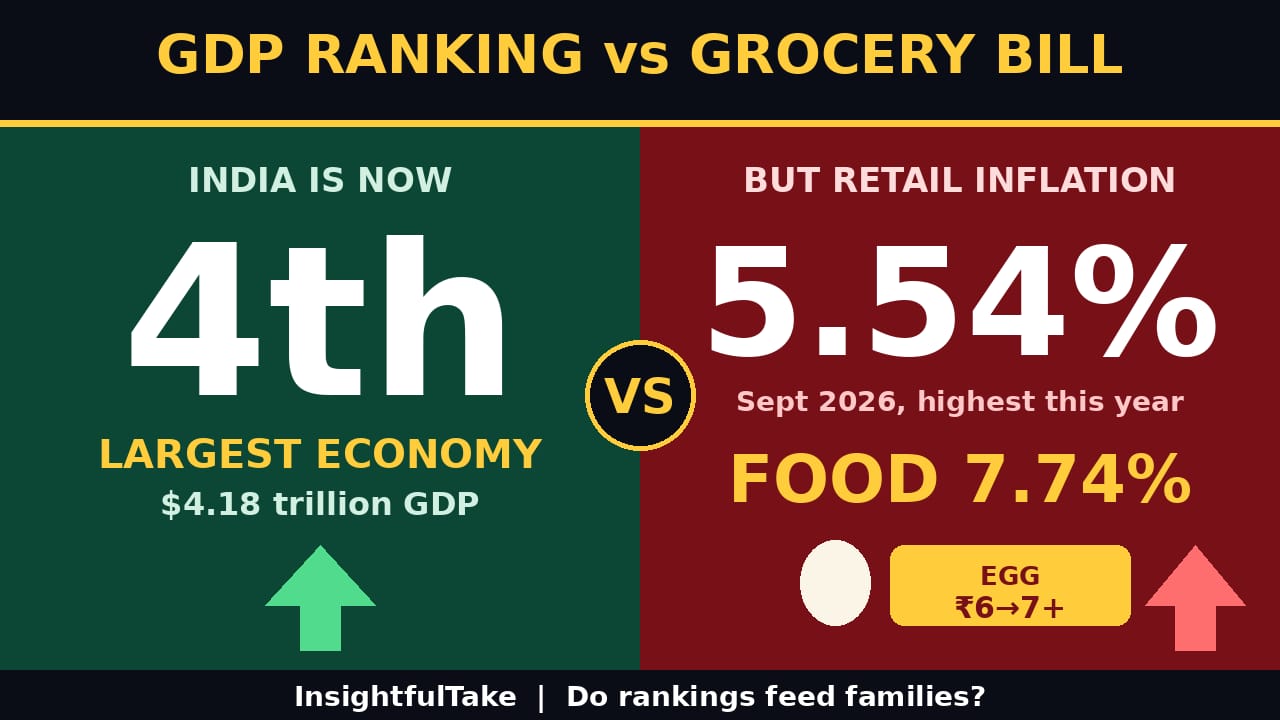
A $4-trillion economy may make global headlines, but rising food prices are putting household budgets under pressure.
India's economic growth has become a major talking point. The country has been projected to join the world's largest economies, its GDP growth figures remain strong, and government statements frequently highlight its rising global economic standing.
But there is another side to this story. For millions of Indian households, economic performance is measured less by international rankings and more by the monthly grocery bill.
Vegetables, cooking essentials, milk, eggs and chicken account for a significant share of everyday household spending. When their prices rise, families have to adjust their budgets, reduce consumption or postpone other expenses. The latest inflation figures suggest that this pressure is becoming increasingly difficult to ignore.
Retail Inflation Rises to 5.54%, Food Inflation at 7.74%
According to the Ministry of Statistics and Programme Implementation (MoSPI), India's retail inflation increased to 5.54% in September 2026, compared with 4.83% in August. Food inflation rose more sharply, reaching 7.74% against 5.97% in the previous month.
The September figure is the highest retail inflation reading recorded so far in 2026 under the current Consumer Price Index series.
The difference between headline and food inflation is particularly important. While overall retail inflation remains within the Reserve Bank of India's permissible range of 2% to 6%, food inflation is considerably higher.
The pressure is also more pronounced in rural India. September's rural retail inflation stood at 6.08%, compared with 4.88% in urban areas. Rural food inflation reached 8.06%, while urban food inflation was 7.18%.
These figures matter because food occupies a substantial share of household expenditure, particularly among lower-income families. A rise in food prices leaves them with less money for education, healthcare, transport and other essential expenses.
The Reserve Bank of India has also flagged the broader spread of price pressures. Its assessment showed that around 37% of the Consumer Price Index basket recorded inflation above 4% in August 2026, compared with 23% in April.
This suggests that inflation is no longer limited to a handful of food items. Price pressures are spreading across a wider range of goods and services.
Why Chicken and Eggs Could Become More Expensive
The poultry industry offers a clear example of how rising agricultural input costs eventually affect consumers.
A recent report by The Economic Times highlighted the sharp increase in the prices of maize and broken rice, two important ingredients used in poultry feed.
Maize, which cost approximately ₹18 per kg a year ago, has climbed to around ₹34 per kg. Broken rice has also increased from ₹14-15 to ₹31-32 per kg over the same period.
Industry representatives fear that maize prices could reach ₹40 per kg by December if supply constraints and stockpiling continue.
The problem is linked partly to weaker monsoon conditions in important maize-producing states, particularly Maharashtra and Karnataka. Industry estimates suggest that the country's kharif maize production could decline by 15-16%.
Rising demand for maize from the ethanol industry has added another source of pressure on availability.
For poultry farmers, these increases translate directly into higher production costs. Feed accounts for a substantial portion of the cost of raising chickens, and producers cannot absorb unlimited increases without affecting their operations.
Industry executives expect wholesale egg prices to rise from around ₹6-7 to ₹7-8 per egg by December. Wholesale prices of dressed chicken could increase from ₹225-250 per kg to ₹260-275.
Some farmers may also sell younger birds earlier than usual to reduce feeding expenses. Industry estimates suggest that poultry production could decline by more than 20% during December and January.
If that happens alongside strong seasonal demand, consumers could face another round of price increases.
The consequences extend beyond poultry farmers. Eggs and chicken are important sources of affordable protein for many Indian families. When their prices rise, households with limited budgets may reduce their consumption.
The Fourth-Largest Economy Claim Needs Context
India's rise in the global economic rankings is an important achievement, but the claim requires some context.
In May 2025, NITI Aayog CEO BVR Subrahmanyam announced that India had overtaken Japan to become the world's fourth-largest economy, citing International Monetary Fund projections that placed India's GDP at approximately $4.187 trillion.
However, economic rankings based on nominal GDP and dollar valuations can change with exchange rates, revised estimates and updated projections.
The IMF's April 2026 World Economic Outlook subsequently placed India sixth in its projected global GDP ranking for 2026, behind the United States, China, Germany, Japan and the United Kingdom.
This distinction is important. Economic rankings are not permanent positions, and a country's global GDP standing does not automatically translate into higher purchasing power for its citizens.
GDP measures the total value of goods and services produced within an economy. It does not tell us how much an average household earns, how income is distributed or how comfortably people can afford essential goods.
A daily-wage worker in Patna, a small business owner in Darbhanga or a salaried employee in Delhi experiences economic conditions through income, employment opportunities and household expenses.
For them, the difference between a manageable monthly budget and a financial struggle may depend on the price of cooking oil, vegetables, milk and electricity rather than the country's position in a global ranking.
What Is the Government Doing About Food Inflation?
The reasons behind rising food prices are not entirely within the government's control. Weather conditions, crop yields, international commodity prices, energy costs and supply-chain disruptions can all influence domestic inflation.
However, these factors do not remove the responsibility of policymakers to respond to emerging price pressures.
The increase in maize and broken rice prices raises questions about agricultural supply management, market monitoring and the availability of essential inputs for the poultry industry.
If production estimates indicate a possible shortage, authorities need to assess whether existing procurement, storage and distribution arrangements are sufficient to prevent excessive price fluctuations.
Monitoring speculative stockpiling and improving the movement of agricultural commodities can also help reduce supply disruptions.
The challenge is to distinguish between a genuine shortage and price increases driven by supply-chain inefficiencies or excessive stocking. Policy responses must address the actual cause rather than rely on temporary interventions.
The RBI's inflation target also needs to be understood correctly. Its 2-6% tolerance band is not a declaration that prices are affordable. It is a framework for maintaining overall price stability. Even inflation within that range can create serious difficulties for households when essential food items become significantly more expensive.
Strong GDP Growth and Household Inflation Can Coexist
There is another side to the economic picture. India's real GDP grew by 8.2% in the July-September quarter of 2025, according to official estimates released by MoSPI in November 2025. Economic growth has also remained resilient in subsequent quarters.
Supporters of the government's economic record point to strong growth, infrastructure investment, manufacturing activity and expanding services as evidence of the country's economic progress.
These are relevant indicators and should not be dismissed. Equally, rising food prices cannot be overlooked simply because GDP growth remains strong.
Both developments can exist at the same time. An economy can expand rapidly while particular sections of its population struggle with the cost of living.
The real test of economic progress is therefore not limited to the size of the national economy. It also involves the quality of employment, real income growth, purchasing power and access to essential goods.
The Next Inflation Numbers Will Matter
MoSPI is scheduled to release India's October 2026 Consumer Price Index data on November 12. The figures will offer a clearer indication of whether the latest rise in inflation is easing or becoming more persistent.
The coming months will also test how effectively policymakers respond to agricultural supply concerns and rising input costs in sectors such as poultry.
India's economic ambitions deserve attention, but so does the financial reality of its households. A country can celebrate its global economic position while acknowledging that millions of families are struggling to manage everyday expenses.
Economic success should ultimately be reflected in people's ability to afford a decent standard of living.
The question is not whether India is growing. It is whether the benefits of that growth are reaching households at a time when the cost of everyday essentials is rising.





















Leave a Comment