
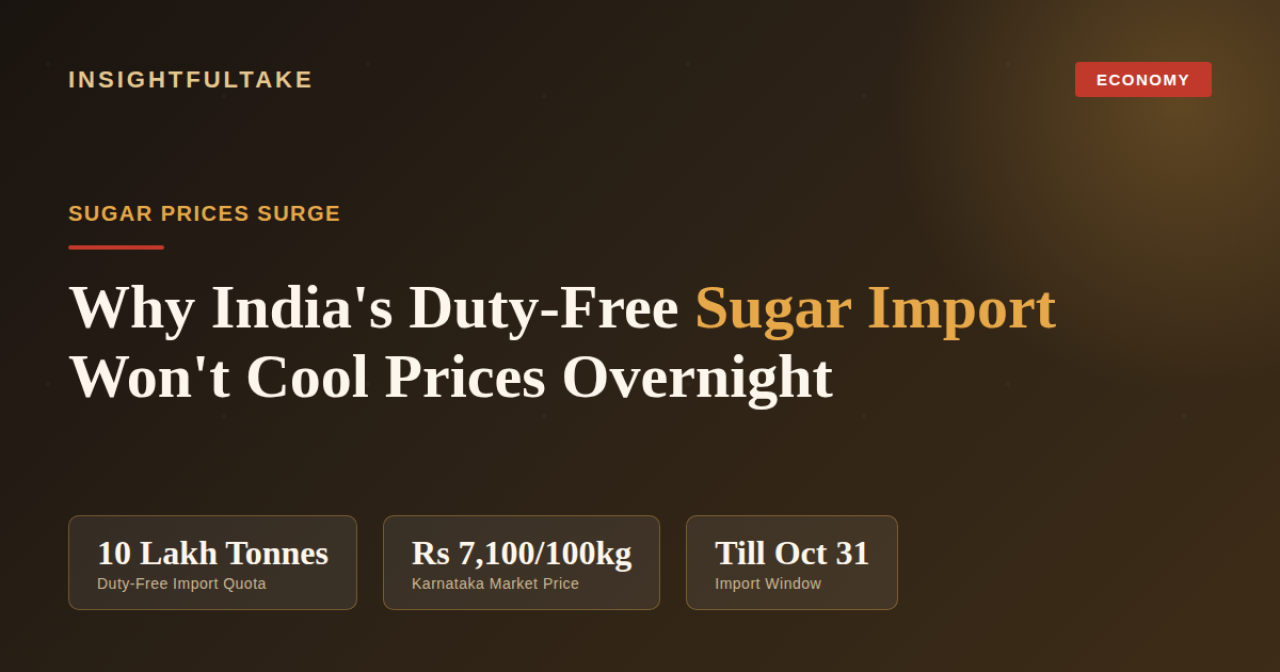
Duty-Free Sugar Imports May Boost Supply, But Indian Consumers Won't See Cheaper Sugar Overnight.
India has opened its doors to duty-free raw sugar imports for the first time in nearly a decade, as the government scrambles to control a price surge that has pushed rates in key markets to record highs.
The Directorate General of Foreign Trade has issued a notification allowing up to 10 lakh tonnes of raw sugar to enter the country without customs duty under a Tariff Rate Quota, valid until October 31. Normally, sugar imports attract a 100 per cent duty, making this waiver a significant policy shift.
Why the Government Moved Now
The timing is telling. India's sugar consumption climbs sharply between August and November, when Ganesh Chaturthi, Dussehra and Diwali drive demand from households, sweet shops and food manufacturers.
Prices in Karnataka, one of the country's major sugar markets, have already touched around Rs 7,100 per 100 kg, a level that has alarmed consumers and policymakers alike.
The last time India permitted raw sugar imports was during the 2016-17 season, underlining just how unusual the intervention is.
What makes the decision particularly notable is the change in the government's approach. Earlier this year, authorities relied primarily on measures aimed at pushing existing domestic stocks into the market rather than bringing in fresh supplies.
The government banned sugar exports from May until September 30, after allowing mills to export up to 2 million tonnes during the season. It also imposed a 4,000-quintal stock limit and a 30-day holding cap on dealers from August 1, alongside a monthly sales quota for mills.
None of these measures managed to arrest the price rise. The government has now turned to imports as a more direct way of increasing domestic availability.
Tighter Stocking Rules
Alongside the import order, authorities have tightened stocking rules further.
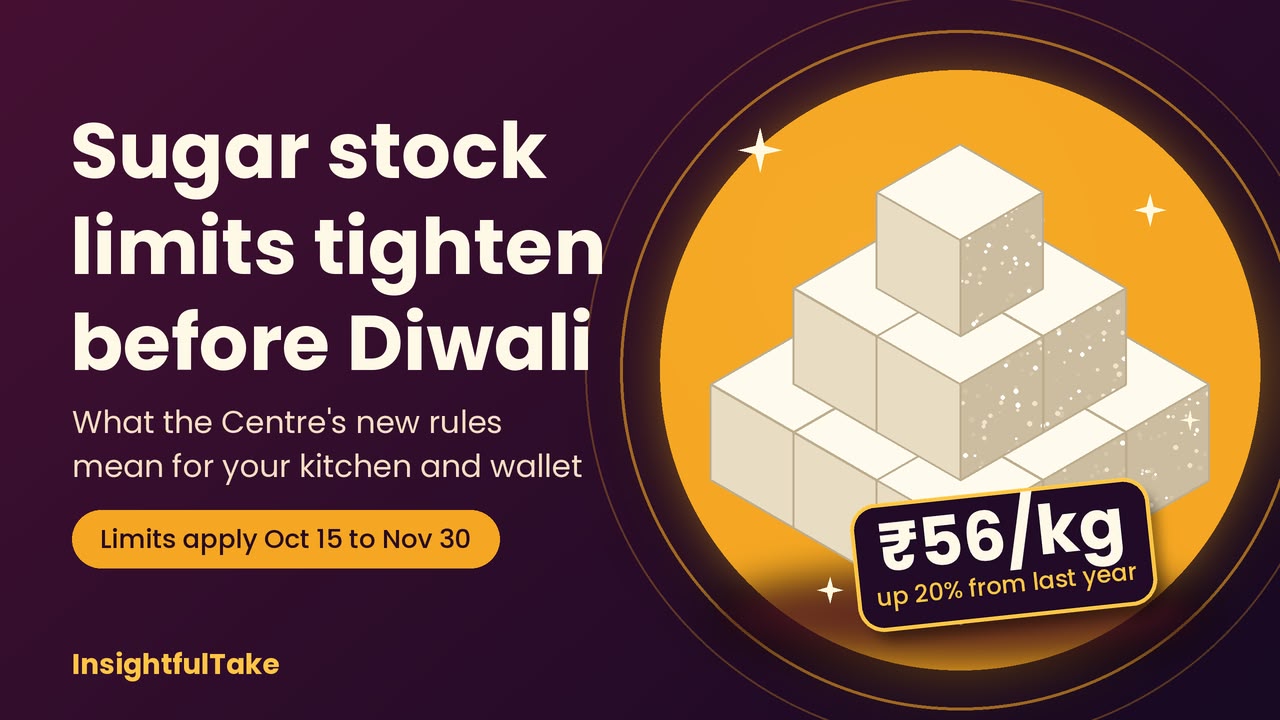
From September 1 until November 30, bulk consumers using more than 10 tonnes of sugar a month will be permitted to hold no more than 15 days' worth of their requirement.
The objective is to prevent hoarding and speculative stockpiling during the festive season, when demand typically rises sharply.
Why Cheaper Sugar Will Take Time to Reach Consumers
The biggest limitation is logistics.
Raw sugar cannot go directly to consumers. It must first be refined into white sugar before reaching the retail market.
According to industry estimates, several steps are involved. The import quota has to be allocated among willing mills, vessels and loading slots must be arranged overseas, and the sea voyage itself can take around a month.
Once the shipment reaches Indian ports, unloading a sizeable cargo can take several weeks, depending on port operations and weather conditions. The sugar must then move to mills for refining, where processing capacity limits how quickly the imported supply can enter the market.
In other words, the additional supply will trickle into the market rather than arrive as a sudden flood.
Industry estimates suggest that only a fraction of the total import quota may actually reach consumers before the import window closes.
Imports May Not Be Cheap Enough to Transform Retail Prices
Cost is another factor working against immediate relief.
Raw sugar sourced from producers such as Brazil is estimated to cost around Rs 45 per kg before refining. After refining charges in India, the cost could rise to roughly Rs 52 per kg.
That limits the scope for a dramatic fall in retail prices.
Yet the announcement could still have an important effect even before the physical sugar arrives. Trade bodies believe the move may help calm speculative buying and discourage further price increases.
In that sense, the policy is not only about adding supply. It is also about influencing market expectations.
How India Reached This Point
The broader supply picture explains the government's urgency.
India, the world's second-largest sugar producer, had initially projected comfortable supplies for the season. But the actual availability of sugar in the domestic market turned out to be tighter than expected.
Around 3 million tonnes of sugar were diverted towards ethanol production this year under India's biofuel blending programme.
Another 8 lakh tonnes were exported before the government halted outbound shipments in May as domestic availability tightened. This was despite an original export quota of 2 million tonnes for the season.
Together, these diversions reduced the amount of sugar available in the domestic pool and contributed to the supply pressure now reflected in prices.
A Signal of Intent, Not Instant Relief
For consumers, the duty-free import window is unlikely to translate into cheaper sugar on supermarket shelves within days.
The measure is better understood as a signal of intent. The government is attempting to increase future availability, discourage hoarding and prevent prices from climbing further as the festive season approaches.
Whether it succeeds will depend on three things: how quickly mills can operationalise the imports, how efficiently ports and logistics networks handle incoming shipments, and how global raw sugar prices behave in the weeks ahead.
India has opened its doors to duty-free raw sugar imports for the first time in nearly a decade, as the government scrambles to control a price surge that has pushed rates in key markets to record highs.
The Directorate General of Foreign Trade has issued a notification allowing up to 10 lakh tonnes of raw sugar to enter the country without customs duty under a Tariff Rate Quota, valid until October 31. Normally, sugar imports attract a 100 per cent duty, making this waiver a significant policy shift.
Why the Government Moved Now
The timing is telling. India's sugar consumption climbs sharply between August and November, when Ganesh Chaturthi, Dussehra and Diwali drive demand from households, sweet shops and food manufacturers.
Prices in Karnataka, one of the country's major sugar markets, have already touched around Rs 7,100 per 100 kg, a level that has alarmed consumers and policymakers alike.
The last time India permitted raw sugar imports was during the 2016-17 season, underlining just how unusual the intervention is.
What makes the decision particularly notable is the change in the government's approach. Earlier this year, authorities relied primarily on measures aimed at pushing existing domestic stocks into the market rather than bringing in fresh supplies.
The government banned sugar exports from May until September 30, after allowing mills to export up to 2 million tonnes during the season. It also imposed a 4,000-quintal stock limit and a 30-day holding cap on dealers from August 1, alongside a monthly sales quota for mills.
None of these measures managed to arrest the price rise. The government has now turned to imports as a more direct way of increasing domestic availability.
Tighter Stocking Rules
Alongside the import order, authorities have tightened stocking rules further.
From September 1 until November 30, bulk consumers using more than 10 tonnes of sugar a month will be permitted to hold no more than 15 days' worth of their requirement.
The objective is to prevent hoarding and speculative stockpiling during the festive season, when demand typically rises sharply.
Why Cheaper Sugar Will Take Time to Reach Consumers
The biggest limitation is logistics.
Raw sugar cannot go directly to consumers. It must first be refined into white sugar before reaching the retail market.
According to industry estimates, several steps are involved. The import quota has to be allocated among willing mills, vessels and loading slots must be arranged overseas, and the sea voyage itself can take around a month.
Once the shipment reaches Indian ports, unloading a sizeable cargo can take several weeks, depending on port operations and weather conditions. The sugar must then move to mills for refining, where processing capacity limits how quickly the imported supply can enter the market.
In other words, the additional supply will trickle into the market rather than arrive as a sudden flood.
Industry estimates suggest that only a fraction of the total import quota may actually reach consumers before the import window closes.
Imports May Not Be Cheap Enough to Transform Retail Prices
Cost is another factor working against immediate relief.
Raw sugar sourced from producers such as Brazil is estimated to cost around Rs 45 per kg before refining. After refining charges in India, the cost could rise to roughly Rs 52 per kg.
That limits the scope for a dramatic fall in retail prices.
Yet the announcement could still have an important effect even before the physical sugar arrives. Trade bodies believe the move may help calm speculative buying and discourage further price increases.
In that sense, the policy is not only about adding supply. It is also about influencing market expectations.
How India Reached This Point
The broader supply picture explains the government's urgency.
India, the world's second-largest sugar producer, had initially projected comfortable supplies for the season. But the actual availability of sugar in the domestic market turned out to be tighter than expected.
Around 3 million tonnes of sugar were diverted towards ethanol production this year under India's biofuel blending programme.
Another 8 lakh tonnes were exported before the government halted outbound shipments in May as domestic availability tightened. This was despite an original export quota of 2 million tonnes for the season.
Together, these diversions reduced the amount of sugar available in the domestic pool and contributed to the supply pressure now reflected in prices.
A Signal of Intent, Not Instant Relief
For consumers, the duty-free import window is unlikely to translate into cheaper sugar on supermarket shelves within days.
The measure is better understood as a signal of intent. The government is attempting to increase future availability, discourage hoarding and prevent prices from climbing further as the festive season approaches.
Whether it succeeds will depend on three things: how quickly mills can operationalise the imports, how efficiently ports and logistics networks handle incoming shipments, and how global raw sugar prices behave in the weeks ahead.






















Leave a Comment