
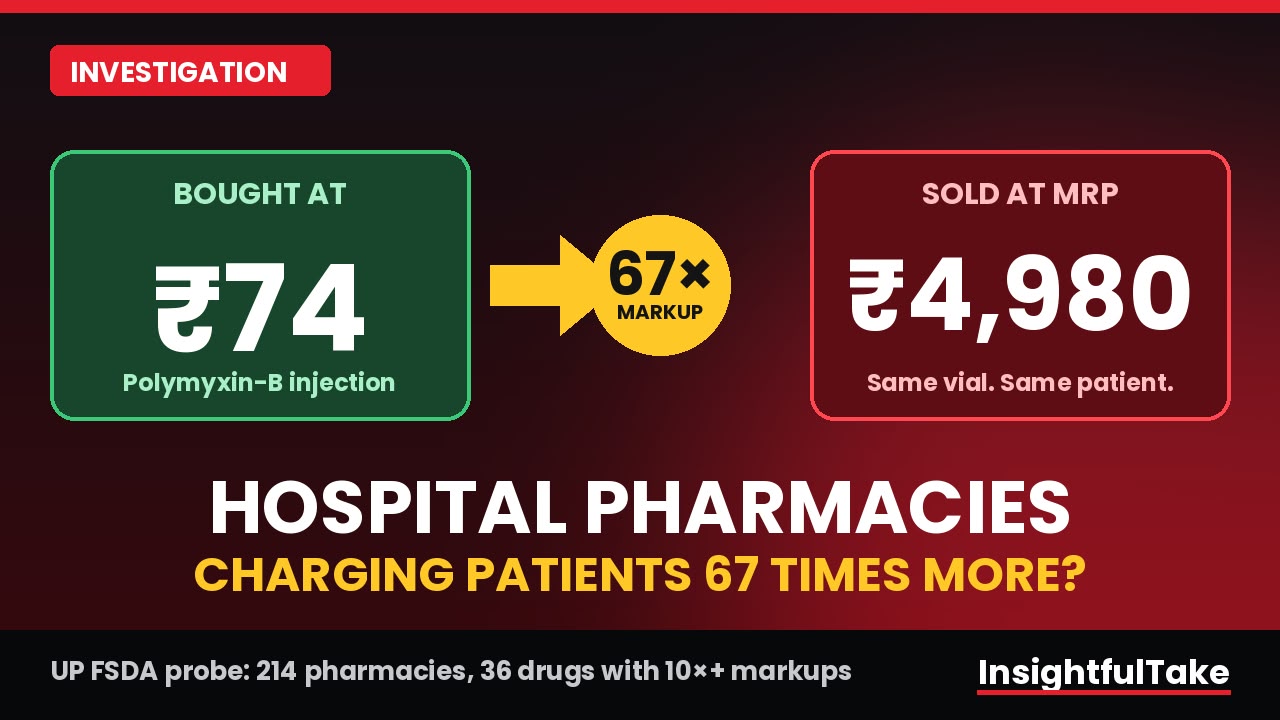
A ₹74 antibiotic injection carried an MRP of ₹4,980. A UP drug regulator’s probe has exposed startling price gaps inside hospital pharmacies.
A vial of polymyxin-B, an antibiotic used to treat serious bacterial infections, was purchased by a hospital pharmacy in Uttar Pradesh for ₹74.09. Patients were charged its printed MRP of ₹4,980.94, nearly 67 times the purchase price.
The figure is among the findings of a probe by Uttar Pradesh's Food Safety and Drug Administration (FSDA) into pharmacies attached to medical colleges and private hospitals. The findings were first reported by Amar Ujala.
What the Investigation Found
The FSDA examined records from 214 pharmacies attached to medical colleges and private hospitals and analysed purchase data for 130 medicines.
In 36 cases, the printed MRP was more than 10 times the price paid by the pharmacy. In some cases, the difference was substantially higher.
The pattern appeared across several categories of medicines.
- Caspofungin 70 mg, used to treat serious fungal infections, was purchased by one pharmacy for ₹800 while the MRP was ₹21,230, a difference of about 26.5 times. Another brand was purchased for ₹897.75 and carried an MRP of ₹19,892.
- A liver-disease injection was purchased for ₹56 and sold at an MRP of ₹3,050.
- Meropenem 1 gram, an antibiotic used for severe bacterial infections, showed MRPs roughly five to 10 times the purchase cost, depending on the brand.
- The report also found large differences in the prices of cancer medicines and other life-saving drugs.
The numbers point to a wider question about how much patients are paying for medicines inside hospital systems compared with what pharmacies actually pay to procure them.
It Is Not Just Medicines
The investigation found similar pricing gaps in medical consumables and devices.
A three-way stopcock, a small device commonly used in intravenous lines, was purchased for ₹6.40 but carried an MRP of ₹163, more than 25 times the purchase price.
Another medical device purchased for ₹20.95 had an MRP of ₹500, nearly 24 times the procurement cost.
The department's analysis points to the role of trade margins and discounts in creating such gaps. In some cases, manufacturers may set high printed MRPs that allow sellers to advertise discounts while still retaining substantial margins.
The issue, however, becomes more serious when the patient has no practical alternative.
The Monopoly Problem
Hospital pharmacies can create a different kind of pricing problem when certain medicines are available only through an in-house counter.
Some specialised medicines may not be readily available in nearby retail pharmacies, leaving patients and their families with little opportunity to compare prices. During an emergency, there may be even less scope to search for alternatives.
In such situations, the printed MRP can effectively become the price a patient has to pay.
For families already dealing with hospitalisation, surgery or a serious illness, the difference can add significantly to the final bill.
Why MRP Is Not Always an Effective Safeguard
The maximum retail price is meant to act as a ceiling. A seller cannot legally charge more than the printed MRP.
But an MRP itself does not necessarily tell a consumer what the medicine actually cost the seller.
When a medicine purchased for ₹74 carries an MRP of almost ₹5,000, the MRP remains legally enforceable as the maximum price even though the underlying procurement cost is dramatically lower.
India's drug pricing framework also does not impose the same level of price control on every medicine. The National Pharmaceutical Pricing Authority (NPPA) regulates prices of medicines covered under the National List of Essential Medicines and other applicable categories. Many branded and newer formulations outside those controls can have substantially greater pricing flexibility.
The Uttar Pradesh findings therefore revive a broader policy question: whether trade margins across the pharmaceutical supply chain should be rationalised so that the gap between procurement costs and retail prices does not become excessive.
What Patients Can Do
Patients and their families can take a few practical steps to reduce unnecessary spending where circumstances allow:
- Ask for the generic name of every prescribed medicine and check whether an equivalent is available elsewhere.
- Compare prices with outside pharmacies when the medicine is not urgently required and hospital rules allow it.
- Check Jan Aushadhi Kendras, which offer a range of generic medicines at lower prices.
- Ask for itemised bills and verify the quantity, MRP and amount charged for each medicine or consumable.
- Question unusually high charges and ask the hospital pharmacy to explain the price difference.
- Report suspected overcharging to the relevant state drug control authorities or appropriate regulatory complaint channels.
In an emergency, however, patients may have little practical ability to shop around. That is precisely why transparency inside hospital pharmacies matters.
Final Take
The FSDA investigation covers one state and a defined sample of hospital pharmacies. Its findings cannot, by themselves, establish that the same pricing gaps exist across India's entire healthcare system.
But the numbers raise an important question about how hospital pharmacies, manufacturers and distributors determine prices, particularly for medicines that patients urgently need and cannot easily source elsewhere.
The issue is not simply the difference between a purchase price and an MRP. It is about information and choice.
A patient who knows that a medicine costs ₹74 at procurement may question a ₹4,980 price. A patient who sees only the printed MRP may have no way of knowing whether that price reflects a reasonable margin or an inflated supply-chain structure.
Better disclosure of procurement and retail pricing, stronger scrutiny of hospital pharmacies, rational trade margins and accessible alternatives could help reduce that information gap.
When a ₹74 vial carries an MRP of nearly ₹5,000, the number demands scrutiny. For a patient already paying the price of illness, the cost of the medicine should not become another mystery.
A vial of polymyxin-B, an antibiotic used to treat serious bacterial infections, was purchased by a hospital pharmacy in Uttar Pradesh for ₹74.09. Patients were charged its printed MRP of ₹4,980.94, nearly 67 times the purchase price.
The figure is among the findings of a probe by Uttar Pradesh's Food Safety and Drug Administration (FSDA) into pharmacies attached to medical colleges and private hospitals. The findings were first reported by Amar Ujala.
What the Investigation Found
The FSDA examined records from 214 pharmacies attached to medical colleges and private hospitals and analysed purchase data for 130 medicines.
In 36 cases, the printed MRP was more than 10 times the price paid by the pharmacy. In some cases, the difference was substantially higher.
The pattern appeared across several categories of medicines.
- Caspofungin 70 mg, used to treat serious fungal infections, was purchased by one pharmacy for ₹800 while the MRP was ₹21,230, a difference of about 26.5 times. Another brand was purchased for ₹897.75 and carried an MRP of ₹19,892.
- A liver-disease injection was purchased for ₹56 and sold at an MRP of ₹3,050.
- Meropenem 1 gram, an antibiotic used for severe bacterial infections, showed MRPs roughly five to 10 times the purchase cost, depending on the brand.
- The report also found large differences in the prices of cancer medicines and other life-saving drugs.
The numbers point to a wider question about how much patients are paying for medicines inside hospital systems compared with what pharmacies actually pay to procure them.
It Is Not Just Medicines
The investigation found similar pricing gaps in medical consumables and devices.
A three-way stopcock, a small device commonly used in intravenous lines, was purchased for ₹6.40 but carried an MRP of ₹163, more than 25 times the purchase price.
Another medical device purchased for ₹20.95 had an MRP of ₹500, nearly 24 times the procurement cost.
The department's analysis points to the role of trade margins and discounts in creating such gaps. In some cases, manufacturers may set high printed MRPs that allow sellers to advertise discounts while still retaining substantial margins.
The issue, however, becomes more serious when the patient has no practical alternative.
The Monopoly Problem
Hospital pharmacies can create a different kind of pricing problem when certain medicines are available only through an in-house counter.
Some specialised medicines may not be readily available in nearby retail pharmacies, leaving patients and their families with little opportunity to compare prices. During an emergency, there may be even less scope to search for alternatives.
In such situations, the printed MRP can effectively become the price a patient has to pay.
For families already dealing with hospitalisation, surgery or a serious illness, the difference can add significantly to the final bill.
Why MRP Is Not Always an Effective Safeguard
The maximum retail price is meant to act as a ceiling. A seller cannot legally charge more than the printed MRP.
But an MRP itself does not necessarily tell a consumer what the medicine actually cost the seller.
When a medicine purchased for ₹74 carries an MRP of almost ₹5,000, the MRP remains legally enforceable as the maximum price even though the underlying procurement cost is dramatically lower.
India's drug pricing framework also does not impose the same level of price control on every medicine. The National Pharmaceutical Pricing Authority (NPPA) regulates prices of medicines covered under the National List of Essential Medicines and other applicable categories. Many branded and newer formulations outside those controls can have substantially greater pricing flexibility.
The Uttar Pradesh findings therefore revive a broader policy question: whether trade margins across the pharmaceutical supply chain should be rationalised so that the gap between procurement costs and retail prices does not become excessive.
What Patients Can Do
Patients and their families can take a few practical steps to reduce unnecessary spending where circumstances allow:
- Ask for the generic name of every prescribed medicine and check whether an equivalent is available elsewhere.
- Compare prices with outside pharmacies when the medicine is not urgently required and hospital rules allow it.
- Check Jan Aushadhi Kendras, which offer a range of generic medicines at lower prices.
- Ask for itemised bills and verify the quantity, MRP and amount charged for each medicine or consumable.
- Question unusually high charges and ask the hospital pharmacy to explain the price difference.
- Report suspected overcharging to the relevant state drug control authorities or appropriate regulatory complaint channels.
In an emergency, however, patients may have little practical ability to shop around. That is precisely why transparency inside hospital pharmacies matters.
Final Take
The FSDA investigation covers one state and a defined sample of hospital pharmacies. Its findings cannot, by themselves, establish that the same pricing gaps exist across India's entire healthcare system.
But the numbers raise an important question about how hospital pharmacies, manufacturers and distributors determine prices, particularly for medicines that patients urgently need and cannot easily source elsewhere.
The issue is not simply the difference between a purchase price and an MRP. It is about information and choice.
A patient who knows that a medicine costs ₹74 at procurement may question a ₹4,980 price. A patient who sees only the printed MRP may have no way of knowing whether that price reflects a reasonable margin or an inflated supply-chain structure.
Better disclosure of procurement and retail pricing, stronger scrutiny of hospital pharmacies, rational trade margins and accessible alternatives could help reduce that information gap.
When a ₹74 vial carries an MRP of nearly ₹5,000, the number demands scrutiny. For a patient already paying the price of illness, the cost of the medicine should not become another mystery.



























Leave a Comment