
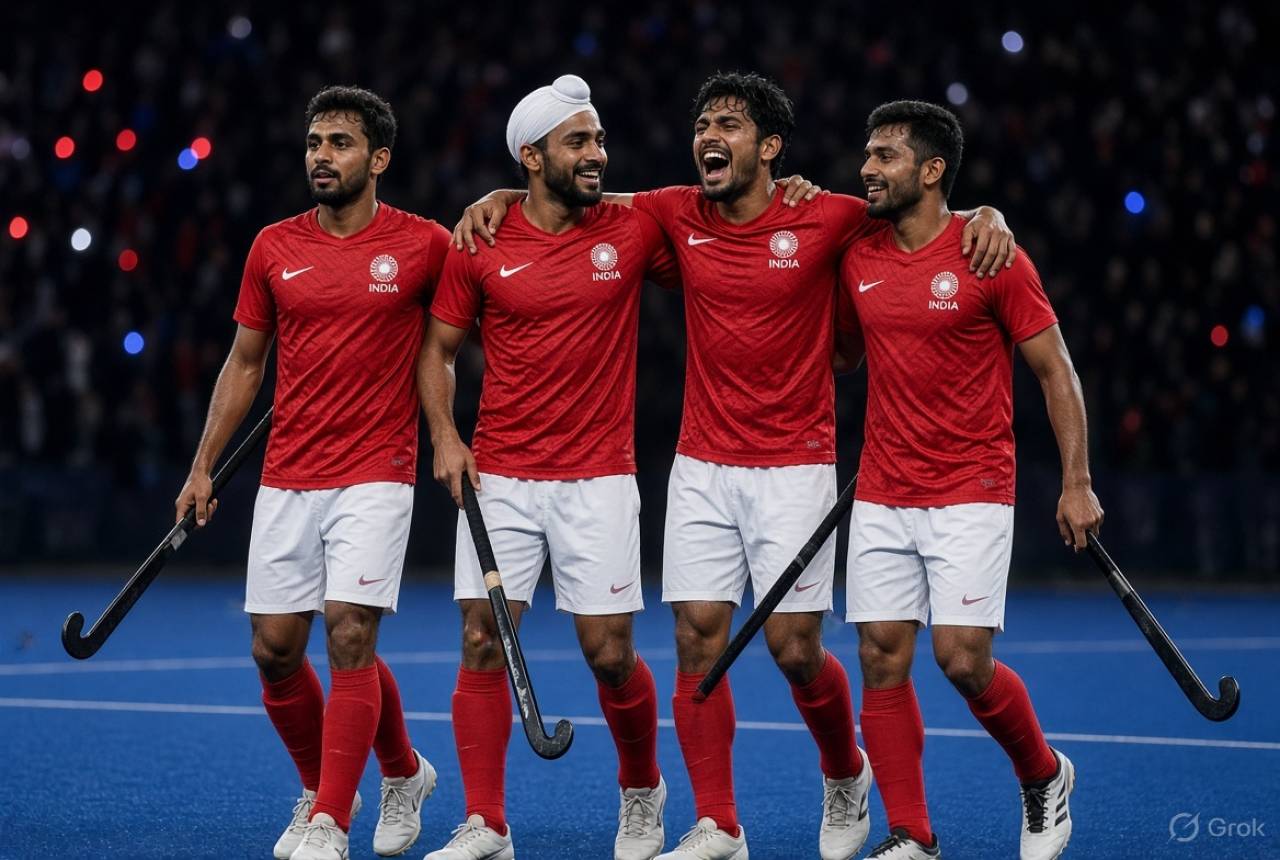
A late Abhishek goal turned a tense 3-3 India-Pakistan battle into a 4-3 thriller, sending India through in one of the rivalry’s most dramatic finishes.
There are matches that end when the final whistle blows. Then there are matches that refuse to leave the body. India’s 4-3 victory over Pakistan in the Asian Games men’s hockey semi-final belonged firmly to the second category. It was not merely a result. It was a pulse that kept rising, dipping and finally exploding in the dying seconds. At the centre of that explosion stood Abhishek, the last-action hero who turned near-certain heartbreak into a national exhale.
The scoreline tells only half the story: India 4, Pakistan 3. The quarters unfolded like chapters of a thriller, with the score moving from 2-0 to 3-1, then 3-2 and finally 4-3. What the numbers cannot capture is the emotional intensity of the evening, as two teams that know each other’s rhythms better than most rivals kept finding new ways to hurt and recover.
Pakistan arrived with the confidence of a side that has long treated India as its sharpest sporting mirror. India, meanwhile, carried the familiar burden of expectation, knowing that another defeat to the old rival could reopen memories of previous disappointments.
From the opening minutes, the contest was less about possession statistics and more about nerve. India seized early control, converting pressure into goals, only for Pakistan to respond with sharp, counter-attacking hockey. By the end of the third quarter, India’s advantage had narrowed and the tension inside the stadium had become almost physical.
Then came the final quarter, the part of the story likely to be retold for years.
With the clock running down and the score locked at 3-3, the match became a test of who could hold their nerve for a few more minutes. Pakistan pressed. India absorbed the pressure. The ball moved in short, nervous bursts.
And then came the moment.
Abhishek found the opening, created the angle and sent the ball into the net. In a match filled with pressure, history and expectation, one decisive stroke changed everything.
The last-action hero had spoken.
What makes the victory linger is not simply the drama of the final goal. It is what the match revealed about the evolution of Indian hockey. India-Pakistan encounters have often been framed through legacy and emotion. Those elements were present again, but they were supported by structure, fitness and a growing willingness to trust young players in high-pressure situations.
Abhishek’s strike was not simply an isolated act of individual brilliance. It came within a team effort that had survived repeated momentum shifts and remained composed when the game was at its most demanding.
There is also a deeper layer to an India-Pakistan hockey match. Sport does not erase history. It carries it into the present and gives it a different language. Every encounter between the two sides comes with memories of partition, border tensions and decades of sporting rivalry.
But on the blue turf, those larger narratives briefly give way to the immediate details of sport: the angle of a stick, the timing of a pass, the placement of a shot and the split-second decision to attack or defend.
When Abhishek scored, the larger history did not disappear. It simply made room for a new sporting memory.
The victory also changes the mood around India’s gold-medal campaign. The team had been pushed to the limit and still found a way through. Pakistan, despite the defeat, had taken the contest deep into the final moments and demonstrated why this rivalry continues to command such attention.
For Indian fans, the images will remain: players clustered in celebration, sticks raised and faces that had been tight with tension suddenly opening with relief.
For the players, the memory will be more private. It will be the feeling of tired legs finding one more sprint, lungs finding one more breath and a teammate finding the net when the moment demanded it.
Abhishek’s goal will dominate the headlines. But the larger story belongs to a team that refused to allow a familiar script to write itself.
It belongs to a young player who stepped into one of the loudest moments of the match and answered it with one decisive action.
And it belongs to a rivalry that, despite all its history, still has the power to produce moments that feel completely new.
That is what great sport does. It takes the oldest stories we know and gives them a new ending.
India did not just beat Pakistan on the hockey field. They added another unforgettable chapter to a rivalry that never seems to run out of them.
There are matches that end when the final whistle blows. Then there are matches that refuse to leave the body. India’s 4-3 victory over Pakistan in the Asian Games men’s hockey semi-final belonged firmly to the second category. It was not merely a result. It was a pulse that kept rising, dipping and finally exploding in the dying seconds. At the centre of that explosion stood Abhishek, the last-action hero who turned near-certain heartbreak into a national exhale.
The scoreline tells only half the story: India 4, Pakistan 3. The quarters unfolded like chapters of a thriller, with the score moving from 2-0 to 3-1, then 3-2 and finally 4-3. What the numbers cannot capture is the emotional intensity of the evening, as two teams that know each other’s rhythms better than most rivals kept finding new ways to hurt and recover.
Pakistan arrived with the confidence of a side that has long treated India as its sharpest sporting mirror. India, meanwhile, carried the familiar burden of expectation, knowing that another defeat to the old rival could reopen memories of previous disappointments.
From the opening minutes, the contest was less about possession statistics and more about nerve. India seized early control, converting pressure into goals, only for Pakistan to respond with sharp, counter-attacking hockey. By the end of the third quarter, India’s advantage had narrowed and the tension inside the stadium had become almost physical.
Then came the final quarter, the part of the story likely to be retold for years.
With the clock running down and the score locked at 3-3, the match became a test of who could hold their nerve for a few more minutes. Pakistan pressed. India absorbed the pressure. The ball moved in short, nervous bursts.
And then came the moment.
Abhishek found the opening, created the angle and sent the ball into the net. In a match filled with pressure, history and expectation, one decisive stroke changed everything.
The last-action hero had spoken.
What makes the victory linger is not simply the drama of the final goal. It is what the match revealed about the evolution of Indian hockey. India-Pakistan encounters have often been framed through legacy and emotion. Those elements were present again, but they were supported by structure, fitness and a growing willingness to trust young players in high-pressure situations.
Abhishek’s strike was not simply an isolated act of individual brilliance. It came within a team effort that had survived repeated momentum shifts and remained composed when the game was at its most demanding.
There is also a deeper layer to an India-Pakistan hockey match. Sport does not erase history. It carries it into the present and gives it a different language. Every encounter between the two sides comes with memories of partition, border tensions and decades of sporting rivalry.
But on the blue turf, those larger narratives briefly give way to the immediate details of sport: the angle of a stick, the timing of a pass, the placement of a shot and the split-second decision to attack or defend.
When Abhishek scored, the larger history did not disappear. It simply made room for a new sporting memory.
The victory also changes the mood around India’s gold-medal campaign. The team had been pushed to the limit and still found a way through. Pakistan, despite the defeat, had taken the contest deep into the final moments and demonstrated why this rivalry continues to command such attention.
For Indian fans, the images will remain: players clustered in celebration, sticks raised and faces that had been tight with tension suddenly opening with relief.
For the players, the memory will be more private. It will be the feeling of tired legs finding one more sprint, lungs finding one more breath and a teammate finding the net when the moment demanded it.
Abhishek’s goal will dominate the headlines. But the larger story belongs to a team that refused to allow a familiar script to write itself.
It belongs to a young player who stepped into one of the loudest moments of the match and answered it with one decisive action.
And it belongs to a rivalry that, despite all its history, still has the power to produce moments that feel completely new.
That is what great sport does. It takes the oldest stories we know and gives them a new ending.
India did not just beat Pakistan on the hockey field. They added another unforgettable chapter to a rivalry that never seems to run out of them.
















Leave a Comment