
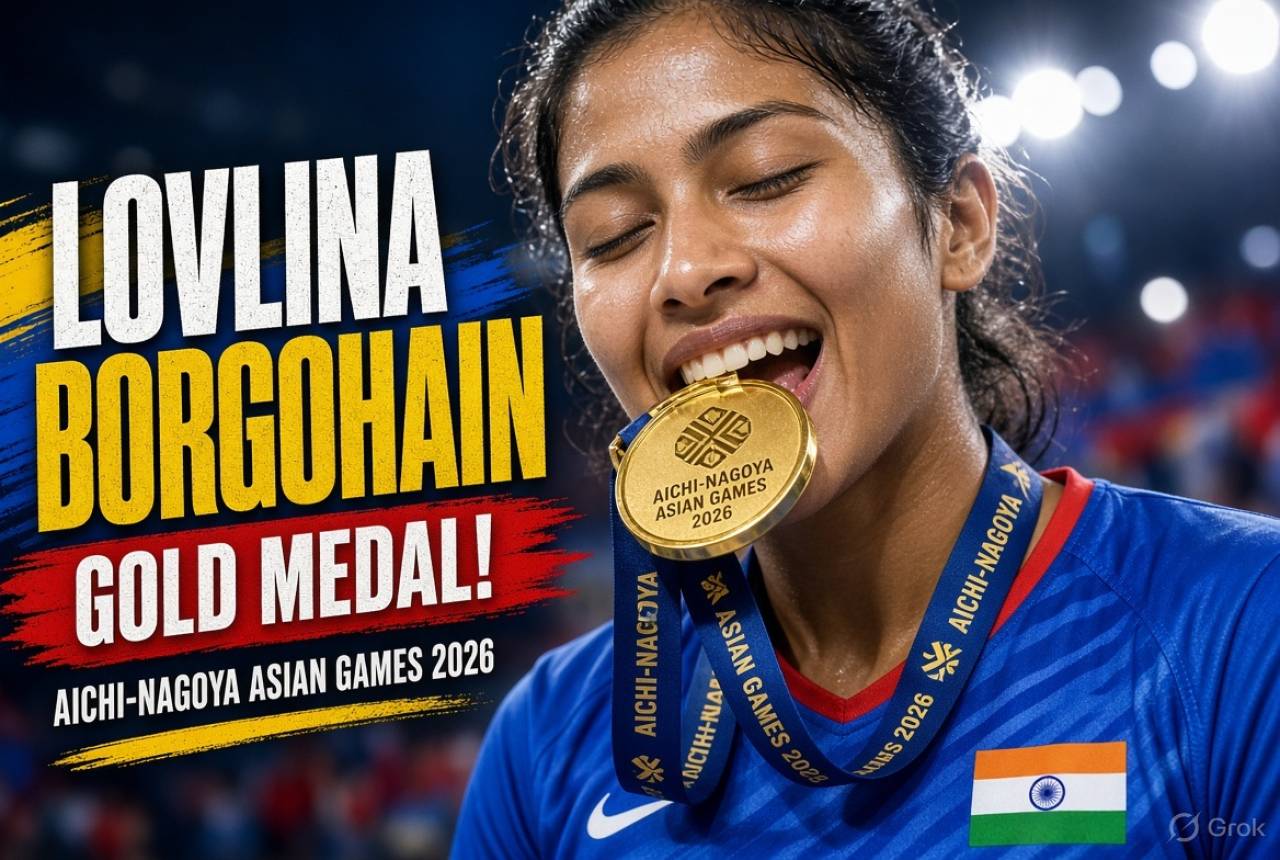
On her 29th birthday, Lovlina Borgohain gave Indian boxing a historic gift: an Asian Games gold medal and a moment that was entirely her own.
Lovlina Borgohain turned 29 on October 2, 2026. She celebrated by doing something only one other Indian woman boxer had done before her: winning Asian Games gold.
In the 75kg final at the Aichi-Nagoya Games, Borgohain became the second Indian woman after Mary Kom to win an Asian Games boxing title. The gold came on her birthday, but the moment was built over years of training, setbacks and international competition.
After the final, Borgohain offered a simple explanation for her approach: “Mujhe bas apne game ko jeena tha.” She just wanted to live her game.
That sentence says a lot about where she is in her career.
There were no loud predictions before the tournament and no attempt to make the Asian Games into a personal campaign. Borgohain entered the competition with a clear focus on her boxing. She wanted to stay in the bout, trust her preparation and avoid getting distracted by everything around it.
The result was the biggest continental title of her career.
For years, comparisons with Mary Kom have followed Borgohain. Both boxers come from Assam. Both rose from modest backgrounds. Both became Olympic medallists. Kom had already broken new ground when she won Asian Games gold in Incheon in 2014.
Borgohain has never wanted her career to become an extension of Kom’s story.
“Main unko apne saath compare nahi karna chahti hoon,” she has said. Their journeys are different. Hers is her own.
That difference now matters even more.
Kom remains the first Indian woman to win Asian Games boxing gold. Borgohain is the second, but her achievement comes after a career that has already taken her to an Olympic bronze medal at Tokyo 2020 and World Championship medals.
The Asian Games title adds another major achievement to that record.
What stands out about Borgohain is the way she talks about competition. She rarely turns a victory into a dramatic statement. Her focus remains on preparation, discipline and what happens inside the ring.
That mindset is particularly useful in boxing, where a fighter can easily become consumed by the importance of the result. Borgohain's approach is more practical: concentrate on the opponent in front of her, trust the work done before the tournament and fight one round at a time.
In Nagoya, it worked.
The timing of the victory makes the story even more striking. At 29, Borgohain is no longer an emerging boxer waiting for her first major breakthrough. She has already been through Olympic pressure, international defeats and the demands of staying at the top level for years.
Her Asian Games gold shows that she still has another important chapter to write.
It also gives Indian women’s boxing another landmark to build on.
Mary Kom’s success helped make women’s boxing visible across India. Borgohain’s career has added another path for young boxers to look towards. For athletes coming from Assam and other parts of the country, her story shows that reaching the top does not require copying someone else’s journey.
There can be different routes to the same ring.
Borgohain has never been the loudest voice in Indian sport. Her interviews are usually short and direct. She does not rely heavily on big statements about destiny, pressure or history.
That plainness makes her post-final words stand out.
She wanted to live her game.
On October 2, that was enough to take her to Asian Games gold.
The medal does not erase the difficult years behind it, and it does not decide what comes next. But it gives Borgohain a title that belongs entirely to her.
Mary Kom was the first Indian woman to win Asian Games boxing gold.
Lovlina Borgohain is now the second.
And on her 29th birthday, she finally had a moment that was completely her own.
Lovlina Borgohain turned 29 on October 2, 2026. She celebrated by doing something only one other Indian woman boxer had done before her: winning Asian Games gold.
In the 75kg final at the Aichi-Nagoya Games, Borgohain became the second Indian woman after Mary Kom to win an Asian Games boxing title. The gold came on her birthday, but the moment was built over years of training, setbacks and international competition.
After the final, Borgohain offered a simple explanation for her approach: “Mujhe bas apne game ko jeena tha.” She just wanted to live her game.
That sentence says a lot about where she is in her career.
There were no loud predictions before the tournament and no attempt to make the Asian Games into a personal campaign. Borgohain entered the competition with a clear focus on her boxing. She wanted to stay in the bout, trust her preparation and avoid getting distracted by everything around it.
The result was the biggest continental title of her career.
For years, comparisons with Mary Kom have followed Borgohain. Both boxers come from Assam. Both rose from modest backgrounds. Both became Olympic medallists. Kom had already broken new ground when she won Asian Games gold in Incheon in 2014.
Borgohain has never wanted her career to become an extension of Kom’s story.
“Main unko apne saath compare nahi karna chahti hoon,” she has said. Their journeys are different. Hers is her own.
That difference now matters even more.
Kom remains the first Indian woman to win Asian Games boxing gold. Borgohain is the second, but her achievement comes after a career that has already taken her to an Olympic bronze medal at Tokyo 2020 and World Championship medals.
The Asian Games title adds another major achievement to that record.
What stands out about Borgohain is the way she talks about competition. She rarely turns a victory into a dramatic statement. Her focus remains on preparation, discipline and what happens inside the ring.
That mindset is particularly useful in boxing, where a fighter can easily become consumed by the importance of the result. Borgohain's approach is more practical: concentrate on the opponent in front of her, trust the work done before the tournament and fight one round at a time.
In Nagoya, it worked.
The timing of the victory makes the story even more striking. At 29, Borgohain is no longer an emerging boxer waiting for her first major breakthrough. She has already been through Olympic pressure, international defeats and the demands of staying at the top level for years.
Her Asian Games gold shows that she still has another important chapter to write.
It also gives Indian women’s boxing another landmark to build on.
Mary Kom’s success helped make women’s boxing visible across India. Borgohain’s career has added another path for young boxers to look towards. For athletes coming from Assam and other parts of the country, her story shows that reaching the top does not require copying someone else’s journey.
There can be different routes to the same ring.
Borgohain has never been the loudest voice in Indian sport. Her interviews are usually short and direct. She does not rely heavily on big statements about destiny, pressure or history.
That plainness makes her post-final words stand out.
She wanted to live her game.
On October 2, that was enough to take her to Asian Games gold.
The medal does not erase the difficult years behind it, and it does not decide what comes next. But it gives Borgohain a title that belongs entirely to her.
Mary Kom was the first Indian woman to win Asian Games boxing gold.
Lovlina Borgohain is now the second.
And on her 29th birthday, she finally had a moment that was completely her own.













Leave a Comment