
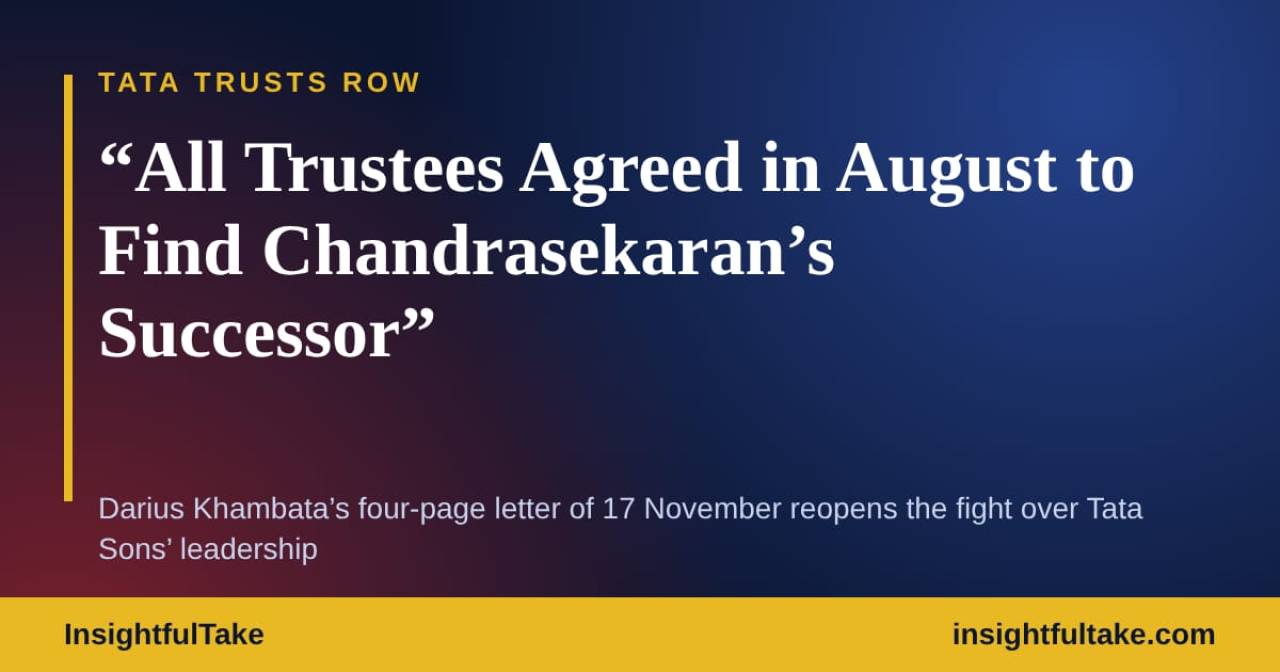
An explosive letter by the outgoing trustee challenges the account of Tata Sons' leadership succession, raising fresh questions about the August agreement, the September reappointment and the balance of authority within the Tata group.
The battle over the leadership of Tata Sons is no longer confined to boardroom discussions. A four-page letter from outgoing Tata Trusts trustee Darius Khambata has brought a crucial question into focus: Had the trustees already agreed to find a successor to N. Chandrasekaran before Tata Sons moved to offer him another term?
In a letter dated 17 November, reviewed by Mint, Khambata claims that all trustees, including vice-chairmen Venu Srinivasan and Vijay Singh, agreed in August to begin the process of identifying a new chairman for Tata Sons. The meeting reportedly took place a day after Chandrasekaran informed the board that he did not wish to seek a third term.
The letter adds another dimension to the growing disagreement between Tata Trusts and Tata Sons over Chandrasekaran's reappointment. More importantly, it challenges the sequence of events presented by two senior trustees who have questioned Khambata's position in the dispute.
The August meeting that could change the succession narrative
Khambata's central argument rests on two dates: 12 and 13 August 2026.
According to his account, Chandrasekaran informed the Tata Sons board on 12 August that he was not interested in another term as chairman. The following day, at a Tata Trusts meeting, all trustees present agreed to respect his decision and begin constituting a Selection Committee to identify a successor.
Khambata specifically states that both Srinivasan and Singh were part of this understanding.
However, the subsequent developments took a different direction.
On 3 September, Tata Sons' Nomination and Remuneration Committee (NRC) met and decided to request Chandrasekaran to reconsider his decision and continue as chairman.
Khambata has questioned whether Srinivasan, who represented Tata Trusts on the Tata Sons board, reminded the NRC of the trustees' reported August resolution.
His argument is that the sequence of events presented by Srinivasan and Singh leaves out a critical part of the decision-making process.
If Khambata's account is accurate, the September recommendation represented a significant departure from the understanding reached among the trustees barely three weeks earlier.
Why Chandrasekaran's third term became controversial
Tata Sons has defended the NRC's decision, stating that the committee arrived at its recommendation after due deliberation.
According to the company's position, Chandrasekaran's contributions and the larger interests of the Tata group were considered before the committee unanimously recommended that he be asked to reconsider his decision and continue as chairman.
The Tata Sons board subsequently approved his reappointment for another five-year term on 17 September.
However, the decision was not supported by Tata Trusts chairman Noel Tata, who opposed the move and later questioned its validity.
This disagreement has exposed an unusual situation within one of India's most influential business groups. The leadership of Tata Sons, its principal holding company, has become the subject of competing interpretations of authority, procedure and institutional decision-making.
At the heart of the issue is whether the NRC and the Tata Sons board could proceed with the reappointment despite the reported understanding among Tata Trusts trustees to identify a successor.
Khambata rejects allegations and turns the criticism back
The letter is not merely an account of the succession timeline. It is also Khambata's response to allegations made against him by Srinivasan and Singh in an earlier communication dated 11 November.
Khambata accuses the two trustees of constructing what he describes as a false narrative by selectively presenting events while ignoring facts that do not support their position.
He categorically rejects the allegations and says that he is being subjected to a personal attack. He also maintains that his conscience is clear.
Another point of disagreement concerns a Tata Trusts resolution dated 17 October 2024. According to the report, the resolution reflected an understanding that trustees should morally support one another's reappointment.
Srinivasan and Singh reportedly questioned whether Khambata had followed this principle.
Khambata counters by pointing to the voting positions of Srinivasan and Noel Tata in the case of fellow trustee Mehli Mistry, whose reappointment was opposed by them.
In a pointed response, he writes, "That is rich," arguing that those who themselves departed from the stated principle cannot selectively invoke it against him.
The exchange illustrates how the disagreement has moved beyond the question of Chandrasekaran's future to include competing interpretations of the conduct and responsibilities of individual trustees.
A governance question bigger than one chairman
The Tata Trusts dispute matters because of the institutional structure behind the Tata group.
Tata Trusts hold the majority stake in Tata Sons, the holding company that oversees a business empire spanning automobiles, steel, information technology, aviation, consumer products and several other sectors.
This makes the relationship between Tata Trusts and the Tata Sons board central to the group's governance.
The present controversy raises an important question: How should the authority of the majority shareholder be reconciled with the independent responsibilities of the company's board and its nomination committee?
If trustees had collectively agreed in August to begin searching for a successor, as Khambata claims, the September recommendation requires a fuller explanation.
On the other hand, Tata Sons maintains that its NRC reached a unanimous decision after considering the company's interests and Chandrasekaran's contribution.
These are competing accounts, and the claims made in Khambata's letter should not be treated as established findings. The positions of Srinivasan, Singh, Noel Tata and Tata Sons also need to be considered before drawing conclusions about the validity of the decisions.
The cost of an unresolved leadership battle
For the Tata group, the implications extend beyond an individual leadership appointment.
Its reputation has been built not only on the scale of its businesses but also on institutional credibility, professional management and a long-standing public image of stability.
A prolonged disagreement among the people responsible for its ownership and leadership risks drawing attention away from business priorities towards internal questions of control and governance.
Employees, investors, business partners and other stakeholders will naturally look for clarity on whether the differences can be resolved through established institutional processes.
The growing exchange of letters and counter-allegations suggests that the succession question has become part of a much wider debate about who has the final say in the Tata group's affairs.
Ultimately, the issue is not simply whether Chandrasekaran should continue as chairman. It is whether the group's governance framework can manage a disagreement between its principal shareholder and the company's board without allowing institutional differences to undermine confidence in the organisation.
















Leave a Comment