
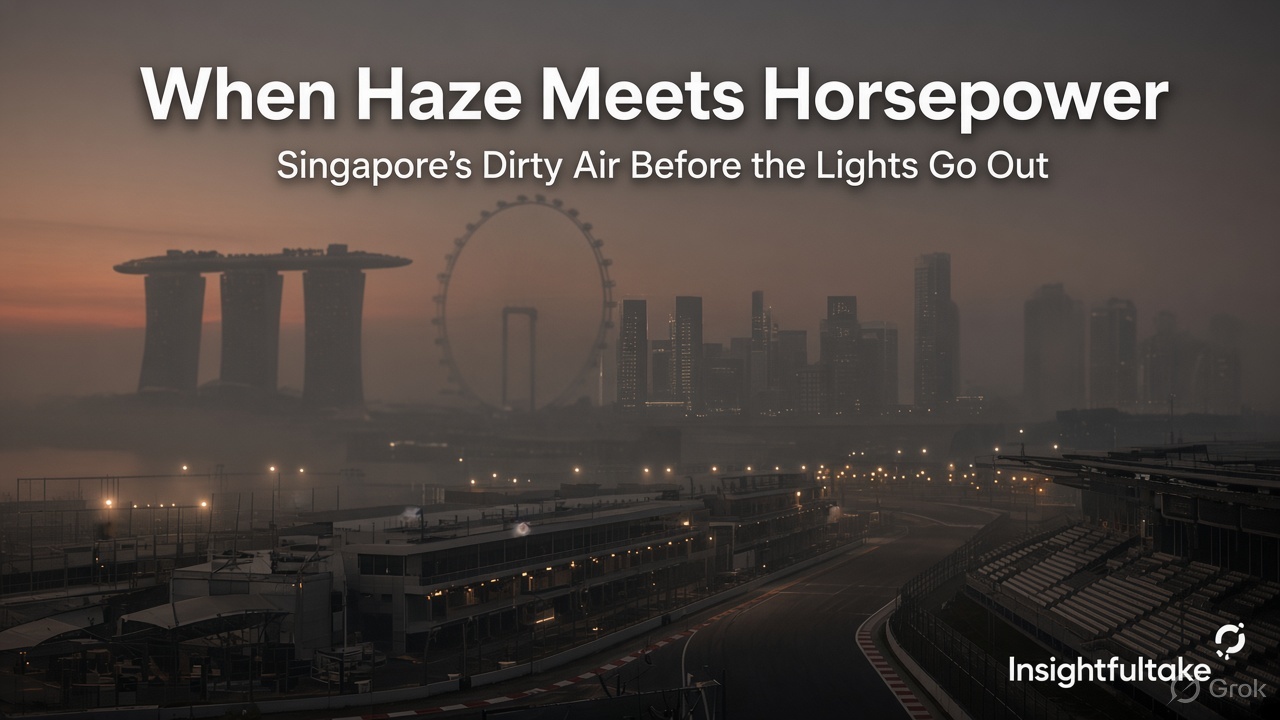
Singapore’s F1 lights are shining through unhealthy air. The smoke reveals a deeper crisis of forest destruction, corporate accountability and public health.
Singapore woke up this week ranked among the world’s most polluted major cities. On September 07, it briefly topped the global list. By September 8, it had slipped to third, behind Kuala Lumpur and Kinshasa, with an Air Quality Index (AQI) of 174. Every region of the city recorded unhealthy air quality. The cause was neither local traffic nor industry. It was smoke drifting from uncontrolled fires across Sumatra and Borneo in Indonesia.
The timing is awkward. The Singapore Grand Prix is underway this weekend. Formula One’s governing body, the Fédération Internationale de l’Automobile (FIA), says the haze does not threaten the race itself. Organisers say they are monitoring visibility, public health and operations and will act if necessary. Drivers have not been seen wearing masks in the paddock. Concerts and crowds of hundreds of thousands are still expected. The show, it appears, will go on.
That decision is understandable in narrow terms. Race control can manage track conditions, and fans can choose whether to attend. Yet the larger picture is harder to ignore. This is not a one-off weather event. It is a recurring pattern driven by human choices, amplified by climate conditions and left largely unpunished.
Indonesia’s Fires Keep Returning
Indonesian authorities recorded the highest number of fire hotspots last month since 2015. That year remains the benchmark for regional disaster. Schools closed, flights were cancelled, diplomatic tensions rose, and the economic cost to Indonesia alone was estimated in the billions.
This year’s fires are again concentrated in peatlands and forest areas cleared for agriculture. The method is old and cheap: slash-and-burn. Dry conditions, intensified by a strong El Niño, can turn those fires into weeks of thick smoke that crosses national borders with the wind.
Greenpeace and local partners have mapped thousands of smoke sources. More than 20 palm oil, pulp and sugar companies appear linked to land concessions where fires started. Several of these companies have ownership or supply-chain ties to Malaysia and Singapore.
The products of this land clearing enter global markets for cooking oil, packaging and biofuels. The smoke ends up in the lungs of people who may never have bought the palm oil or used the products linked to the fires.
The Human Cost of the Haze
Singapore’s National Environment Agency has warned that dry weather will keep the risk elevated in the coming days. All five regions of the city have recorded unhealthy air quality. The advice is familiar: reduce outdoor activity, stay hydrated and watch for symptoms.
In Malaysia, some schools have closed. Indonesia has recorded tens of thousands of respiratory cases linked to the fires. These are measurable public-health costs, paid largely by people who have no say in land-clearing decisions hundreds of kilometres away.
The damage extends beyond immediate breathing difficulties. Fine particles in smoke can aggravate asthma and other respiratory conditions, while prolonged exposure to polluted air increases the risk of serious health problems. Children, older people and those with existing medical conditions are particularly vulnerable.
The people exposed to the haze are often far removed from the commercial decisions that help create it. They cannot control how plantations are cleared, how peatlands are managed or whether companies enforce environmental standards across their supply chains.
Why the Smoke Is So Difficult to Stop
The underlying problem is straightforward. Peat soils store enormous amounts of carbon. When peatlands are drained and burned, they release that carbon into the atmosphere, contributing to global emissions while generating dangerous local pollution.
Laws against illegal burning exist, but enforcement remains difficult. Singapore’s Transboundary Haze Pollution Act allows action against companies whose activities contribute to haze in the country, including in certain circumstances when those activities take place abroad.
In practice, tracing responsibility through complex corporate structures and gathering evidence across national borders can limit the law’s reach. Indonesia has improved fire monitoring since the 2015 crisis, yet hotspots continue to return, particularly during dry periods associated with El Niño.
The problem is not simply a lack of information. Satellite monitoring can identify fires, and investigations can connect some of them to land concessions. The harder task is translating that evidence into effective enforcement, meaningful penalties and changes in business practices.
The Economic Argument Cannot End the Debate
The fresh angle is not that pollution is bad or that Formula One races should be cancelled. It is that the region continues to treat the haze as a seasonal inconvenience rather than a failure of land governance and corporate accountability.
Palm oil generates export revenue and supports millions of livelihoods. That economic reality matters. Palm oil is also used in a wide range of everyday products, making the industry deeply connected to global supply chains.
But the economic benefits do not erase the public-health costs that arrive whenever the smoke thickens. The two are linked through the same supply chains that connect plantations in Kalimantan to supermarket shelves and, indirectly, to companies operating from Singapore.
The question is who pays for the damage. Companies and investors may benefit from cheap land clearance, while residents across Southeast Asia bear the health costs. Governments must manage the resulting public-health emergency, and workers lose productive days when schools, workplaces and outdoor activities are disrupted.
Unless these costs are reflected in corporate decisions, the financial incentive to clear land cheaply can remain stronger than the incentive to protect it.
Formula One’s Uncomfortable Contrast
Formula One’s presence this weekend makes the contrast difficult to miss. The Marina Bay circuit is lit, polished and global. The air above it is not.
Spectators will cheer beneath a hazy sky. Drivers will race in conditions that have prompted public-health warnings. The event will generate headlines and tourism revenue. None of that changes the source of the pollution or the fact that the same pattern has repeated for decades.
The Grand Prix is not responsible for Indonesia’s fires. Nor does cancelling a race automatically address the conditions that allow them to recur. But a major international event taking place amid unhealthy air offers a reminder of how easily a visible spectacle can overshadow a less visible crisis.
The race will last a weekend. The consequences of forest and peatland fires can last much longer.
What Needs to Change
The solutions are well understood, even if implementing them remains difficult. Governments need more transparent concession maps, stronger penalties for repeat offenders and better coordination to investigate fires that cross corporate and national boundaries.
Peatlands must be protected and restored rather than drained for agricultural expansion. Companies need to demonstrate that their supply chains are not linked to destructive land clearance. Buyers and investors can strengthen that pressure by demanding traceability and acting when suppliers fail to meet environmental commitments.
Regional cooperation also needs to move beyond diplomatic statements. Agreements are of limited value if countries cannot establish responsibility, share evidence and impose consequences when environmental damage crosses borders.
The obstacle is political will, combined with the economic influence of the industries involved. Until the costs of haze are felt more directly by those who profit from land clearance, the smoke is likely to return when the rains fail.
This weekend, the cars will run. The lights will shine. The crowds will eventually leave.
The haze may remain.
Singapore woke up this week ranked among the world’s most polluted major cities. On September 07, it briefly topped the global list. By September 8, it had slipped to third, behind Kuala Lumpur and Kinshasa, with an Air Quality Index (AQI) of 174. Every region of the city recorded unhealthy air quality. The cause was neither local traffic nor industry. It was smoke drifting from uncontrolled fires across Sumatra and Borneo in Indonesia.
The timing is awkward. The Singapore Grand Prix is underway this weekend. Formula One’s governing body, the Fédération Internationale de l’Automobile (FIA), says the haze does not threaten the race itself. Organisers say they are monitoring visibility, public health and operations and will act if necessary. Drivers have not been seen wearing masks in the paddock. Concerts and crowds of hundreds of thousands are still expected. The show, it appears, will go on.
That decision is understandable in narrow terms. Race control can manage track conditions, and fans can choose whether to attend. Yet the larger picture is harder to ignore. This is not a one-off weather event. It is a recurring pattern driven by human choices, amplified by climate conditions and left largely unpunished.
Indonesia’s Fires Keep Returning
Indonesian authorities recorded the highest number of fire hotspots last month since 2015. That year remains the benchmark for regional disaster. Schools closed, flights were cancelled, diplomatic tensions rose, and the economic cost to Indonesia alone was estimated in the billions.
This year’s fires are again concentrated in peatlands and forest areas cleared for agriculture. The method is old and cheap: slash-and-burn. Dry conditions, intensified by a strong El Niño, can turn those fires into weeks of thick smoke that crosses national borders with the wind.
Greenpeace and local partners have mapped thousands of smoke sources. More than 20 palm oil, pulp and sugar companies appear linked to land concessions where fires started. Several of these companies have ownership or supply-chain ties to Malaysia and Singapore.
The products of this land clearing enter global markets for cooking oil, packaging and biofuels. The smoke ends up in the lungs of people who may never have bought the palm oil or used the products linked to the fires.
The Human Cost of the Haze
Singapore’s National Environment Agency has warned that dry weather will keep the risk elevated in the coming days. All five regions of the city have recorded unhealthy air quality. The advice is familiar: reduce outdoor activity, stay hydrated and watch for symptoms.
In Malaysia, some schools have closed. Indonesia has recorded tens of thousands of respiratory cases linked to the fires. These are measurable public-health costs, paid largely by people who have no say in land-clearing decisions hundreds of kilometres away.
The damage extends beyond immediate breathing difficulties. Fine particles in smoke can aggravate asthma and other respiratory conditions, while prolonged exposure to polluted air increases the risk of serious health problems. Children, older people and those with existing medical conditions are particularly vulnerable.
The people exposed to the haze are often far removed from the commercial decisions that help create it. They cannot control how plantations are cleared, how peatlands are managed or whether companies enforce environmental standards across their supply chains.
Why the Smoke Is So Difficult to Stop
The underlying problem is straightforward. Peat soils store enormous amounts of carbon. When peatlands are drained and burned, they release that carbon into the atmosphere, contributing to global emissions while generating dangerous local pollution.
Laws against illegal burning exist, but enforcement remains difficult. Singapore’s Transboundary Haze Pollution Act allows action against companies whose activities contribute to haze in the country, including in certain circumstances when those activities take place abroad.
In practice, tracing responsibility through complex corporate structures and gathering evidence across national borders can limit the law’s reach. Indonesia has improved fire monitoring since the 2015 crisis, yet hotspots continue to return, particularly during dry periods associated with El Niño.
The problem is not simply a lack of information. Satellite monitoring can identify fires, and investigations can connect some of them to land concessions. The harder task is translating that evidence into effective enforcement, meaningful penalties and changes in business practices.
The Economic Argument Cannot End the Debate
The fresh angle is not that pollution is bad or that Formula One races should be cancelled. It is that the region continues to treat the haze as a seasonal inconvenience rather than a failure of land governance and corporate accountability.
Palm oil generates export revenue and supports millions of livelihoods. That economic reality matters. Palm oil is also used in a wide range of everyday products, making the industry deeply connected to global supply chains.
But the economic benefits do not erase the public-health costs that arrive whenever the smoke thickens. The two are linked through the same supply chains that connect plantations in Kalimantan to supermarket shelves and, indirectly, to companies operating from Singapore.
The question is who pays for the damage. Companies and investors may benefit from cheap land clearance, while residents across Southeast Asia bear the health costs. Governments must manage the resulting public-health emergency, and workers lose productive days when schools, workplaces and outdoor activities are disrupted.
Unless these costs are reflected in corporate decisions, the financial incentive to clear land cheaply can remain stronger than the incentive to protect it.
Formula One’s Uncomfortable Contrast
Formula One’s presence this weekend makes the contrast difficult to miss. The Marina Bay circuit is lit, polished and global. The air above it is not.
Spectators will cheer beneath a hazy sky. Drivers will race in conditions that have prompted public-health warnings. The event will generate headlines and tourism revenue. None of that changes the source of the pollution or the fact that the same pattern has repeated for decades.
The Grand Prix is not responsible for Indonesia’s fires. Nor does cancelling a race automatically address the conditions that allow them to recur. But a major international event taking place amid unhealthy air offers a reminder of how easily a visible spectacle can overshadow a less visible crisis.
The race will last a weekend. The consequences of forest and peatland fires can last much longer.
What Needs to Change
The solutions are well understood, even if implementing them remains difficult. Governments need more transparent concession maps, stronger penalties for repeat offenders and better coordination to investigate fires that cross corporate and national boundaries.
Peatlands must be protected and restored rather than drained for agricultural expansion. Companies need to demonstrate that their supply chains are not linked to destructive land clearance. Buyers and investors can strengthen that pressure by demanding traceability and acting when suppliers fail to meet environmental commitments.
Regional cooperation also needs to move beyond diplomatic statements. Agreements are of limited value if countries cannot establish responsibility, share evidence and impose consequences when environmental damage crosses borders.
The obstacle is political will, combined with the economic influence of the industries involved. Until the costs of haze are felt more directly by those who profit from land clearance, the smoke is likely to return when the rains fail.
This weekend, the cars will run. The lights will shine. The crowds will eventually leave.
The haze may remain.










Leave a Comment