
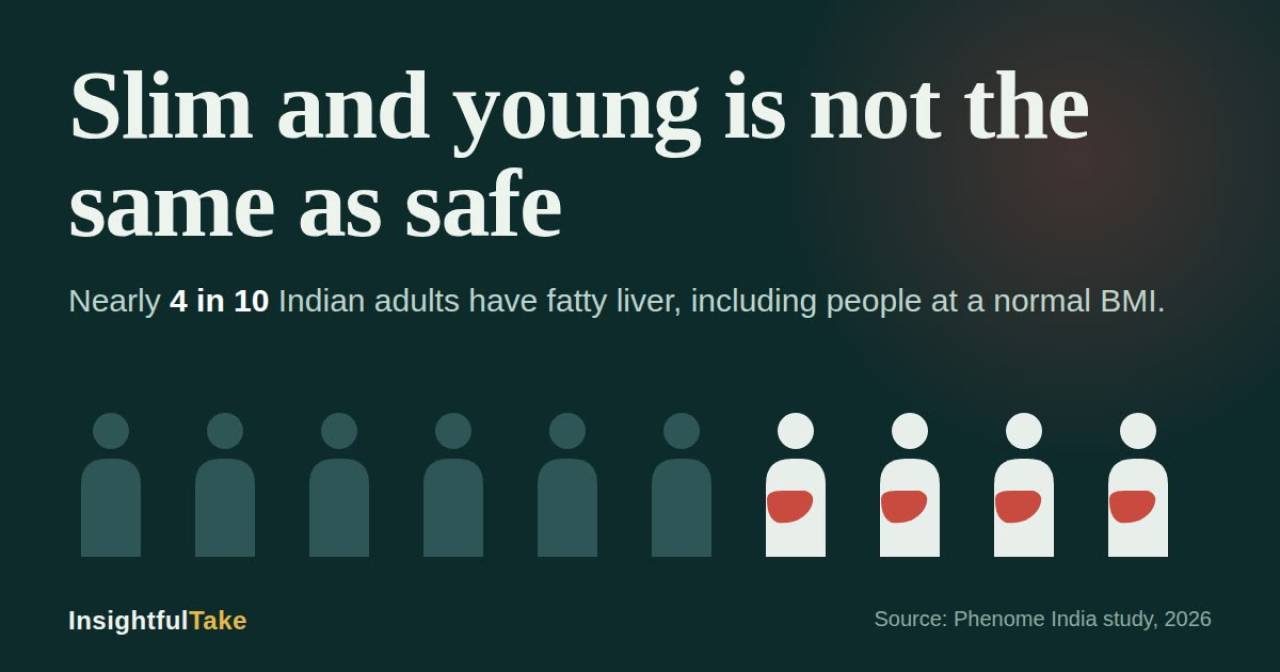
Being young and slim does not always protect against fatty liver. New Indian research shows why normal body weight can hide an important metabolic risk.
Almost everyone in urban India has seen the line on a health check-up report: “Grade 1 fatty liver.” Many people, especially those who are young, slim and do not drink alcohol, tend to ignore it.
It may be a mistake.
A growing body of Indian research shows that fatty liver disease is not limited to people who are overweight or obese. Young adults with a normal body weight can also develop excess fat in the liver, particularly when insulin resistance and other metabolic problems are present.
It Is Not a Disease of the Overweight
A study in Thiruvananthapuram district screened 2,373 adults aged 18 to 30. None were obese and few consumed alcohol. Yet about one in four had fat accumulation in the liver.
One important factor is insulin resistance. When the body does not respond properly to insulin, fat tissue can release more fatty acids into the bloodstream. The liver absorbs some of this excess fat, and when it cannot process it efficiently, fat begins to accumulate.
South Asians can develop these metabolic problems at lower body weights than many other populations. A 2006 Yale study found that insulin resistance was three to four times more common in lean young Asian-Indian men than in white men. Their livers also contained roughly twice as much fat.
This difference is one reason Asian health guidelines use lower BMI thresholds. A BMI of 23 is generally considered overweight for Asian populations, compared with 25 in many Western guidelines.
Indian studies have repeatedly pointed in the same direction. A biopsy-based study of lean liver donors found that 33.7% already had fatty liver disease. A Delhi survey of 6,146 residents, with Dr Shiv Kumar Sarin among its authors, found metabolic fatty liver in 56.4% of participants. About 11.3% of those affected were lean.
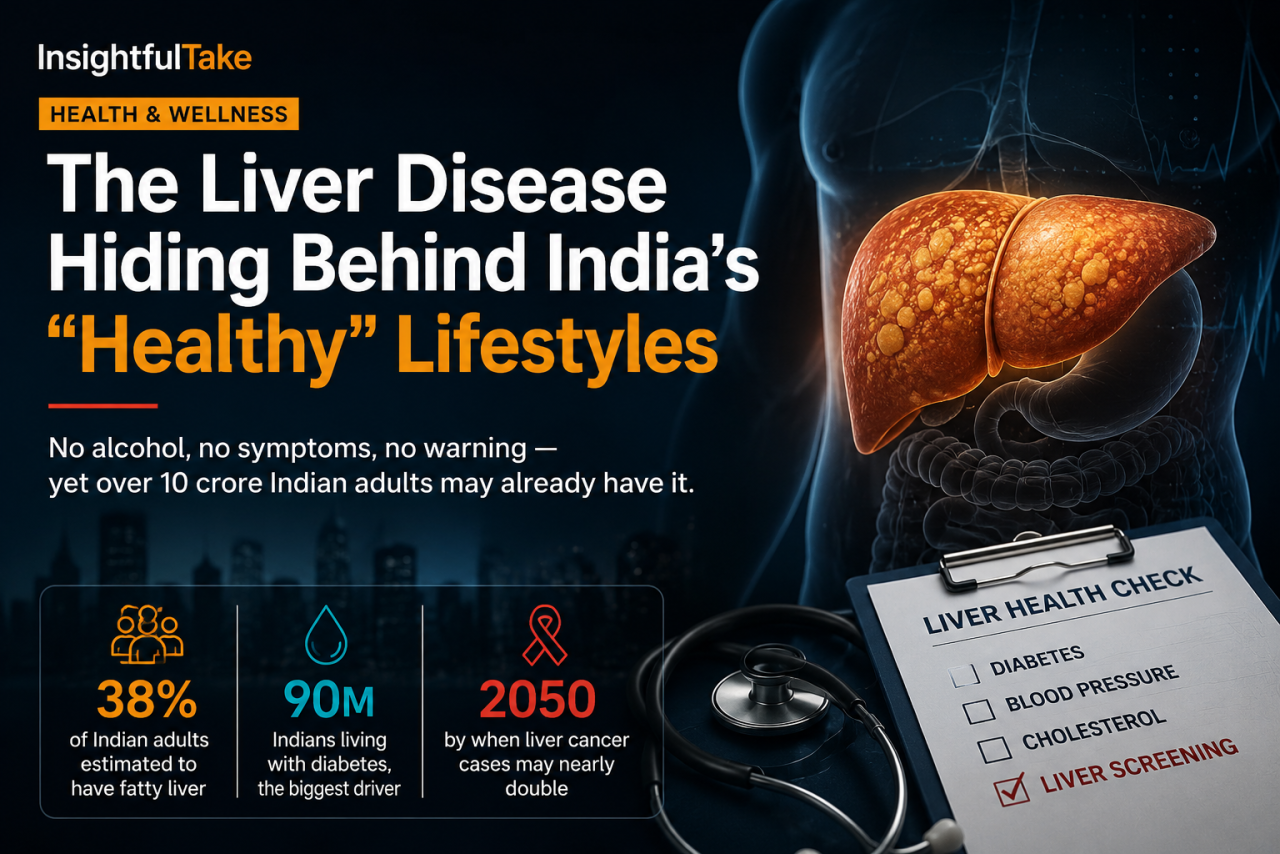
The national picture is also concerning. The Phenome India study, published in The Lancet Regional Health – Southeast Asia, screened 7,764 adults across 27 cities. Nearly 48% met the study criteria for fatty liver disease. After adjustment for age, the figure was 38.9%. People who reported drinking alcohol were excluded.
Fat Is the Warning. Scar Is the Danger
Fat accumulation by itself does not necessarily cause serious liver damage. Many people with simple fatty liver never develop advanced liver disease. For them, the greater long-term risks may include diabetes and cardiovascular disease.
The situation becomes more serious when liver injury develops.
When excess fat overwhelms liver cells, harmful by-products can accumulate. Cells become damaged or die, triggering inflammation. This process can activate stellate cells, which produce collagen and contribute to the formation of scar tissue.
Doctors classify liver fibrosis from F0 to F4. F0 means no fibrosis, while F4 represents cirrhosis.
The increase in risk with advanced fibrosis is substantial. In an analysis of 17,301 patients who underwent liver biopsy, the risk of death from liver disease was 7.6 times higher at F3 fibrosis than in patients without fibrosis. At F4, the risk was about 15 times higher.
The Phenome India study found significant fibrosis in 6.3% of people with fatty liver, compared with 1.7% among those without it. The Delhi survey also found advanced fibrosis to be about three times more common among people with fatty liver, at 6.2% compared with 1.8%.
There is, however, an important difference between early fibrosis and established cirrhosis. When the underlying liver injury is reduced or stopped, some scar tissue can regress. Advanced cirrhosis, particularly once complications develop, is much harder to reverse.
Finding the Scar Is Harder Than Finding the Fat
An ultrasound can detect fat in the liver, but it does not reliably tell doctors how much fibrosis has developed.
One commonly used first-line tool is the FIB-4 score, which uses age and blood-test results to estimate the likelihood of advanced fibrosis. But age is a major part of the calculation, which creates a problem for younger patients. European guidelines acknowledge that FIB-4 performs poorly in people under 35.
This means that a young person should not necessarily assume that a low fibrosis score rules out liver damage.
Dr Sarin has argued for looking at two separate questions: how much fat is present in the liver and whether fibrosis has begun.
For someone whose health report shows fatty liver, a useful question for a doctor is therefore not simply whether the liver contains fat, but whether fibrosis has also been assessed and which test was used.
What the New Drugs Can and Cannot Do
New treatments have changed the conversation around fatty liver disease, particularly for patients with metabolic dysfunction-associated steatohepatitis, or MASH, and fibrosis.
Resmetirom, a drug designed to increase fat metabolism in liver cells, improved fibrosis by at least one stage in about a quarter of patients after 52 weeks, compared with 14.2% receiving placebo.
Semaglutide, the GLP-1 drug widely known for its effects on weight and blood sugar, produced fibrosis improvement in 36.8% of patients after 72 weeks, compared with 22.4% in the placebo group.
But these results need to be interpreted carefully. Neither drug has yet demonstrated that it prevents cirrhosis or death from liver disease. The clinical trials also involved patients who were considerably heavier than the typical slim young Indian adult, with average BMI levels close to 35.
Whether the same benefits apply to a slim 28-year-old with fatty liver remains uncertain.
The Indian treatment landscape has also changed. On July 18, 2026, India's drug regulator approved Wegovy, containing semaglutide 2.4 mg, for adults with non-cirrhotic MASH and moderate to advanced fibrosis, alongside a reduced-calorie diet and increased physical activity.
Resmetirom has regulatory approval in the United States and Europe, but there has not yet been an Indian launch identified. Torrent Pharma has discussed plans to bring the drug to India around 12 to 18 months after the relevant patent expires.
India also has saroglitazar, which received approval in 2020 based on a company-sponsored trial involving 102 patients. That study primarily assessed disease activity rather than demonstrating reversal of liver scarring.
What Still Works Best
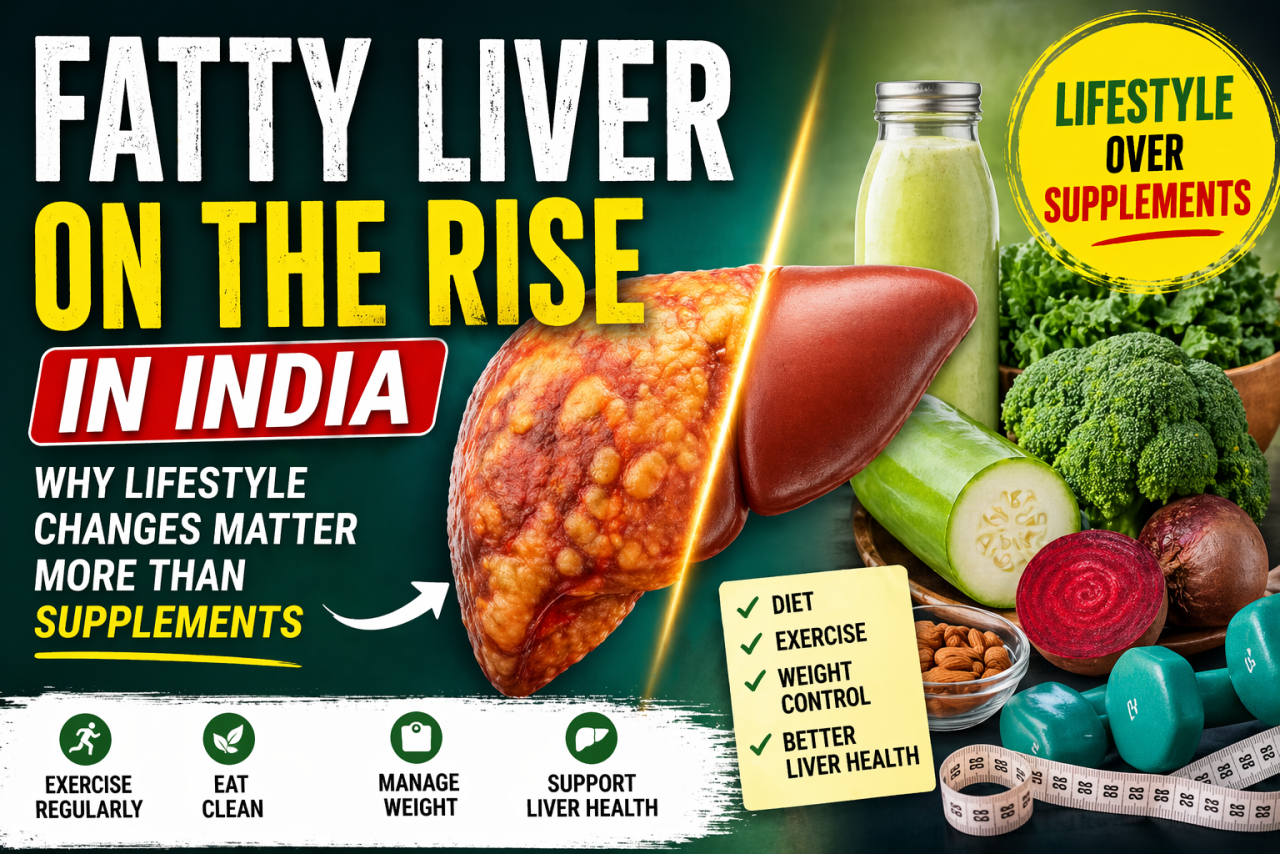
Lifestyle change remains central to treatment.
Weight loss has some of the strongest evidence behind it. Among patients who lost about 10% of their body weight over a year, inflammation resolved in 90% and fibrosis regressed in 45%.
Dr Sarin sees a role for newer medicines, but argues that drugs should not replace dietary changes and regular exercise. He has also called for clinical trials that assess the broader metabolic picture, including liver fat, cholesterol and other lipids, diabetes and cardiovascular risk.
The prevention question is equally important.
If young, lean Indians can develop fatty liver without obvious obesity, should screening begin much earlier?
Dr Sarin has argued that screening should start in schools. But there is still a major evidence gap. Researchers have not followed enough lean young Indians with fatty liver for long enough to establish whether their risk of progressing to cirrhosis is higher, lower or similar to that of heavier patients on whom much of the existing evidence is based.
For now, a normal BMI should not be treated as a clean bill of health.
Waist circumference, blood sugar, cholesterol and triglycerides can provide important clues about metabolic health. And when a health report says “fatty liver”, particularly in a young or apparently slim person, it deserves a proper follow-up rather than a shrug.
Almost everyone in urban India has seen the line on a health check-up report: “Grade 1 fatty liver.” Many people, especially those who are young, slim and do not drink alcohol, tend to ignore it.
It may be a mistake.
A growing body of Indian research shows that fatty liver disease is not limited to people who are overweight or obese. Young adults with a normal body weight can also develop excess fat in the liver, particularly when insulin resistance and other metabolic problems are present.
It Is Not a Disease of the Overweight
A study in Thiruvananthapuram district screened 2,373 adults aged 18 to 30. None were obese and few consumed alcohol. Yet about one in four had fat accumulation in the liver.
One important factor is insulin resistance. When the body does not respond properly to insulin, fat tissue can release more fatty acids into the bloodstream. The liver absorbs some of this excess fat, and when it cannot process it efficiently, fat begins to accumulate.
South Asians can develop these metabolic problems at lower body weights than many other populations. A 2006 Yale study found that insulin resistance was three to four times more common in lean young Asian-Indian men than in white men. Their livers also contained roughly twice as much fat.
This difference is one reason Asian health guidelines use lower BMI thresholds. A BMI of 23 is generally considered overweight for Asian populations, compared with 25 in many Western guidelines.
Indian studies have repeatedly pointed in the same direction. A biopsy-based study of lean liver donors found that 33.7% already had fatty liver disease. A Delhi survey of 6,146 residents, with Dr Shiv Kumar Sarin among its authors, found metabolic fatty liver in 56.4% of participants. About 11.3% of those affected were lean.
The national picture is also concerning. The Phenome India study, published in The Lancet Regional Health – Southeast Asia, screened 7,764 adults across 27 cities. Nearly 48% met the study criteria for fatty liver disease. After adjustment for age, the figure was 38.9%. People who reported drinking alcohol were excluded.
Fat Is the Warning. Scar Is the Danger
Fat accumulation by itself does not necessarily cause serious liver damage. Many people with simple fatty liver never develop advanced liver disease. For them, the greater long-term risks may include diabetes and cardiovascular disease.
The situation becomes more serious when liver injury develops.
When excess fat overwhelms liver cells, harmful by-products can accumulate. Cells become damaged or die, triggering inflammation. This process can activate stellate cells, which produce collagen and contribute to the formation of scar tissue.
Doctors classify liver fibrosis from F0 to F4. F0 means no fibrosis, while F4 represents cirrhosis.
The increase in risk with advanced fibrosis is substantial. In an analysis of 17,301 patients who underwent liver biopsy, the risk of death from liver disease was 7.6 times higher at F3 fibrosis than in patients without fibrosis. At F4, the risk was about 15 times higher.
The Phenome India study found significant fibrosis in 6.3% of people with fatty liver, compared with 1.7% among those without it. The Delhi survey also found advanced fibrosis to be about three times more common among people with fatty liver, at 6.2% compared with 1.8%.
There is, however, an important difference between early fibrosis and established cirrhosis. When the underlying liver injury is reduced or stopped, some scar tissue can regress. Advanced cirrhosis, particularly once complications develop, is much harder to reverse.
Finding the Scar Is Harder Than Finding the Fat
An ultrasound can detect fat in the liver, but it does not reliably tell doctors how much fibrosis has developed.
One commonly used first-line tool is the FIB-4 score, which uses age and blood-test results to estimate the likelihood of advanced fibrosis. But age is a major part of the calculation, which creates a problem for younger patients. European guidelines acknowledge that FIB-4 performs poorly in people under 35.
This means that a young person should not necessarily assume that a low fibrosis score rules out liver damage.
Dr Sarin has argued for looking at two separate questions: how much fat is present in the liver and whether fibrosis has begun.
For someone whose health report shows fatty liver, a useful question for a doctor is therefore not simply whether the liver contains fat, but whether fibrosis has also been assessed and which test was used.
What the New Drugs Can and Cannot Do
New treatments have changed the conversation around fatty liver disease, particularly for patients with metabolic dysfunction-associated steatohepatitis, or MASH, and fibrosis.
Resmetirom, a drug designed to increase fat metabolism in liver cells, improved fibrosis by at least one stage in about a quarter of patients after 52 weeks, compared with 14.2% receiving placebo.
Semaglutide, the GLP-1 drug widely known for its effects on weight and blood sugar, produced fibrosis improvement in 36.8% of patients after 72 weeks, compared with 22.4% in the placebo group.
But these results need to be interpreted carefully. Neither drug has yet demonstrated that it prevents cirrhosis or death from liver disease. The clinical trials also involved patients who were considerably heavier than the typical slim young Indian adult, with average BMI levels close to 35.
Whether the same benefits apply to a slim 28-year-old with fatty liver remains uncertain.
The Indian treatment landscape has also changed. On July 18, 2026, India's drug regulator approved Wegovy, containing semaglutide 2.4 mg, for adults with non-cirrhotic MASH and moderate to advanced fibrosis, alongside a reduced-calorie diet and increased physical activity.
Resmetirom has regulatory approval in the United States and Europe, but there has not yet been an Indian launch identified. Torrent Pharma has discussed plans to bring the drug to India around 12 to 18 months after the relevant patent expires.
India also has saroglitazar, which received approval in 2020 based on a company-sponsored trial involving 102 patients. That study primarily assessed disease activity rather than demonstrating reversal of liver scarring.
What Still Works Best
Lifestyle change remains central to treatment.
Weight loss has some of the strongest evidence behind it. Among patients who lost about 10% of their body weight over a year, inflammation resolved in 90% and fibrosis regressed in 45%.
Dr Sarin sees a role for newer medicines, but argues that drugs should not replace dietary changes and regular exercise. He has also called for clinical trials that assess the broader metabolic picture, including liver fat, cholesterol and other lipids, diabetes and cardiovascular risk.
The prevention question is equally important.
If young, lean Indians can develop fatty liver without obvious obesity, should screening begin much earlier?
Dr Sarin has argued that screening should start in schools. But there is still a major evidence gap. Researchers have not followed enough lean young Indians with fatty liver for long enough to establish whether their risk of progressing to cirrhosis is higher, lower or similar to that of heavier patients on whom much of the existing evidence is based.
For now, a normal BMI should not be treated as a clean bill of health.
Waist circumference, blood sugar, cholesterol and triglycerides can provide important clues about metabolic health. And when a health report says “fatty liver”, particularly in a young or apparently slim person, it deserves a proper follow-up rather than a shrug.






















Leave a Comment