
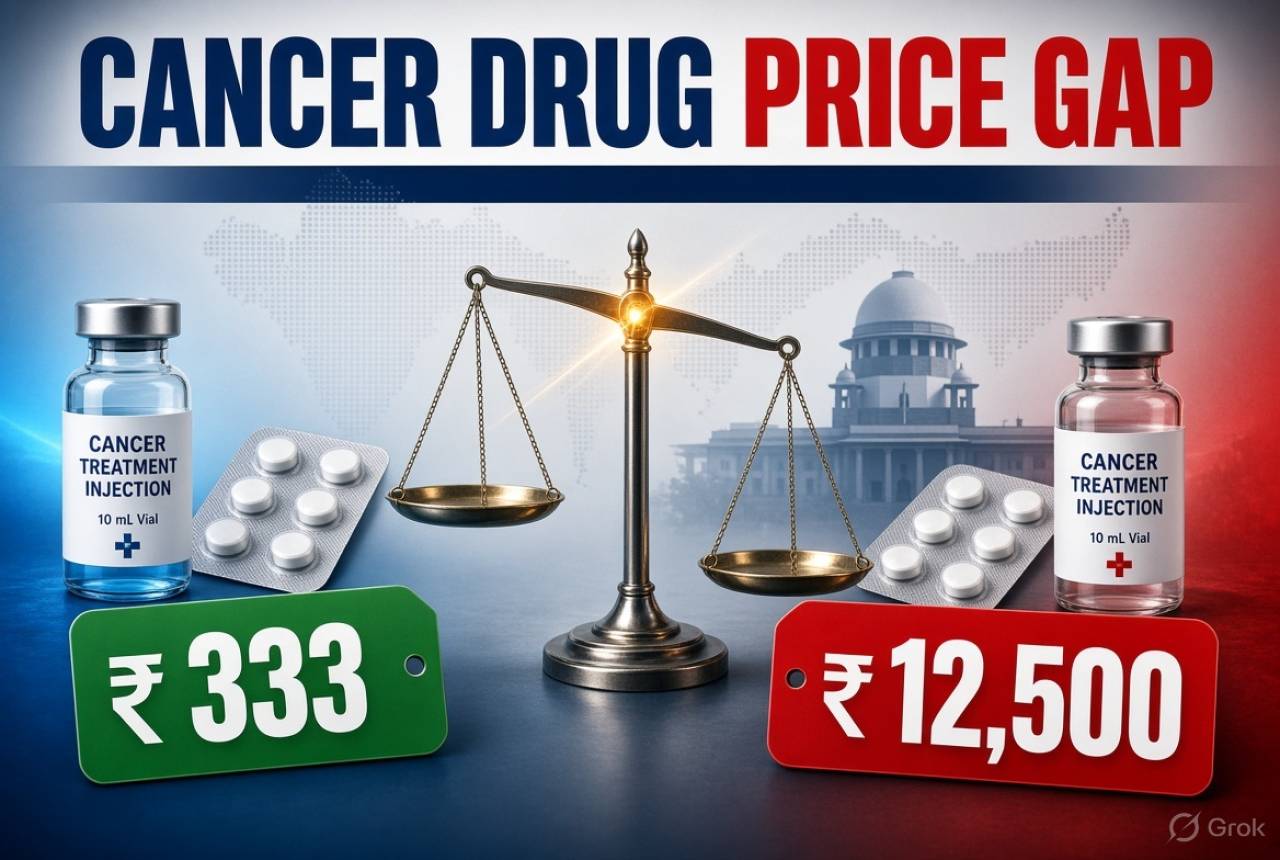
A cancer drug bought for ₹333 can carry an MRP above ₹10,000. The Supreme Court has questioned why patients face such a wide price gap.
A vial of paclitaxel 260 mg can cost the government about ₹333. The MRP of some brands of the same medicine is between ₹10,000 and ₹12,500.
Government procurement rates examined in a recent investigation show wide differences in the prices paid for several cancer medicines and the MRPs at which some of those medicines are sold in the market. In some cases, the difference runs into several thousand rupees for a single vial. In two of the ten medicines examined, the gap was more than 30 times.
The figures have drawn the attention of the Supreme Court, which questioned the pricing of cancer medicines twice within a week.
Docetaxel 120 mg, for instance, was procured at around ₹369, while MRPs cited for some brands ranged from ₹4,000 to ₹13,500. Gemcitabine 1,000 mg was available through government procurement at about ₹1,309, against MRPs of ₹25,000 to ₹32,000 for some products.
Bevacizumab, rituximab and trastuzumab were among the other cancer medicines where substantial differences were reported.
These numbers need some context. A government procurement price is not the same thing as the cost at which a medicine reaches a private pharmacy. Government agencies buy in bulk, usually through competitive tenders. Manufacturers bidding for large contracts can offer much lower prices than those available in the retail market.
But the size of the differences raises a separate question: how much of that gap ultimately reaches the patient?
When the same medicine enters two very different markets
A government health agency buying thousands of vials has bargaining power. A patient buying one vial does not.
In the private market, the price depends on the brand, distribution chain and the MRP printed on the pack. Patients may also have limited knowledge of other brands containing the same active ingredient.
Brand-based prescriptions can add another layer to the problem. If a doctor writes a particular brand and the hospital pharmacy stocks that brand, a patient may not know that another company sells the same medicine at a lower price.
For someone undergoing chemotherapy, this is not a small difference.
Treatment can involve multiple cycles, with medicines required repeatedly. A price difference of several thousand rupees on one vial can therefore become a much larger expense over the course of treatment.
What the Supreme Court has questioned
The Supreme Court examined the issue on September 22 after being told about a medicine procured for around ₹2,700 but sold at about ₹27,000.
Seven days later, on September 29, the Court returned to the issue. During the proceedings, the bench described the pricing gap as “open loot” and sought further examination of the matter.
The two hearings have put a spotlight on a part of the medicine market that patients rarely get to see. Between the manufacturer's price and the amount on a pharmacy bill are several stages of procurement, distribution, wholesale pricing, retail margins and taxation.
A government procurement rate, therefore, cannot simply be treated as the cost of producing the medicine. Nor does a high MRP automatically mean that a seller is making the entire difference as profit.
Still, a gap of 10, 20 or 30 times deserves closer scrutiny, particularly when the medicine is being used to treat a serious disease.
Where price regulation comes in
India has a price-control framework for medicines, administered in large part through the National Pharmaceutical Pricing Authority (NPPA). Essential medicines covered by the relevant price-control rules are subject to limits on their prices.
Not every cancer medicine, every strength or every brand falls under the same pricing conditions. That distinction matters when comparing procurement rates with market MRPs.
Bulk procurement creates another difference. A state corporation purchasing thousands of units can negotiate a rate that would not be available to an individual buyer.
Even after accounting for those factors, however, the figures cited in the investigation raise questions about transparency.
Patients often see only the final bill. They may not know the procurement price, the price of competing brands or whether an equivalent medicine is available at a lower cost.
That information gap becomes particularly serious in cancer care, where families may already be paying for consultations, scans, hospitalisation, surgery and repeated treatment cycles.
The burden is bigger than one medicine bill
Cancer treatment can continue for months. Some patients require repeated chemotherapy, targeted therapy or other expensive medicines.
For a family with limited savings, an additional ₹5,000 or ₹10,000 on a single medicine is not simply a difference between two retail prices. It can mean borrowing money, postponing another expense or relying on family members to arrange funds before the next treatment cycle.
Government hospitals and public procurement programmes can offer medicines at substantially lower rates, but access is not uniform. Many patients continue to receive treatment in private hospitals, where medicine bills can form a significant part of the total cost.
That is why the availability of cheaper alternatives matters only if patients are actually told about them and are free to choose them where medically appropriate.
What greater transparency could look like
Hospitals and pharmacies could make the pricing of high-cost medicines easier to understand. Patients could be given information on the brand prescribed, available equivalent brands and their respective prices.
Doctors could also prescribe by generic name where clinically appropriate, allowing patients and pharmacists to consider lower-cost alternatives without compromising treatment.
Regulators, meanwhile, could examine unusually large differences between procurement rates and retail prices, particularly for medicines used widely in cancer treatment.
None of this means that every difference between a government tender price and an MRP is unjustified. Bulk discounts, manufacturing costs, quality requirements, distribution and other expenses all affect the final price.
The concern is what happens when those differences become so large that patients struggle to understand why the same medicine costs hundreds of rupees in one setting and thousands in another.
The Supreme Court's intervention has brought that question into the open. The hearings may now push regulators, hospitals and drug companies to provide clearer answers on how these prices are arrived at.
For a cancer patient, the difference between ₹333 and ₹10,000 is not an accounting exercise. It is the amount that may have to be found before treatment can continue.
It makes the pricing question much bigger than the MRP printed on a medicine pack. It is ultimately about how much information, choice and protection a patient has at the point where a costly treatment becomes unavoidable.
A vial of paclitaxel 260 mg can cost the government about ₹333. The MRP of some brands of the same medicine is between ₹10,000 and ₹12,500.
Government procurement rates examined in a recent investigation show wide differences in the prices paid for several cancer medicines and the MRPs at which some of those medicines are sold in the market. In some cases, the difference runs into several thousand rupees for a single vial. In two of the ten medicines examined, the gap was more than 30 times.
The figures have drawn the attention of the Supreme Court, which questioned the pricing of cancer medicines twice within a week.
Docetaxel 120 mg, for instance, was procured at around ₹369, while MRPs cited for some brands ranged from ₹4,000 to ₹13,500. Gemcitabine 1,000 mg was available through government procurement at about ₹1,309, against MRPs of ₹25,000 to ₹32,000 for some products.
Bevacizumab, rituximab and trastuzumab were among the other cancer medicines where substantial differences were reported.
These numbers need some context. A government procurement price is not the same thing as the cost at which a medicine reaches a private pharmacy. Government agencies buy in bulk, usually through competitive tenders. Manufacturers bidding for large contracts can offer much lower prices than those available in the retail market.
But the size of the differences raises a separate question: how much of that gap ultimately reaches the patient?
When the same medicine enters two very different markets
A government health agency buying thousands of vials has bargaining power. A patient buying one vial does not.
In the private market, the price depends on the brand, distribution chain and the MRP printed on the pack. Patients may also have limited knowledge of other brands containing the same active ingredient.
Brand-based prescriptions can add another layer to the problem. If a doctor writes a particular brand and the hospital pharmacy stocks that brand, a patient may not know that another company sells the same medicine at a lower price.
For someone undergoing chemotherapy, this is not a small difference.
Treatment can involve multiple cycles, with medicines required repeatedly. A price difference of several thousand rupees on one vial can therefore become a much larger expense over the course of treatment.
What the Supreme Court has questioned
The Supreme Court examined the issue on September 22 after being told about a medicine procured for around ₹2,700 but sold at about ₹27,000.
Seven days later, on September 29, the Court returned to the issue. During the proceedings, the bench described the pricing gap as “open loot” and sought further examination of the matter.
The two hearings have put a spotlight on a part of the medicine market that patients rarely get to see. Between the manufacturer's price and the amount on a pharmacy bill are several stages of procurement, distribution, wholesale pricing, retail margins and taxation.
A government procurement rate, therefore, cannot simply be treated as the cost of producing the medicine. Nor does a high MRP automatically mean that a seller is making the entire difference as profit.
Still, a gap of 10, 20 or 30 times deserves closer scrutiny, particularly when the medicine is being used to treat a serious disease.
Where price regulation comes in
India has a price-control framework for medicines, administered in large part through the National Pharmaceutical Pricing Authority (NPPA). Essential medicines covered by the relevant price-control rules are subject to limits on their prices.
Not every cancer medicine, every strength or every brand falls under the same pricing conditions. That distinction matters when comparing procurement rates with market MRPs.
Bulk procurement creates another difference. A state corporation purchasing thousands of units can negotiate a rate that would not be available to an individual buyer.
Even after accounting for those factors, however, the figures cited in the investigation raise questions about transparency.
Patients often see only the final bill. They may not know the procurement price, the price of competing brands or whether an equivalent medicine is available at a lower cost.
That information gap becomes particularly serious in cancer care, where families may already be paying for consultations, scans, hospitalisation, surgery and repeated treatment cycles.
The burden is bigger than one medicine bill
Cancer treatment can continue for months. Some patients require repeated chemotherapy, targeted therapy or other expensive medicines.
For a family with limited savings, an additional ₹5,000 or ₹10,000 on a single medicine is not simply a difference between two retail prices. It can mean borrowing money, postponing another expense or relying on family members to arrange funds before the next treatment cycle.
Government hospitals and public procurement programmes can offer medicines at substantially lower rates, but access is not uniform. Many patients continue to receive treatment in private hospitals, where medicine bills can form a significant part of the total cost.
That is why the availability of cheaper alternatives matters only if patients are actually told about them and are free to choose them where medically appropriate.
What greater transparency could look like
Hospitals and pharmacies could make the pricing of high-cost medicines easier to understand. Patients could be given information on the brand prescribed, available equivalent brands and their respective prices.
Doctors could also prescribe by generic name where clinically appropriate, allowing patients and pharmacists to consider lower-cost alternatives without compromising treatment.
Regulators, meanwhile, could examine unusually large differences between procurement rates and retail prices, particularly for medicines used widely in cancer treatment.
None of this means that every difference between a government tender price and an MRP is unjustified. Bulk discounts, manufacturing costs, quality requirements, distribution and other expenses all affect the final price.
The concern is what happens when those differences become so large that patients struggle to understand why the same medicine costs hundreds of rupees in one setting and thousands in another.
The Supreme Court's intervention has brought that question into the open. The hearings may now push regulators, hospitals and drug companies to provide clearer answers on how these prices are arrived at.
For a cancer patient, the difference between ₹333 and ₹10,000 is not an accounting exercise. It is the amount that may have to be found before treatment can continue.
It makes the pricing question much bigger than the MRP printed on a medicine pack. It is ultimately about how much information, choice and protection a patient has at the point where a costly treatment becomes unavoidable.




















Leave a Comment