
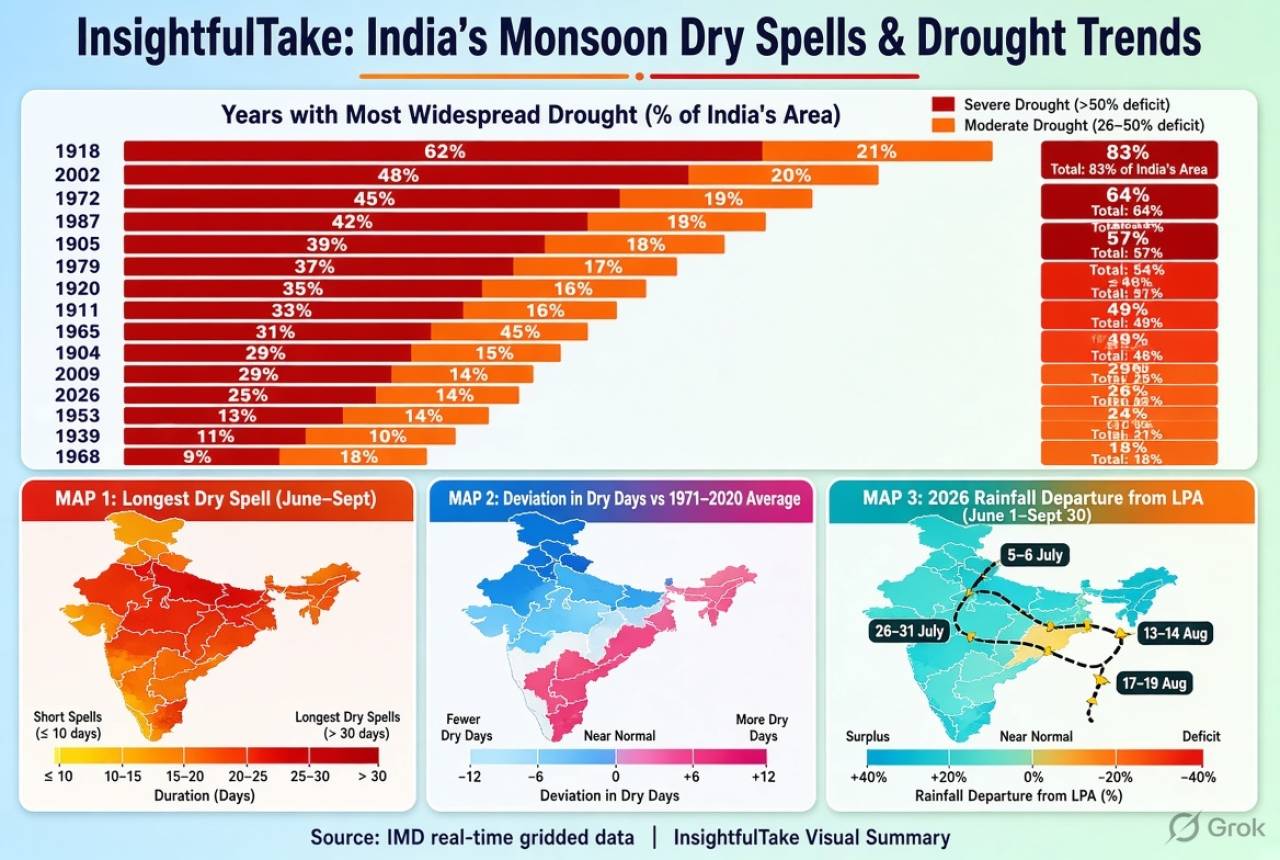
India’s 2026 monsoon delivered a sharp contrast: floods in some regions, long dry spells in others, and drought-like conditions across 39% of the country.
India’s southwest monsoon ended with a sharp contrast across the country. Some regions received heavy rain and faced floods, while several others went through long periods without rain. An analysis of India Meteorological Department data shows that 39% of India’s geographical area experienced drought-like conditions during the June-September monsoon season.
The national rainfall figure alone does not show the full picture. The timing of rain, its distribution and the length of dry spells mattered greatly this year.
One of the weakest monsoons in recent history
The southwest monsoon is vital to India because it provides about 75% of the country’s annual rainfall. It affects farming, reservoirs, groundwater and the rural economy.
This year, monsoon rainfall was about 756 mm in area-weighted terms, making it the 17th lowest monsoon rainfall since 1901. It was around 10.5% below the 1971-2020 average, according to the analysis.
The drought figures add another concern. Gridded rainfall data showed that 39% of the country experienced drought-like conditions, while 11.7% was in the severe category.
The area under drought-like conditions was the 17th highest since 1901. The area classified as severe drought was the 25th highest during the same period.
These numbers do not mean that 39% of India was officially declared drought-hit. Drought is assessed using several indicators and does not depend only on the national rainfall average. However, a prolonged shortage of rain can create serious problems for crops, soil moisture and water supplies.
Long gaps between rain became a major problem
The length of dry spells was one of the important features of this monsoon.
Parts of Tamil Nadu, Andhra Pradesh, Karnataka, Maharashtra, Gujarat and Rajasthan recorded their longest dry spells of the June-September season. In some areas, the gap between rainy days stretched beyond 50 days.
Several states also had more dry days than the average recorded between 1971 and 2020.
For farmers, the number of rainy days can be as important as the total amount of rain. A field may receive a reasonable amount of rainfall over four months, but crops can still suffer if most of that rain falls within a few heavy spells followed by weeks of dry weather.
This is especially difficult for farmers dependent on rain-fed agriculture. Long gaps can affect sowing, crop growth and soil moisture. Farmers may then have to depend more on groundwater or irrigation, where those facilities are available.
Floods and drought appeared together
The monsoon also showed a wide regional difference in rainfall.
Low-pressure systems forming over the Bay of Bengal brought heavy rain to parts of eastern and central India during July, August and September. Odisha, Chhattisgarh, Madhya Pradesh and parts of Uttar Pradesh received substantial rainfall from these systems.
As a result, floods and drought-like conditions occurred during the same monsoon season.
Bihar offers a clear example of this contradiction. Parts of the state remained deficient in rainfall, while flooding occurred because rivers and tributaries carried large volumes of water from Nepal and neighbouring areas.
This creates a difficult situation for farmers. Floods can damage crops, homes and roads, while rainfall shortages at other times can leave fields short of moisture. The same region can therefore face water excess and water shortage within the same season.
El Niño does not explain everything
The monsoon also took place amid concerns over El Niño, the periodic warming of the central and eastern Pacific Ocean that can influence weather patterns around the world, including the Indian monsoon.
However, the rainfall distribution this year cannot be explained by El Niño alone. The behaviour of weather systems within the monsoon season also influenced where rain fell and where long dry spells developed.
The bigger lesson from the 2026 monsoon is that India cannot judge rainfall only by looking at one national percentage.
A national average can hide major differences between states, districts and even neighbouring areas. One place may be dealing with flood while another is struggling with dry soil and falling water levels.
For farmers and policymakers, these differences matter.
India’s southwest monsoon ended with a sharp contrast across the country. Some regions received heavy rain and faced floods, while several others went through long periods without rain. An analysis of India Meteorological Department data shows that 39% of India’s geographical area experienced drought-like conditions during the June-September monsoon season.
The national rainfall figure alone does not show the full picture. The timing of rain, its distribution and the length of dry spells mattered greatly this year.
One of the weakest monsoons in recent history
The southwest monsoon is vital to India because it provides about 75% of the country’s annual rainfall. It affects farming, reservoirs, groundwater and the rural economy.
This year, monsoon rainfall was about 756 mm in area-weighted terms, making it the 17th lowest monsoon rainfall since 1901. It was around 10.5% below the 1971-2020 average, according to the analysis.
The drought figures add another concern. Gridded rainfall data showed that 39% of the country experienced drought-like conditions, while 11.7% was in the severe category.
The area under drought-like conditions was the 17th highest since 1901. The area classified as severe drought was the 25th highest during the same period.
These numbers do not mean that 39% of India was officially declared drought-hit. Drought is assessed using several indicators and does not depend only on the national rainfall average. However, a prolonged shortage of rain can create serious problems for crops, soil moisture and water supplies.
Long gaps between rain became a major problem
The length of dry spells was one of the important features of this monsoon.
Parts of Tamil Nadu, Andhra Pradesh, Karnataka, Maharashtra, Gujarat and Rajasthan recorded their longest dry spells of the June-September season. In some areas, the gap between rainy days stretched beyond 50 days.
Several states also had more dry days than the average recorded between 1971 and 2020.
For farmers, the number of rainy days can be as important as the total amount of rain. A field may receive a reasonable amount of rainfall over four months, but crops can still suffer if most of that rain falls within a few heavy spells followed by weeks of dry weather.
This is especially difficult for farmers dependent on rain-fed agriculture. Long gaps can affect sowing, crop growth and soil moisture. Farmers may then have to depend more on groundwater or irrigation, where those facilities are available.
Floods and drought appeared together
The monsoon also showed a wide regional difference in rainfall.
Low-pressure systems forming over the Bay of Bengal brought heavy rain to parts of eastern and central India during July, August and September. Odisha, Chhattisgarh, Madhya Pradesh and parts of Uttar Pradesh received substantial rainfall from these systems.
As a result, floods and drought-like conditions occurred during the same monsoon season.
Bihar offers a clear example of this contradiction. Parts of the state remained deficient in rainfall, while flooding occurred because rivers and tributaries carried large volumes of water from Nepal and neighbouring areas.
This creates a difficult situation for farmers. Floods can damage crops, homes and roads, while rainfall shortages at other times can leave fields short of moisture. The same region can therefore face water excess and water shortage within the same season.
El Niño does not explain everything
The monsoon also took place amid concerns over El Niño, the periodic warming of the central and eastern Pacific Ocean that can influence weather patterns around the world, including the Indian monsoon.
However, the rainfall distribution this year cannot be explained by El Niño alone. The behaviour of weather systems within the monsoon season also influenced where rain fell and where long dry spells developed.
The bigger lesson from the 2026 monsoon is that India cannot judge rainfall only by looking at one national percentage.
A national average can hide major differences between states, districts and even neighbouring areas. One place may be dealing with flood while another is struggling with dry soil and falling water levels.
For farmers and policymakers, these differences matter.



















Leave a Comment