
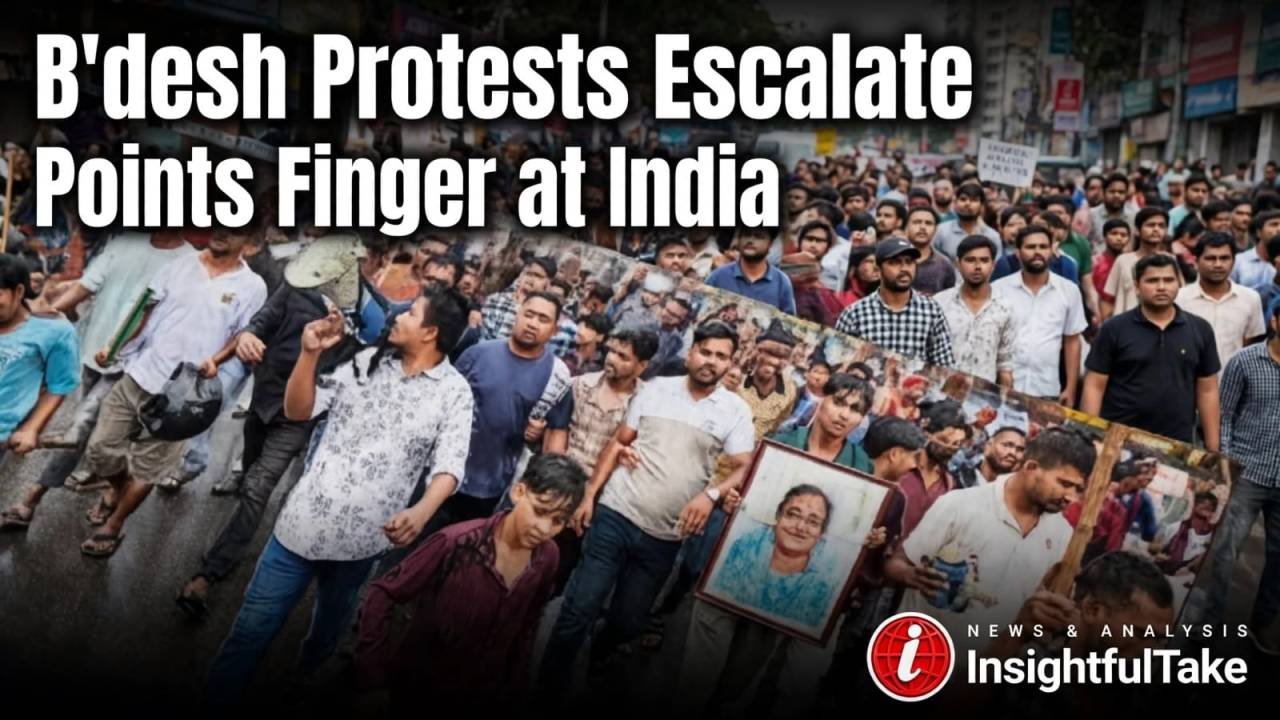
Sheikh Hasina's proposed return from India has reignited Bangladesh's political crisis, creating fresh challenges for Tarique Rahman's government and New Delhi.
Bangladesh is witnessing another spell of political unrest, with the dispute over former Prime Minister Sheikh Hasina's return exposing deep divisions within the country's political establishment. What appears to be a disagreement over a passport has quickly turned into a wider confrontation involving street violence, political arrests, India-Bangladesh relations and the future of the Awami League.
On Thursday, a bus and a truck were set on fire on the Dhaka-Chattogram highway. Crude bombs reportedly exploded across six districts overnight, while a section of railway line was also set ablaze. In Dhaka, police arrested 107 people within 24 hours over suspected links to the Awami League.
The immediate trigger was Hasina's reported request for a new passport. Living in India since fleeing Bangladesh during the student-led uprising in August 2024, the 78-year-old former prime minister has indicated that she intends to return in December. Bangladesh's refusal to issue her a passport has added another layer to an already bitter political confrontation.
The Awami League responded with a week of protests, culminating in a nationwide shutdown. The protest received greater support in southern districts, where the party retains a stronger organisational presence, but failed to generate the same response across the country.
Two Political Rivals, Two Exiles
The political circumstances surrounding Sheikh Hasina and Prime Minister Tarique Rahman reveal an extraordinary reversal of fortunes.
Rahman spent 17 years in exile in London during Hasina's rule. He returned to Bangladesh, led his party to a landslide victory in February and assumed office as prime minister. Hasina, meanwhile, remains in Delhi, facing a death sentence handed down by a Bangladeshi tribunal in absentia.
The two leaders have effectively exchanged political positions. One has returned from exile to occupy the country's highest political office, while the other is attempting to find a way back from abroad.
Their personal histories have become inseparable from Bangladesh's political struggle. For Hasina, returning would mean challenging the legitimacy of the political order that emerged after her departure. For Rahman's government, allowing her return without addressing the charges against her could create serious political and legal complications.
The result is a confrontation in which neither side appears willing to make an early compromise.
Why India Has Become Part of Bangladesh's Political Crisis
India's role has become increasingly sensitive because Hasina has been living on Indian soil since August 2024.
Speaking in Lalmonirhat, a district bordering India, Rahman accused Awami League leaders of neglecting Bangladesh's national interests. He suggested that the country where they had taken refuge had become their master and that they were working against Bangladesh to please it. Although he did not name India, the reference was widely understood.
New Delhi faces a difficult diplomatic balancing act. Hasina's government maintained close relations with India, particularly on security and regional connectivity. However, Bangladesh remains an important neighbour with a population of around 170 million and significant economic and strategic relevance.
Dhaka has sought Hasina's extradition under the bilateral extradition treaty. India has so far not agreed to hand her over.
Relations had shown signs of improvement after Rahman took office. India sent Lok Sabha Speaker Om Birla and Foreign Secretary Vikram Misri to his swearing-in ceremony, while Bangladesh's foreign minister visited New Delhi in April. However, Rahman's expected visit to India appears to have stalled, with Dhaka making Hasina's return an important condition for further political engagement.
The longer the dispute continues, the greater the risk that a bilateral relationship built around trade, security and regional cooperation will become hostage to one political personality.
Ordinary Bangladeshis Bear the Cost
Political confrontations are usually led by powerful leaders, but their consequences reach ordinary citizens first.
Recent incidents have included attacks on vehicles, shops and political workers. Passengers travelling on the Dhaka-Chattogram highway escaped unharmed when vehicles were set on fire, but such incidents expose the risks faced by people who have little control over the political developments around them.
Shops in Gopalganj town were vandalised. Two BNP members were reportedly killed on Wednesday night, while the houses of two BNP lawmakers in Hasina's home district came under attack.
Meanwhile, garment workers are continuing their separate protests demanding higher wages. Their economic concerns risk receiving less attention as political tensions dominate public debate.
Disrupted highways, railway services and commercial activity also affect businesses and workers across the region. Border communities in West Bengal, Assam, Tripura and Bihar have economic and family connections with Bangladesh. Any prolonged disruption can affect cross-border trade, transport and livelihoods.
Bangladesh's political leadership cannot afford to treat these developments merely as a contest between rival parties. Public safety and economic stability must remain central to the government's response.
December Could Become Another Political Flashpoint
Hasina has indicated that she intends to return to Bangladesh, with or without a passport. The possibility has created another source of uncertainty for Rahman's government.
If she attempts to enter Bangladesh, authorities will face difficult decisions involving her legal status, the pending judicial proceedings and the political consequences of her arrival. Any attempt to arrest her could trigger further protests, while negotiations could invite criticism from political opponents.
The Awami League maintains that it deserves political space, particularly after being barred from participating in elections. The government, on the other hand, accuses the party of using violence and unrest to destabilise the country.
These competing positions reflect a deeper problem in Bangladesh's democratic transition. A political system cannot achieve lasting stability simply by excluding a major political force, nor can a party claim democratic legitimacy while its supporters are accused of violence and intimidation.
Accountability for alleged crimes and the right to political participation need to be addressed through credible institutions rather than street confrontations.
Bangladesh and India Need a Way Beyond Political Rivalry
Bangladesh needs political stability, credible institutions and an environment in which citizens can participate without fear. Repeated arrests, shutdowns and retaliatory violence will only deepen the country's divisions.
India, meanwhile, must assess the long-term consequences of its position. Protecting its diplomatic interests cannot mean overlooking the importance of a stable relationship with Dhaka. Equally, any decision concerning Hasina must take into account legal obligations, humanitarian considerations and regional stability.
The December deadline may become another major test for Bangladesh's new political leadership and India's neighbourhood diplomacy. The passport dispute has exposed much deeper questions about political accountability, exile, democratic participation and the future of bilateral relations.


















Leave a Comment