
Bihar has seized crores of litres of liquor under prohibition. But rising narcotics cases and gaps in addiction treatment reveal a growing challenge the state cannot afford to ignore.
For ten years, Bihar has fought one enemy with everything it has. Police have seized around 3.16 crore litres of liquor and made about 7.15 lakh arrests, averaging roughly 196 a day. Prohibition has been the state’s loudest promise, and its enforcement has been relentless.
But a state can be so busy guarding the front door that it fails to hear the back wall coming down.
The Numbers Nobody Is Shouting About
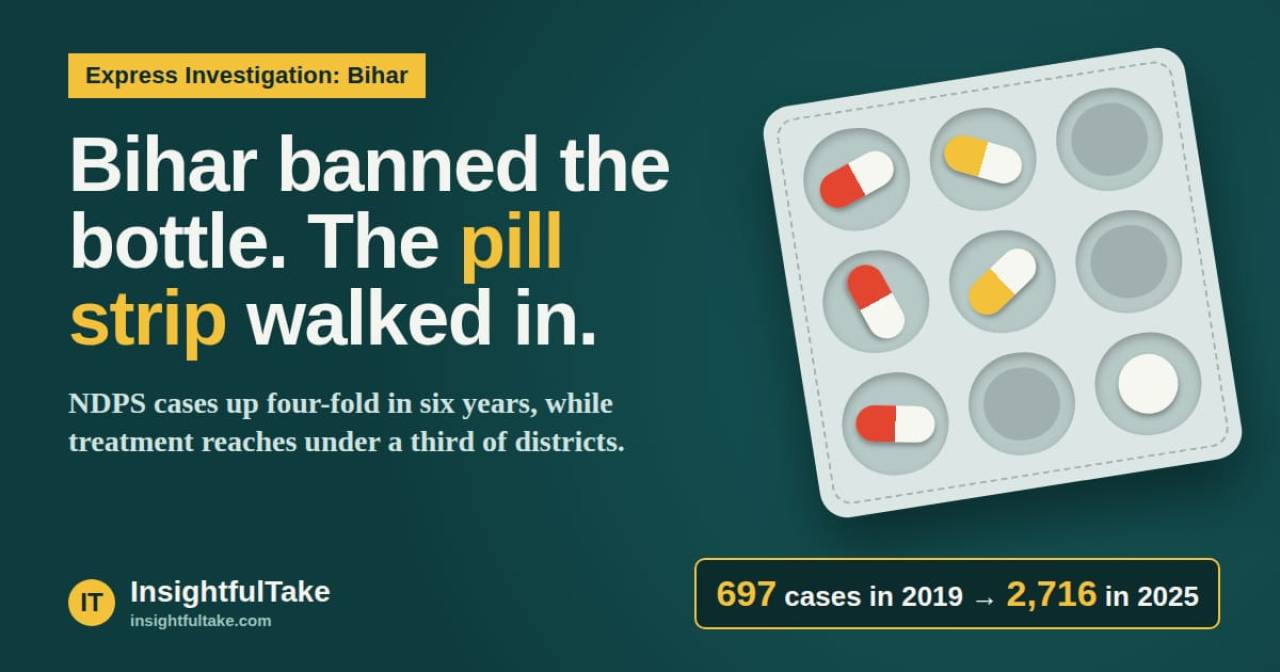
Bihar Police data reviewed by The Indian Express shows narcotics cases registered under the Narcotic Drugs and Psychotropic Substances (NDPS) Act rising from 1,822 in 2022 to 2,716 in 2025. The first five months of 2026 have already recorded 1,905 cases, 83 more than the entire year of 2022. In 2019, the state registered just 697 cases for the whole year.
The number of accused also jumped sharply, from 2,112 in 2024 to 4,146 in 2025, nearly doubling in a single year.
Seizure patterns have changed too. The emerging market runs on pocket-sized packets, tablet strips, vials and heroin, including a local variant called “kota”, sometimes concealed in soap boxes. Smugglers have found that pills are easier to hide and transport than liquor bottles.
A report from Patna put capsule seizures at more than 10.71 lakh in just seven months. In another major seizure, the Directorate of Revenue Intelligence (DRI) recently caught a passenger carrying 2.949 kg of methaqualone at Patliputra Junction, with the consignment valued at around ₹36 crore.
The pattern points to a drug market that is becoming harder to detect, transport by transport and packet by packet.
Did Prohibition Cause This?
This is where honesty matters. The data shows drug cases rising alongside prohibition, but it does not establish that one caused the other.
Drug trafficking is influenced by several factors, including Bihar’s open border with Nepal, connectivity challenges, unemployment and the wider problem of pharmaceutical drug misuse across India.
Some critics argue that restricting alcohol has encouraged certain users and sellers to turn to substances that are cheaper, easier to carry and harder to detect. Supporters of prohibition counter that the ban has reduced domestic violence and household spending on liquor, while maintaining that the government remains committed to controlling both alcohol and drugs.
Both arguments deserve scrutiny. Neither should be accepted without evidence.
What is harder to ignore is the imbalance in enforcement. Bihar has spent a decade building an extensive machinery to implement prohibition. The rise in drug cases raises a pressing question: has the state developed an equally effective response to narcotics trafficking, pharmaceutical misuse and addiction?
A policy can remain firmly in place while the nature of the problem changes around it.
The Cure Is Missing
The sharpest warning may not be about arrests or seizures. It is about treatment.
Beneficiaries at de-addiction centres under the Nasha Mukt Bharat Abhiyaan rose from 1,487 in 2022–23 to 29,429 in 2024–25, a nearly twenty-fold increase.
These figures indicate a growing demand for support, although they do not, by themselves, establish the scale of addiction across the state. They also raise questions about whether treatment services are expanding quickly enough to meet that demand.
Yet centrally supported treatment facilities operate in fewer than one-third of Bihar’s districts.
For a state with a population of more than 12 crore, this is a serious gap. Addiction cannot be addressed through police action alone. It requires accessible treatment, trained counsellors, mental health support, rehabilitation and follow-up care to help people avoid relapse.
When treatment is distant, expensive or difficult to access, families are often left to manage the crisis themselves. Many may not know where to seek help or may hesitate because of the stigma attached to addiction.
A state that can mobilise thousands of arrests must also ask how many people it can bring into effective treatment.
A Crisis for Children
The drug trade carries another danger: its potential reach among adolescents and young adults.
Police officers cited in the investigation have expressed concern that the expanding market could contribute to juvenile crime. Cheap pills, small packets and informal distribution networks can make certain substances easier to obtain and conceal.
For a teenager in a Patna neighbourhood, access may not require a bar, a liquor bottle or an established supplier. It may take little more than ₹50 and a friend who knows someone.
The example is illustrative, not proof that all young people face the same level of exposure. But it captures the challenge facing law enforcement, schools and families: small quantities and informal networks can make drug use difficult to detect until dependence, poor academic performance or criminal involvement becomes visible.
The response must begin before that point.
Schools and colleges need access to counselling and early-intervention services. Parents need reliable information about warning signs. Young people struggling with substance use need a route to treatment that does not automatically label them criminals.
Those who organise trafficking and profit from addiction must face the law. Those who need medical care must be able to receive it.
Why the State’s Spine Is at Stake
A spine is more than bone. It carries weight, coordinates movement and keeps a body upright.
A state’s institutional spine is made up of its police, hospitals, schools, counsellors and community services working together.
Bihar has spent a decade training its enforcement machinery to hunt down liquor. But the expanding drug problem demands a broader institutional response. Healthcare services remain unevenly distributed, prevention efforts need greater reach, and young people facing unemployment and social insecurity need credible alternatives.
The problem is not that every institution has failed. It is that their efforts have yet to come together at the scale the crisis demands.
Police can seize drugs, but they cannot rehabilitate an entire population of people struggling with addiction. Hospitals can treat patients, but they cannot dismantle trafficking networks. Schools can raise awareness, but they cannot replace accessible mental health services.
Without coordination, each institution tackles one part of the problem while the larger system continues to struggle.
That is how a crisis grows in the gaps between departments.
What Would Strengthen Bihar’s Response?
1. Treatment facilities in every district
Bihar needs accessible de-addiction services across the state, backed by trained counsellors, medical professionals, rehabilitation programmes and follow-up support. Treatment should not depend on a family’s ability to travel long distances.
2. Policing that targets suppliers and networks
Enforcement must focus on trafficking networks, wholesale suppliers, repeat offenders and the financial channels that sustain the trade. People struggling with addiction should be directed towards treatment wherever appropriate, rather than treated as interchangeable with organised traffickers.
3. Tighter monitoring of pharmaceutical supplies
The state needs stronger monitoring of pharmacies, wholesale distributors and suspicious medicine sales. Prescription drugs and other pharmaceutical substances can be diverted into illegal markets, making regulatory oversight essential.
4. Schools and colleges as first responders
Educational institutions should have trained counsellors, age-appropriate awareness programmes and clear referral systems. Students who need help must be able to seek it without fear of humiliation or automatic criminalisation.
5. Transparent public data
Bihar should publish regular, district-wise figures on drug cases, seizures, arrests, prosecutions, treatment access and rehabilitation outcomes. Arrests and seizures measure enforcement activity; they do not, on their own, establish whether drug use and addiction are declining.
Public data would help citizens assess whether the state’s response is working and where resources are most urgently needed.
Final Take
Bihar has demonstrated that it can enforce a ban on an extraordinary scale. The harder test is whether it can show the same determination in confronting the quieter, less visible and potentially devastating drug crisis spreading through its communities.
The liquor bottle was visible, so the state hunted it. The pill strip is small, easy to conceal and often harder to trace. The state must now learn to recognise the threat it poses.
A decade of prohibition has not, by itself, made Bihar safe from substance abuse. Nor does the rise in drug cases prove that prohibition caused the crisis. What the figures do show is that the state faces a changing challenge that demands more than the enforcement model it has relied on for years.
The next decade will be judged not simply by the number of bottles seized or people arrested, but by whether fewer young people become trapped in addiction, whether treatment reaches those who need it, and whether trafficking networks are effectively dismantled.
A state’s strength is measured not only by what it bans, but also by what it prevents, treats and restores.


















Leave a Comment