
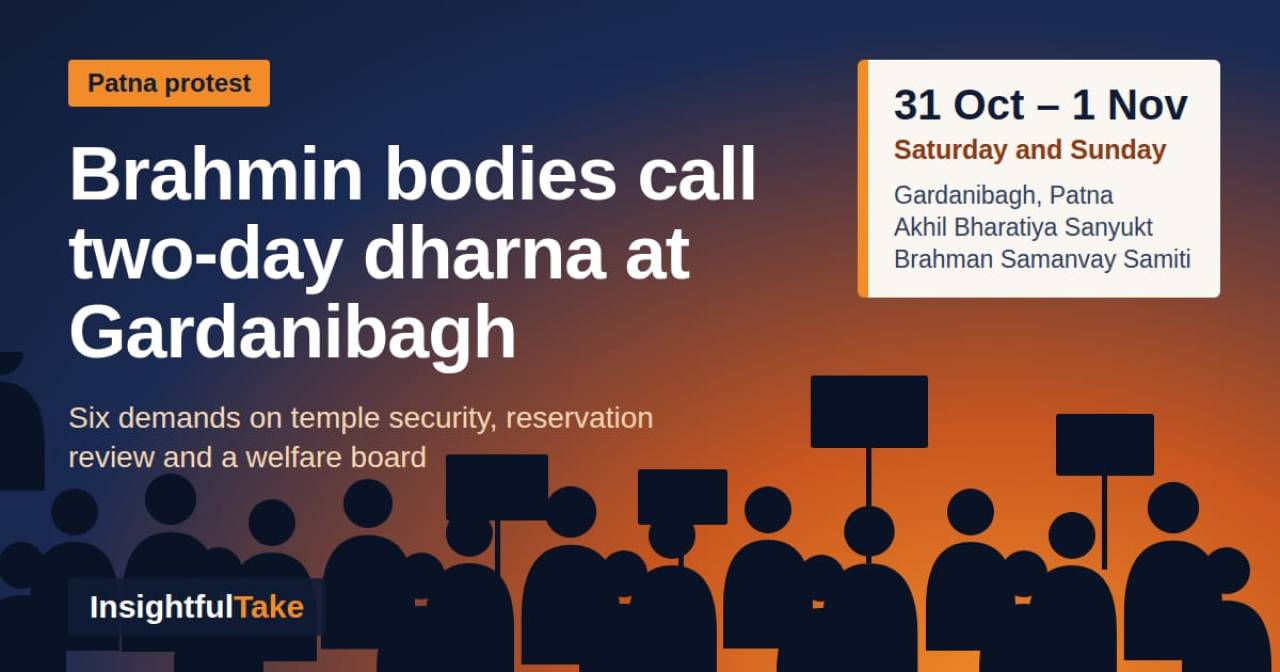
Temple security, reservation review and a Brahmin welfare board among the demands for October 31 and November 1.
The Akhil Bharatiya Sanyukt Brahman Samanvay Samiti has called a two-day dharna at Gardanibagh in Patna on October 31 and November 1, inviting members of the upper-caste Sanatan community who share its concerns to join the protest and press a six-point charter of demands before the state and central governments.
The organisers have described the event as a symbolic two-day demonstration. The call has been issued by Ashutosh Kumar Jha, founder of the Rashtriya Brahman Mahasabha and the Parshuram Seva Sansthan.
The event's publicity material carries the slogans “Brahman Ekta Zindabad” and “Sanatan Dharma Zindabad”, alongside an image of Bhagwan Parshuram.
Six Demands of the Organisers
The Samiti has outlined six demands concerning community welfare, religious institutions, reservation and legislation:
- Security for priests and mahants: Protection of the lives and property of priests and mahants associated with maths and temples.
- Removal of encroachments: Clearance of encroachments from math and temple land.
- Withdrawal of the UGC law: Withdrawal of the legislation or regulatory provisions referred to by the organisers as the UGC law.
- Abolition of the SC/ST Act: Repeal of the Scheduled Castes and Scheduled Tribes (Prevention of Atrocities) Act.
- Review of reservation: A review of the reservation system, with benefits extended to poor people across communities.
- Welfare boards and commissions: Establishment of a Brahmin Welfare Board in Bihar on the Telangana model, along with a Brahmin Commission or Savarna Commission at the state and central levels. The organisers also seek Brahmin hostels in every district to support education for economically disadvantaged members of the community.
An Appeal for Community Unity
The announcement is accompanied by an open letter from the Parshuram Seva Sansthan and the Rashtriya Brahman Mahasabha, addressed to members of the community. Beginning with “Jai Parshuram, Jai Chanakya”, the letter extends greetings for Navratri, Diwali, Bhai Dooj and Chhath.
The letter says the organisations have worked for decades on the community's social, cultural, economic and spiritual concerns. It argues that greater unity would help address the problems facing its members.
To underline the community's historical contributions, the letter names figures such as Dadhichi, Vashishta, Bhagwan Parshuram, Chanakya, Adi Shankaracharya and Mandan Mishra. It also cites freedom fighters Mangal Pandey, Chandrashekhar Azad and Bal Gangadhar Tilak.
According to the organisers, these figures contributed to the country's security, intellectual traditions and freedom struggle. The letter argues that the present generation must organise itself to take up similar responsibilities.
The organisations allege that political calculations have sidelined the community. They contend that reservation policies have been influenced by vote-bank considerations, affecting the opportunities available to young people and undermining the principle of equal rights. The letter accuses political parties of dividing society for electoral gains and says the practice should no longer be tolerated.
Merit, Reservation and Representation
Merit and representation form a central part of the organisations' argument. The letter claims that candidates scoring 90 per cent are excluded from opportunities while those scoring below 40 per cent receive a disproportionate share of administrative positions. It presents this as evidence of a system that, in its view, fails to reward merit.
The organisers call for economic empowerment, poverty reduction, quality education and equal opportunities. They argue that children from every caste, religion and community should receive the support needed to develop their abilities.
The letter also criticises the SC/ST Act, alleging that members of a large section of society face unnecessary harassment under its provisions. It refers to the Supreme Court's role in debates over the law and questions why the government, which abrogated Article 370, cannot repeal legislation that the organisers consider discriminatory.
These are the organisations' stated positions. The demands remain politically contested, particularly the proposed repeal of the SC/ST Act and the call for a fundamental review of reservation policy.
A Platform Beyond Party Politics
The organisers say the Samiti does not align itself with any political party or faction. The letter states that the organisation is neither opposed to nor formally aligned with any party and expresses support for the central and state governments.
“Our fight is not with the system, but with its flaws,” the letter says.
The organisers also state that discussions targeting individual political parties or leaders will not be permitted on the platform. Decisions taken collectively, they say, will be binding on members.
The letter describes the organisation as a common forum where Brahmins affiliated with different political parties can raise community concerns together. It places society, the state and the nation above party interests.
Building the Organisation From the Grassroots
The letter outlines a plan to expand the organisation through village-level participation. Where a unit does not exist in a gram panchayat, members are encouraged to organise a general meeting and elect local representatives rather than have office-bearers appointed from above.
The same process is proposed at block and district levels. The organisers argue that leadership should emerge from within communities and remain connected to villages.
The letter urges members to participate without delay, arguing that democratic institutions are more likely to respond to groups that act collectively. It calls for a sustained campaign to protect the community's interests and contribute to what it describes as building a “golden bird” India.
Gardanibagh: Patna's Protest Venue
Gardanibagh is an established location for demonstrations in Patna. The Patna High Court designated a site in the locality for dharnas and protests to reduce disruption to residents and traffic in busier parts of the city.
Organisations holding demonstrations there generally inform the district administration in advance. The Samiti's proposed gathering is expected to bring participants from different districts of Bihar.
The Wider Debate Over Reservation and Caste-Based Protection
The demands raised by the Samiti touch on contentious questions in Indian public life, including caste-based discrimination, reservation, economic disadvantage and the role of community-specific welfare institutions.
Supporters of the SC/ST (Prevention of Atrocities) Act, including Dalit organisations, regard it as an essential legal safeguard against caste-based violence and discrimination. Advocates of reservation argue that it addresses historical exclusion and continuing barriers to representation.
At the same time, several organisations representing upper-caste communities have called for greater emphasis on economic disadvantage when determining access to welfare and opportunities. Demands for community-specific boards and commissions reflect a broader debate over how governments should address the needs of economically disadvantaged groups.
The proposed dharna in Patna will provide a platform for the Samiti to press its demands. Its reception will depend on participation, the response of the authorities and the wider political debate surrounding its six-point charter.















Leave a Comment