
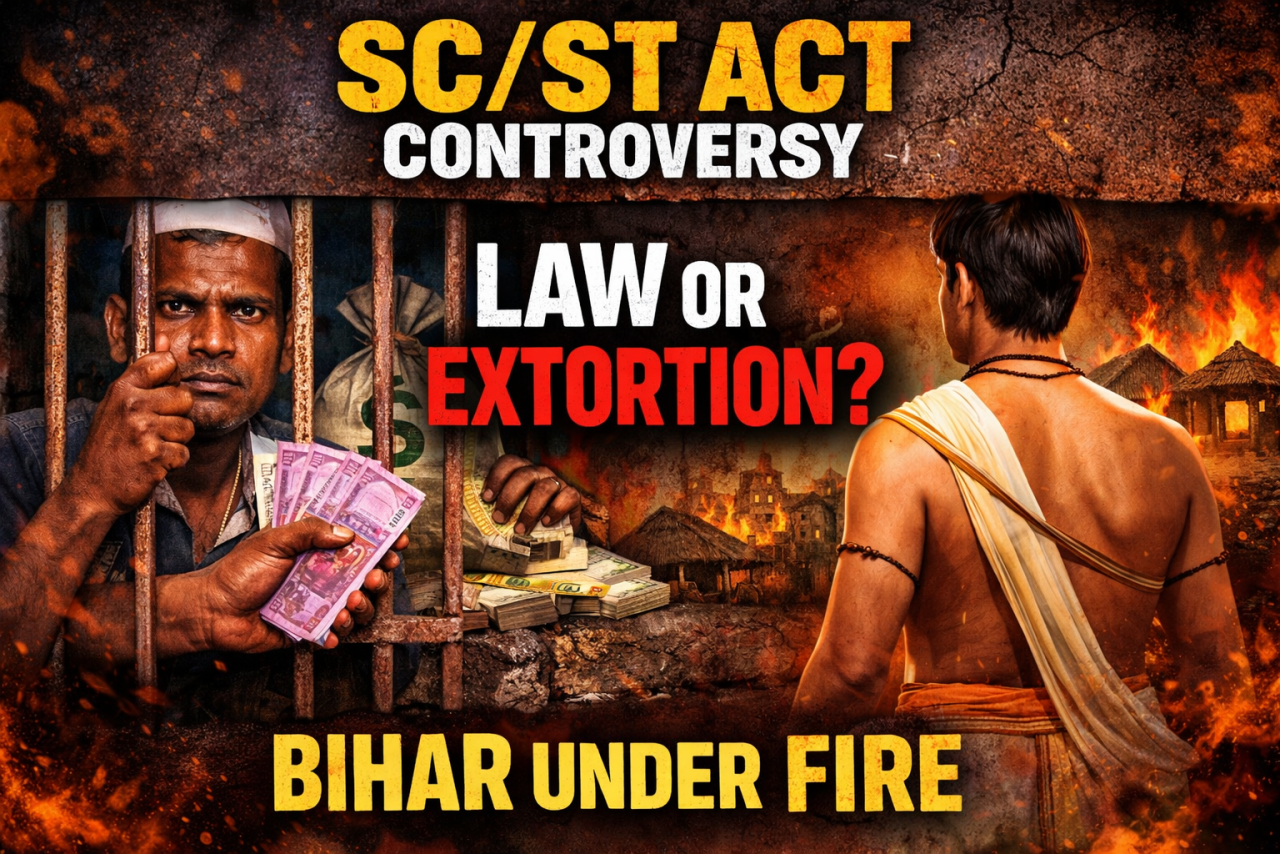
A village dispute in Bihar’s Darbhanga has spiralled into a legal and social flashpoint, raising difficult questions about how powerful laws operate within fragile rural realities.
The developments in Harinagar village in Bihar’s Darbhanga district have brought renewed attention to the functioning of the Scheduled Castes and Scheduled Tribes (Prevention of Atrocities) Act, 1989 within rural social contexts. What began as a dispute over a payment of approximately ₹2.5 lakh has since expanded into a large criminal case involving more than 200 accused, arrests, and allegations that extend beyond the immediate incident.
The episode has, in effect, become a point of reference in a wider debate on how stringent legal provisions operate in socially complex environments.
A Local Dispute, A Widening Case
According to accounts from the area, the initial disagreement arose from a financial dispute between a Dalit family and members of the Savarn community. The situation reportedly escalated into a confrontation, following which allegations of caste-based abuse and violence were made.
Subsequently, a First Information Report (FIR) was registered under relevant provisions of the SC/ST Act. The scale of the FIR has drawn particular attention:
- More than 200 individuals have been named
- Several of the accused are said to have been included as part of a larger group
- Families, rather than individuals alone, appear to have been drawn into the case
Arrests were carried out shortly thereafter, and a police presence was established in the village to maintain order.
Allegations of Informal Settlement Efforts
In recent days, local accounts have also referred to attempts at an informal settlement. It is alleged that an individual identified as Ram Vilash Paswan approached a former Mukhiya (village head), as well as certain members of the Savarn community, to explore the possibility of resolving the matter through financial compensation.
These claims suggest:
- Private outreach to selected individuals
- Discussions involving monetary settlement in exchange for relief in the case
- Reluctance among some to speak publicly, citing concerns of escalation
It must be noted that these allegations have not been independently verified by investigating agencies. However, their circulation has contributed to a perception that formal legal proceedings and informal negotiations may be intersecting in this instance.
Social Context and Its Implications
The resonance of the Harinagar case cannot be understood in isolation from Bihar’s social composition. As per Census data:
- Scheduled Castes constitute roughly 16% of the population
- Scheduled Tribes account for about 1.3%
In rural areas, caste continues to influence economic arrangements, labour relations, and access to local authority. Consequently, disputes—particularly those involving financial or social tensions—often acquire a broader social dimension.
In such a setting, the invocation of the SC/ST Act transforms a localised disagreement into a matter with community-wide implications.
Similar Incidents and Emerging Concerns
Observers point to comparable developments in other parts of the State.
In Korthu village in Rohtas district, a local dispute reportedly led to the registration of a case involving multiple accused, raising concerns about the breadth of implication.
In the Ghanshyampur region of Darbhanga, recent clashes are also said to have resulted in FIRs under the SC/ST Act, with some residents expressing concern about the inclusion of a large number of individuals.
While each case differs in its specific facts, a pattern is being discussed in public discourse:
- A local dispute, often economic in nature
- Escalation into confrontation
- Allegations invoking caste-based provisions
- Registration of a wide-ranging FIR
Whether this reflects misuse of the law or the inherent complexity of caste-linked conflicts remains a matter of debate.
The Nature of the Law
The SC/ST Act was enacted to address entrenched patterns of caste-based discrimination and violence. Its provisions are deliberately stringent, incorporating:
- Non-bailable offences in several instances
- Immediate police intervention
- Provision for trial in designated courts
These features are intended to ensure that complaints are acted upon promptly and that victims are afforded legal protection.
At the same time, the law’s strength can result in significant immediate consequences for those accused, including arrest, social stigma, and the burden of legal proceedings. It is this dual effect that often places such cases at the centre of public debate.
Divergent Perceptions
In Harinagar, as in similar cases, perceptions appear to be divided.
Sections of the Scheduled Caste community emphasise the necessity of the law, arguing that without such provisions, instances of caste-based abuse would remain underreported or unaddressed.
Conversely, some among the accused families contend that the scale of the FIR has resulted in undue hardship and that individuals not directly involved may have been implicated.
These contrasting viewpoints reflect broader tensions in rural society, where questions of justice, identity, and power are closely intertwined.
Official Position
Law enforcement authorities have maintained that the investigation is ongoing and that all actions will be guided by evidence. Officials have indicated that:
- Individual roles will be examined carefully
- No conclusions will be drawn solely on the basis of allegations
- Steps are being taken to maintain peace in the area
Such an approach is likely to be critical in ensuring both accountability and fairness.
A Question of Balance
The Harinagar case underscores the challenges inherent in implementing strong legal safeguards within complex social settings. The SC/ST Act remains an essential instrument for addressing historical injustice. At the same time, its application in situations involving large numbers of accused raises questions about proportionality and due process.
Ultimately, the issue may not lie in the law itself, but in ensuring that its use inspires confidence across communities.
Final Take
As the investigation proceeds, the facts of the Harinagar case will be tested through due process. However, the broader concerns it has brought to the fore are unlikely to recede quickly.
At stake is not only the outcome of a single case, but the larger question of how legal mechanisms can function effectively in socially stratified environments—delivering justice while sustaining trust.
In a State where caste continues to shape everyday life, maintaining that balance remains an ongoing challenge.





















Leave a Comment