
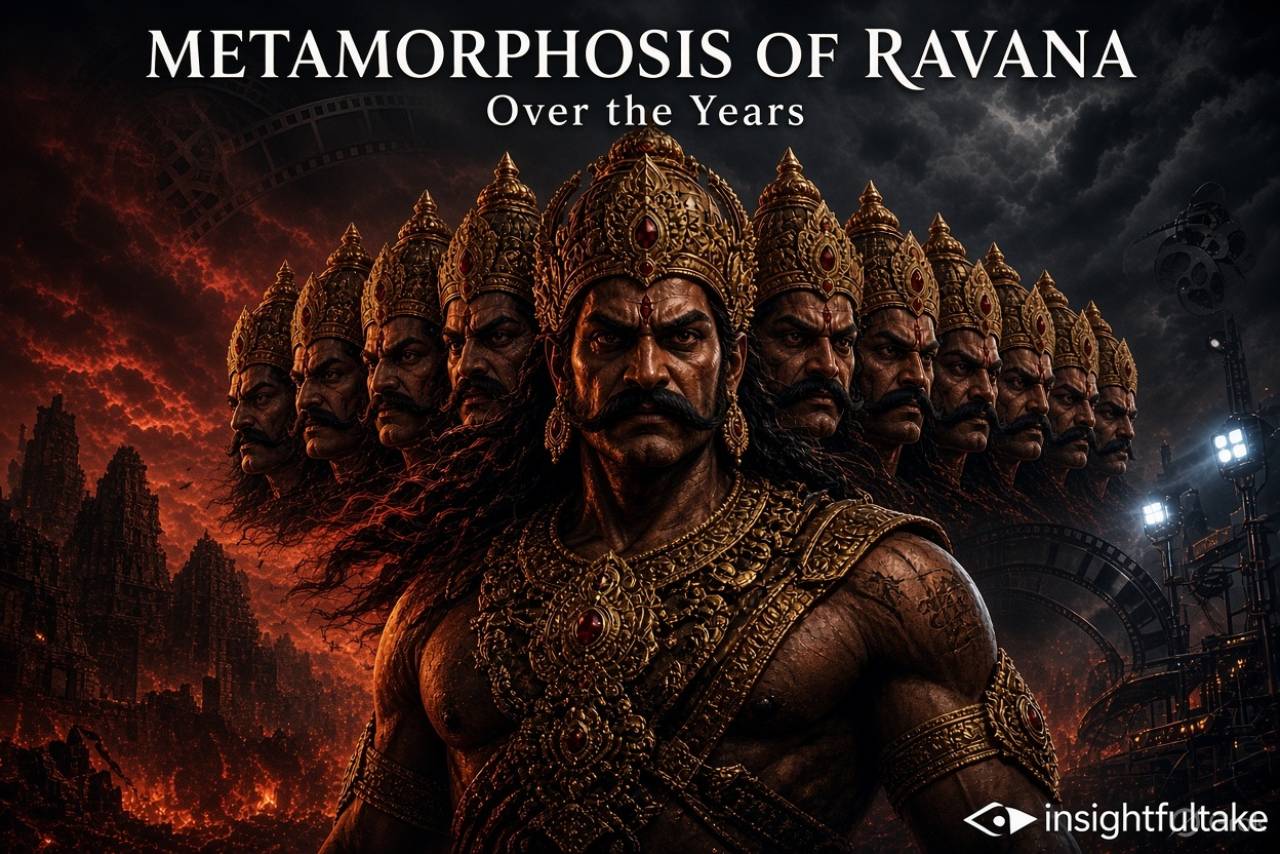
From Arvind Trivedi's iconic portrayal to Yash's upcoming role, discover how Indian cinema has reimagined Ravana across generations.
Ravana has evolved on screen from a formidable mythological villain into a layered character shaped by changing ideas of power, pride, knowledge and ambition. From silent cinema to big-budget spectacles, each generation has found a new way to portray the legendary king of Lanka.
Ravana remains one of the most striking figures in the Ramayana. The ten-headed king of Lanka was a great scholar, a devotee of Lord Shiva, a powerful ruler and the man who abducted Sita, setting the stage for his final battle with Rama. His character combines extraordinary abilities with personal flaws, making him one of the most compelling figures in Indian mythology.
Over more than a century, Indian cinema and television have repeatedly reinterpreted Ravana. What began as a largely one-dimensional antagonist has gradually opened the door to portrayals that explore his scholarship, royal stature, devotion and complex personality.
The Early Years: Ravana as the Face of Evil
Ravana's cinematic journey began in the early years of Indian filmmaking. Dadasaheb Phalke's Lanka Dahan (1917) is among the earliest landmark mythological films associated with his story. In the silent-film era, storytelling depended heavily on visual gestures, dramatic expressions and recognisable symbols.
Ravana was presented primarily as a powerful and frightening opponent of Rama. The emphasis was on the familiar moral conflict between good and evil, leaving little room for psychological depth.
This approach reflected the storytelling conventions of early mythological cinema. Audiences already knew the broad outline of the Ramayana, so the film's task was to bring its characters and dramatic events to life on screen.
South Indian Cinema Gives Ravana Grandeur
During the 1950s and 1960s, South Indian cinema brought greater scale and theatrical intensity to mythological characters. Ravana began to emerge not merely as a demon king but as a ruler whose strength, learning and pride commanded attention.
N. T. Rama Rao, popularly known as NTR, portrayed Ravana in films such as Bhookailas (1958) and Seetha Rama Kalyanam (1961). Having also played Rama in other productions, NTR was familiar with both sides of the epic's central conflict.
His portrayal gave Ravana a commanding presence. The character's arrogance remained central, but his stature as a king and scholar added another dimension. Ravana was no ordinary enemy. He possessed knowledge, authority and ambition, even as his pride led him towards destruction.
Other celebrated South Indian actors, including Dr Rajkumar and S. V. Ranga Rao, also contributed to the tradition of powerful mythological performances. Through elaborate costumes, expressive acting and theatrical dialogue, this period helped establish Ravana as a character who could dominate a scene rather than simply serve as an obstacle for the hero.
Ramanand Sagar's Ramayan Makes Ravana a Household Name
Television transformed Ravana's place in popular culture in 1987, when Ramanand Sagar's Ramayan brought the epic into millions of Indian homes.
Arvind Trivedi's portrayal became one of the most recognisable screen interpretations of the character. His forceful voice, dramatic expressions, imposing appearance and displays of anger made Ravana unforgettable to viewers.
For a generation that followed the serial week after week, Trivedi became closely associated with the king of Lanka. His performance reinforced Ravana's identity as the embodiment of ego and unchecked power, while preserving the character's royal authority.
The success of the serial also demonstrated how television could shape collective cultural memory. Ravana was no longer a figure encountered only through religious texts, stage performances or occasional films. He became a familiar presence in everyday conversations, festivals and popular references.
For many viewers, subsequent portrayals would inevitably be compared with Trivedi's interpretation.
Beyond the Villain: Ravana Gets a Human Dimension
As television and cinema explored mythological stories through different narrative styles, some productions moved beyond the conventional image of Ravana as an unambiguous villain.
Shyam Benegal's historical television series Bharat Ek Khoj (1988), based on Jawaharlal Nehru's The Discovery of India, offered a different approach to presenting India's historical and cultural narratives. However, Ravana's cinematic and television portrayals are best understood through the broader range of mythological adaptations rather than treating every retelling as a direct character study.
In the 2008 television adaptation Ramayan, Akhilendra Mishra brought his own intensity to the role, retaining Ravana's commanding personality and royal stature.
These portrayals continued a long-standing tension in the character's representation. Ravana is remembered for abducting Sita and opposing Rama, but traditional narratives also describe him as learned, powerful and devoted to Shiva. These qualities do not erase his wrongdoing; instead, they make his downfall a story about the misuse of extraordinary abilities.
The contrast between his achievements and his fatal flaws gives filmmakers considerable scope to explore the character without abandoning the moral framework of the epic.
Raavan and Adipurush: Modern Interpretations, Mixed Responses
Modern filmmakers have experimented with Ravana-inspired characters, shifting the focus from literal retellings of the epic to contemporary settings and visual reinventions.
In Mani Ratnam's Raavan (2010), Abhishek Bachchan played Beera, a character inspired by Ravana. Set in a modern world, the film explored the conflict between authority, rebellion, morality and personal relationships. Beera was not a direct recreation of the mythological king, but the connection allowed the filmmaker to revisit familiar themes through a contemporary narrative.
The film demonstrated that Ravana's story could inspire characters who exist outside the traditional mythological setting.
A more direct reinterpretation arrived with Adipurush (2023), in which Saif Ali Khan portrayed Lankesh, the film's version of Ravana. The character's appearance and presentation departed from familiar visual conventions, relying on a modern costume design, stylised imagery and extensive visual effects.
The film faced substantial criticism from sections of its audience over its character designs, dialogue and treatment of the epic. The response highlighted a central challenge for filmmakers adapting culturally significant stories: visual innovation must contend with deeply rooted public expectations.
Nevertheless, Adipurush showed that Ravana remains a character through whom filmmakers attempt to test the boundaries of mythological storytelling.
Television Continues to Explore Ravana's Many Shades
Television has continued to offer different interpretations of the king of Lanka.
Karthik Jayaram portrayed Ravana in Siya Ke Ram, a series that gave greater attention to Sita's perspective on the epic. Nikitin Dheer took on the role in Shrimad Ramayan, while Shalin Bhanot played Ravana in Ram Siya Ke Luv Kush.
Each production brought its own performance style, visual language and narrative emphasis. Some leaned towards traditional depictions of the powerful antagonist, while others sought to provide additional context to the characters and events surrounding the central conflict.
This variety reflects the flexibility of the Ramayana as a storytelling tradition. Its characters have been interpreted differently across regions, languages, theatre, literature, television and cinema. Ravana's screen identity continues to change as creators explore different aspects of the same enduring narrative.
Yash's Ravana: The Next Chapter
Another major interpretation is expected in Nitesh Tiwari's two-part Ramayana, featuring Yash as Ravana, Ranbir Kapoor as Rama and Sai Pallavi as Sita.
Yash has spoken about Ravana as an exciting role because of the character's multiple shades and nuances. His involvement as a co-producer also places him in a position to contribute to how the character is presented.
The production is expected to combine large-scale visuals with contemporary filmmaking techniques while drawing on one of India's most influential epics. The challenge will be to create a compelling screen presence without reducing Ravana either to a conventional villain or to a romanticised figure whose flaws disappear behind his achievements.
Ravana's enduring appeal lies precisely in this tension. He is a formidable king and scholar, but his power does not protect him from the consequences of his actions. Any fresh interpretation must reckon with both sides of that legacy.
Why Ravana's Screen Image Keeps Changing
Ravana's cinematic journey reflects changing audience expectations and storytelling methods.
Early films presented him primarily as the enemy who had to be defeated. Mid-century productions emphasised his grandeur, strength and royal authority. Ramanand Sagar's television serial made him a defining cultural figure, while more recent adaptations have experimented with his appearance, motivations and moral complexity.
The ten heads, the golden city of Lanka and the final confrontation with Rama remain familiar elements of his story. What changes is the emphasis placed on them. One filmmaker may highlight his arrogance, another his scholarship, and another the conflict between his abilities and his inability to restrain his pride.
Such interpretations need not make Ravana a hero to make him interesting. Understanding his strengths alongside his failures can deepen the moral questions at the heart of the epic.
His knowledge could not save him from his choices. His devotion did not make him immune to wrongdoing. His power could command a kingdom, but it could not prevent his downfall.
An Ancient Character for Every Generation
From the early days of Indian cinema to contemporary mythological spectacles, Ravana has remained a character that actors and filmmakers return to with renewed interest.
His appeal extends beyond his role as Rama's adversary. He represents the uneasy relationship between knowledge and wisdom, ambition and restraint, authority and accountability. These themes continue to resonate because they reach beyond the world of mythology.
The metamorphosis of Ravana on screen is therefore not simply a history of changing costumes, performances or special effects. It is also a reflection of how Indian audiences revisit an ancient story and reconsider the people who inhabit it.
The central lesson of his downfall remains recognisable: extraordinary knowledge and power cannot compensate for destructive choices. Yet the ways in which actors bring that lesson to life continue to evolve.
More than a century after Ravana entered the world of Indian cinema, audiences still have reasons to watch his story unfold. Each new portrayal offers another perspective on the king of Lanka, while keeping alive the enduring conflict between greatness and pride.
















Leave a Comment