
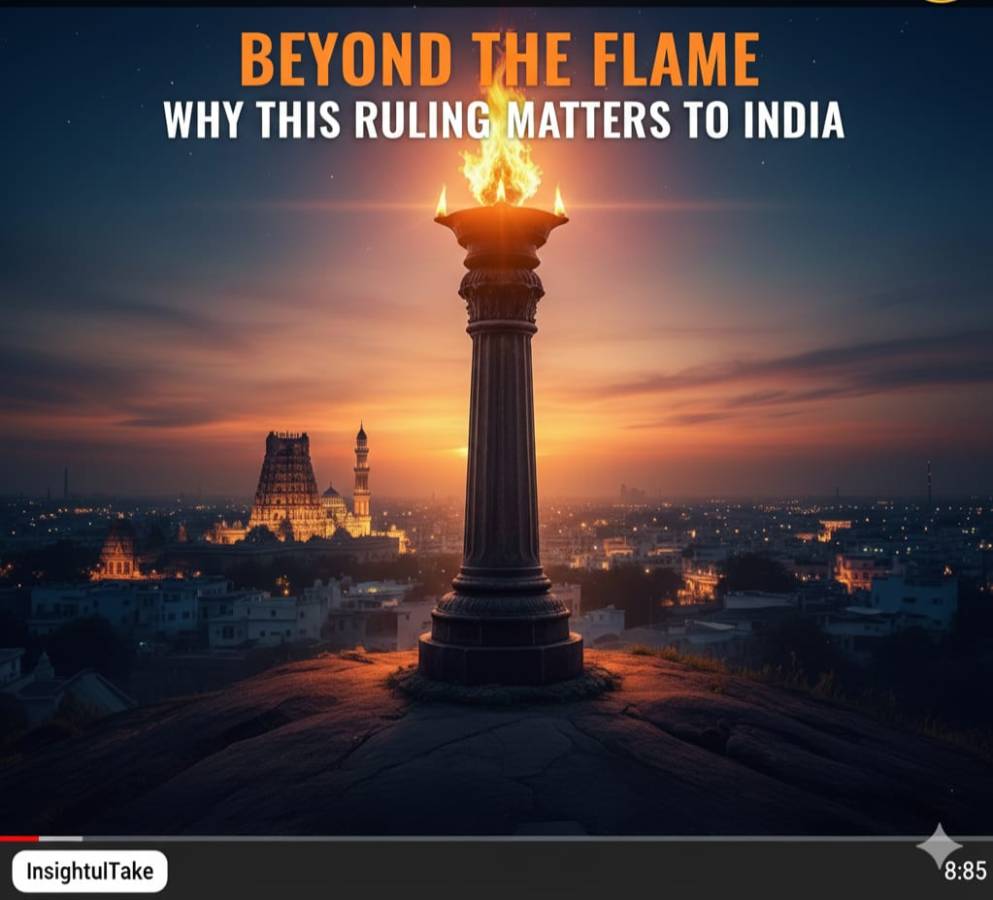
The glow of a single lamp atop Madurai’s Thiruparankundram Hills has ignited a legal and social conversation far brighter than the flame itself. On Tuesday (January 06, 2026), a division bench of the Madras High Court upheld a ruling allowing the traditional lighting of the Karthigai Deepam at a stone pillar on the hill. While the case centered on a specific religious ritual, the court’s sharp rebuke of the state government’s “imaginary ghost” of law-and-order concerns offers a profound new perspective for the common citizen. It is a landmark moment that redefines the relationship between the state, the judiciary, and the individual’s right to faith.
Faith vs. Fear: Trashing the ‘Imaginary Ghost’
The most striking aspect of the judgment was the court’s dismissal of the Tamil Nadu government’s apprehension of communal disharmony. For years, the state resisted the lighting of the lamp, citing its proximity to a centuries-old dargah and the potential for public disorder.
However, Justices G. Jayachandran and K.K. Ramakrishnan noted that a “mighty state” fearing a small, regulated ritual is “ridiculous.” By calling these fears an “imaginary ghost,” the court sent a clear message that the state cannot use the excuse of security to stall the exercise of fundamental rights. For the average Indian, this is a vital protection. It ensures that the government cannot arbitrarily restrict public gatherings or traditions simply because it is “inconvenient” to manage them.
A Blueprint for Coexistence
The Thiruparankundram Hill is a microcosm of India’s pluralistic identity, housing the Arulmigu Subramania Swamy Temple, ancient Jain beds, and the Sikkandar Badhusha Dargah. The court’s ruling did not favor one faith over another; instead, it established a framework for peaceful coexistence.
By allowing a limited temple team to light the lamp under the supervision of the district administration and the Archaeological Survey of India (ASI), the court balanced religious freedom with heritage preservation and public safety. This “middle path” serves as a lesson for communities across India: religious identity and public order are not naturally at odds. Conflict often arises not from the ritual itself, but from the political mileage sought by those managing it.
The Citizen’s Right to Tradition
The ruling also touched upon the historical and literary roots of the tradition, referencing ancient Tamil texts like Agananooru. For the common person, this reinforces the idea that tradition is not a “granted privilege” but a “vested right.” The court’s observation that the state should have used this as an opportunity to foster interfaith harmony “rather than division” is a direct call for a more proactive and inclusive governance style.
Key Takeaways
|
Key Takeaway |
Impact on the Common Citizen |
|
Evidence-based Policing |
Authorities cannot ban traditions based on vague “assumptions.” |
|
Judicial Oversight |
The court remains a shield against executive overreach in religious matters. |
|
Communal Harmony |
Coexistence is possible when administrative capacity meets religious tolerance. |
Let There Be Light
The Madras High Court’s verdict is more than a victory for devotees. It is a victory for the constitutional principle that “public order” must be maintained through competence, not through the suppression of rights. As the state moves to challenge this in the Supreme Court, the core lesson remains: in a diverse democracy, the role of the state is to facilitate the light of freedom, not to shroud it in the darkness of fear.
















Leave a Comment