
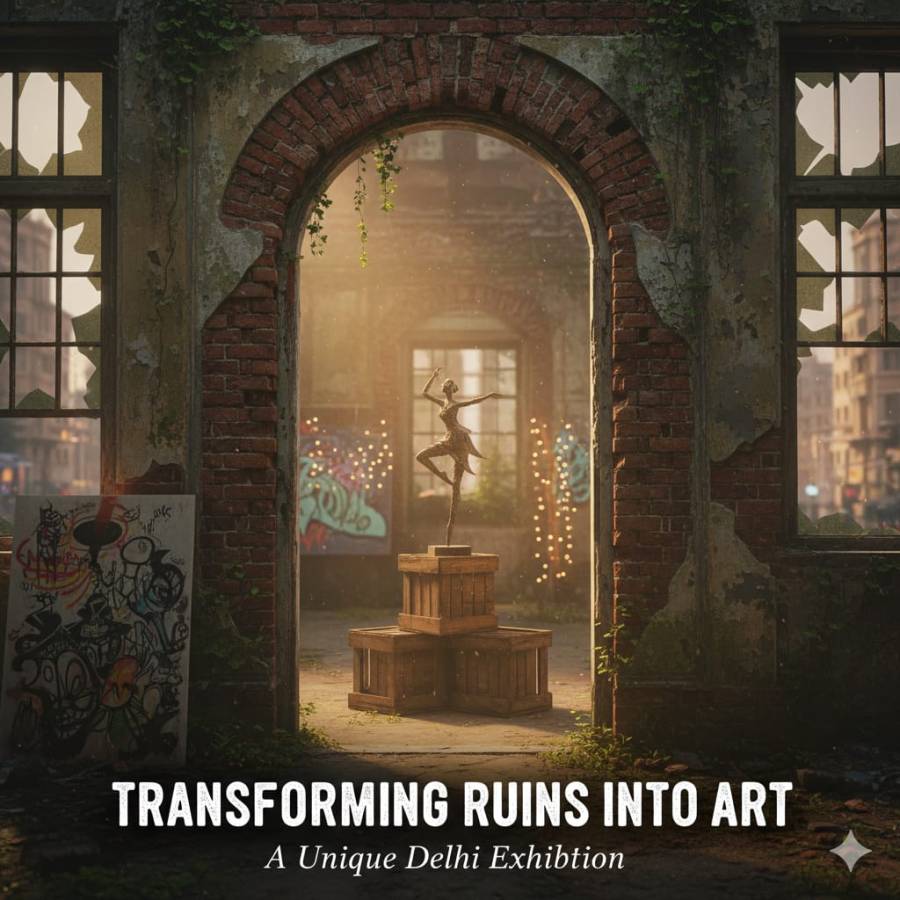
What happens when art refuses the safety of white walls and chooses instead to live among cracks, damp stains and broken plaster? In Connaught Place, a forgotten building offered an unexpected answer, turning decay into dialogue and ruin into revelation.
In the heart of Connaught Place, known for its colonial colonnades, high-end stores and constant crowds, a long-abandoned five-storey building at F14/15, Inner Circle came alive for a brief period with art and creative energy. Titled Party Is Elsewhere, the exhibition unfolded not inside a pristine gallery but within the cracked walls and peeling surfaces of a structure long surrendered to time.
It was not merely an art show. It was an experiment in space, decay, and perception.
A Building Reclaimed by Time
The venue itself told a story before any artwork did. Windows on the upper floors were boarded up with plastic sheets and cardboard instead of glass. Inside, paint peeled off in thick flakes, revealing red brick and exposed plumbing beneath. Graffiti layered the walls—traces of years of neglect and urban anonymity.
The second floor, once bustling with offices, had been shut for over a decade. When curators Amit Kumar Jain and Reha Sodhi first stepped in, they found not a gallery but a ruin. Debris fell from the walls daily. Severe seepage worsened during rainfall, threatening both visitors and installations. For over a month, the team worked simply to make the building minimally accessible, clearing rubble and stabilizing fragile corners.
Yet the decay was not erased. It was embraced.
Art in a Fragile Architecture
The building’s instability shaped the exhibition in profound ways. In areas where the walls could not bear weight, paintings were suspended on near-invisible strings. Sculptures and installations were placed wherever the structure allowed—sometimes precariously, always deliberately.
A sculpture by Himmat Shah found its place atop an old bar counter. A triptych by Shilpa Gupta rested on a ledge jutting from fractured plaster. Meanwhile, Mithu Sen’s work was projected onto the broken floor tiles of a former bathroom, turning ruin into resonance.
These placements were not mere aesthetic choices. They were negotiations with gravity, fragility, and risk. The building dictated the display as much as curatorial intent did. Art did not dominate the environment—it coexisted with it.
Beyond the “White Cube”
Traditional galleries operate within what is often called the “white cube”—sanitized, controlled spaces designed to minimize distraction and spotlight the artwork. Party Is Elsewhere rejected that logic entirely.
Here, the walls were not neutral; they were active participants. Cracks framed canvases. Damp stains formed accidental backdrops. Light filtered unevenly through patched windows. The environment was raw, imperfect, and alive.
The curators intentionally removed wall labels and captions, disrupting another convention of gallery culture. Visitors were not guided by neatly printed descriptions. There were no explanatory plaques to lean on. The absence of contextual markers encouraged instinctive engagement—but it also demanded more from the viewer.
For some, this was liberating. For others, disorienting.
Accessibility Through Imperfection
The building’s past added another layer to the narrative. Years ago, the space housed a nightclub called Oh My God—a gathering spot for the city’s elite before it fell silent and shuttered. By reviving it as an art venue, the curators attempted to bridge worlds: high contemporary art and the city’s broader public.
Visitor Bhoomika Sharma captured the essence of this shift. Unlike traditional galleries, where pristine silence and academic undertones can intimidate newcomers, this setting felt informal, almost forgiving. The cracked walls did not demand prior knowledge. The absence of labels meant no pressure to “understand correctly.” The ruin softened the hierarchy between art and audience.
Ironically, decay became democratizing.
Risk and Reward
Yet the challenges were real. Structural instability posed safety concerns. Seepage threatened artworks. Mounting pieces required unconventional and sometimes risky solutions. The exhibition existed in constant dialogue with uncertainty.
But therein lay its power.
By moving art out of climate-controlled sanctuaries and into a space marked by erosion and history, Party Is Elsewhere questioned what makes a gallery legitimate. Is it the cleanliness of walls, or the intensity of engagement? Must art be separated from life’s messiness to be meaningful?
In the crumbling rooms of F14/15, creativity did not merely survive adversity—it fed on it.
A Case Study in Cultural Reimagination
At its core, Party Is Elsewhere was not about romanticizing ruin. It was about reclaiming overlooked spaces and challenging inherited norms. It demonstrated that art need not wait for perfection. Sometimes, imperfection amplifies it.
In transforming a decaying building in Connaught Place into a vibrant cultural hub, the curators navigated structural decay, safety risks, and conceptual resistance. What emerged was more than an exhibition—it was a statement about accessibility, adaptability, and the evolving language of contemporary art.
In a city constantly reinventing itself, this fleeting experiment left behind a lasting question: What other forgotten spaces are waiting to speak?
























Leave a Comment