
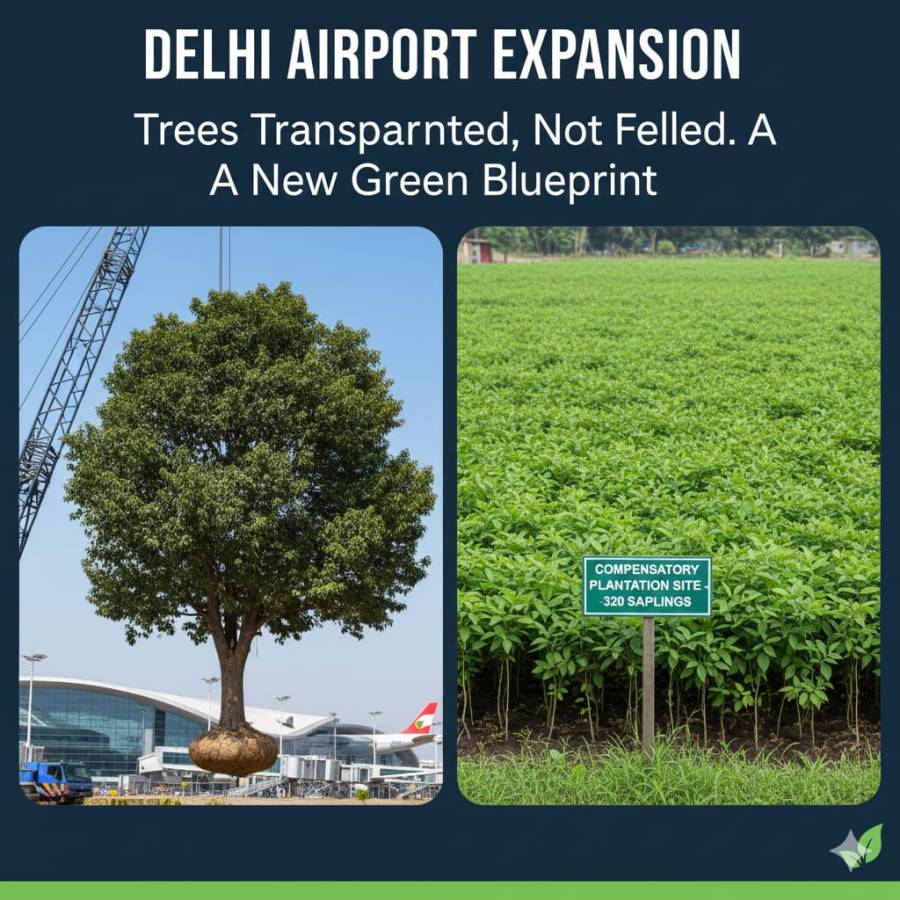
Can an airport expand without cutting down a single tree? At Delhi’s IGI Airport, authorities have chosen transplantation over felling—setting a new benchmark for how infrastructure growth and environmental responsibility can move forward together.
The ongoing balance between infrastructure growth and environmental protection has reached an important moment at India’s busiest aviation hub. In a notable policy decision, the Delhi State Forest and Wildlife Department has granted permission to relocate 32 trees for expansion work at Indira Gandhi International Airport (IGI).
The approval is part of a strategic plan to expand apron facilities required for aircraft maintenance, repair, and overhaul (MRO). While infrastructure projects frequently attract criticism for their ecological impact, this order establishes a structured and accountable framework under the Delhi Preservation of Trees Act, 1994.
Transplantation Over Felling: A Clear Policy Shift
A key feature of the decision is the outright rejection of tree felling. Out of 34 trees initially identified, permission was granted to transplant only 32. Authorities have strictly mandated relocation rather than cutting, reinforcing a growing administrative preference for preserving existing green cover.
To safeguard the process, the department has imposed several stringent conditions:
- Active Nesting Protection: No transplantation can occur if a tree contains active bird nests, ensuring protection of local avian biodiversity.
- Advance Intimation: A tree officer must be notified at least three days before work begins.
- Financial Safeguard: The applicant has deposited ₹18.24 lakh to cover transplantation and long-term maintenance costs.
This structured approach ensures that ecological considerations remain central to the expansion process.
Digital Monitoring and Accountability
One of the most significant aspects of the order is the emphasis on transparency through technology-driven oversight.
- Every transplanted tree and newly planted sapling will be geotagged.
- Plantation details will be uploaded to a dedicated forest department portal.
- Annual progress reports must be submitted, including geo-referenced, time-stamped photographs.
Such measures address long-standing concerns about compensatory plantations failing due to poor follow-up. By mandating digital documentation and periodic monitoring, the department ensures that environmental commitments extend beyond symbolic compliance.
Compensatory Afforestation: A 10:1 Commitment
The approval includes a robust compensatory plantation plan. For the 32 transplanted trees, authorities have mandated the planting of 320 saplings—a 10:1 ratio designed to strengthen the city’s green cover.
The compensatory plantation site has been identified at New Udaan Bhawan, opposite Terminal 3 of the airport. Following a ground inspection, the site was deemed suitable and sufficient for supporting new growth.
Additionally, the saplings must be maintained for seven years, ensuring they reach a level of maturity where independent survival is viable. This long-term maintenance requirement reinforces the seriousness of the environmental safeguards.
A Blueprint for Future Infrastructure Projects
The IGI Airport case offers a potential model for balancing infrastructure expansion with environmental responsibility. By rejecting tree felling and insisting on transplantation alongside substantial compensatory planting, the Delhi government has demonstrated that development and conservation can coexist under a well-enforced legal framework.
The combination of financial deposits, strict regulatory oversight, and digital monitoring mechanisms creates a system of measurable accountability. For policymakers, it signals that urban expansion can proceed without compromising ecological commitments. For environmental stakeholders, it establishes a benchmark to evaluate similar projects in the future.
As cities continue to modernize, the IGI Airport decision may serve as a reference point—proving that growth does not necessarily require the sacrifice of green cover, but rather smarter planning and enforceable safeguards.























Leave a Comment