
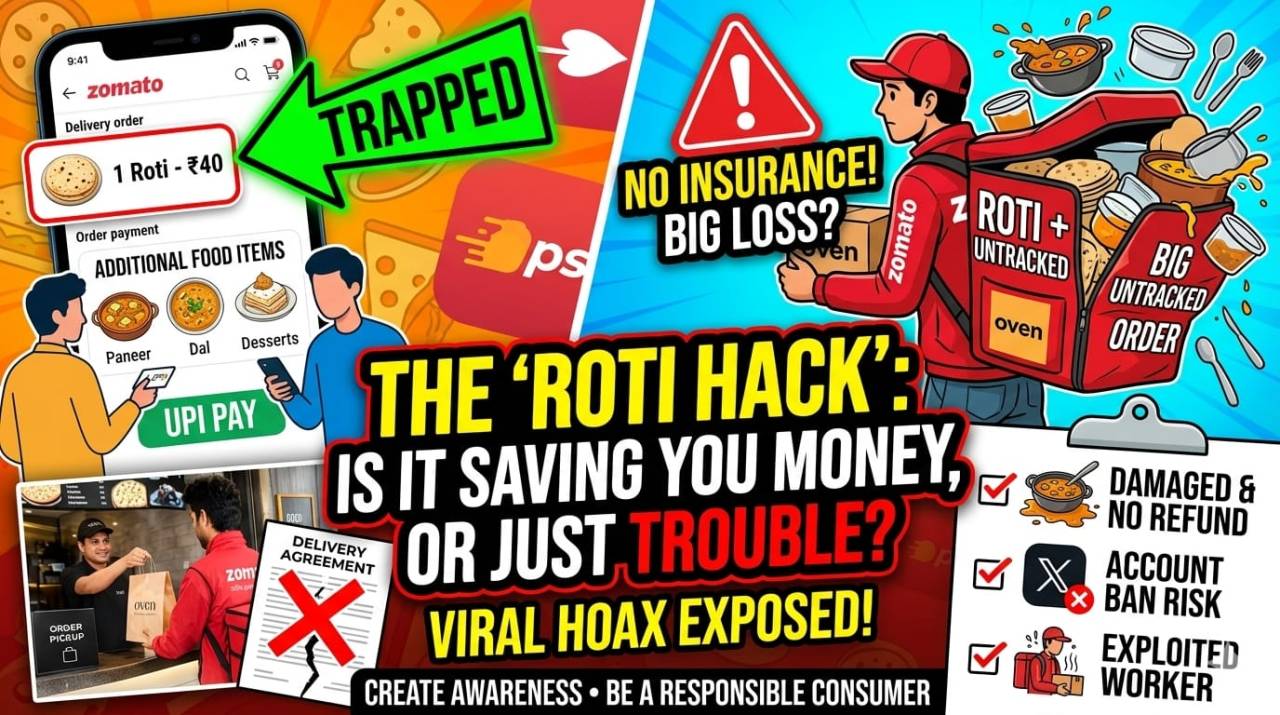
A ₹40 roti order may look harmless—but this viral food delivery trick reveals the hidden cracks in India’s convenience economy.
A viral social media post has ignited a heated online debate over a controversial food delivery “hack” that many users are calling clever, while others are branding unethical. Shared initially by a user on X, the trick revolves around exploiting a loophole in food delivery platforms such as Zomato and Swiggy.
The method is deceptively simple. A customer places a very small order on a delivery app—often something as inexpensive as a ₹40 roti—to secure a delivery rider. Immediately afterward, the customer contacts the restaurant directly and requests additional dishes such as paneer butter masala, dal makhani, or other expensive items, paying the eatery separately via UPI. The restaurant then packs everything together into one bag, while the delivery rider unknowingly transports the much larger order.
At first glance, the idea appears attractive. Customers save money by avoiding inflated app prices, restaurants escape steep platform commissions, and everyone seems to benefit. But beneath the surface, this viral “hack” exposes a far more fragile reality about the economics of India’s convenience-driven food delivery ecosystem.
The Illusion of a “Win-Win”
The popularity of this loophole reflects growing frustration with high delivery charges, platform commissions, packaging fees, and surge pricing. Many restaurants have repeatedly argued that food delivery platforms take commissions ranging between 20% and 30%, squeezing already thin profit margins.
For consumers, the appeal is equally obvious. Ordering directly from the restaurant often results in lower prices than those displayed on apps, where menu items are frequently marked up. By combining a token app order with direct payment to the restaurant, customers believe they are bypassing unnecessary middlemen.
On paper, it sounds like a practical workaround:
- Restaurants retain a larger share of revenue.
- Consumers spend less money.
- The delivery infrastructure is still utilized.
However, what looks efficient in theory creates serious cracks in accountability, fairness, and operational sustainability.
Consumers May Lose More Than They Save
While the hack may save a few hundred rupees in the short term, it strips away several protections that food delivery platforms normally provide.
No Protection for Missing or Damaged Food
When an order is placed fully through an app, there is a digital record of every purchased item. If food arrives late, spilled, spoiled, or incomplete, customers can file complaints and seek refunds.
But in this loophole, the app only recognizes the ₹40 roti.
If the restaurant forgets the paneer butter masala or the packaging leaks during transit, the platform has no obligation to compensate the customer. From the app’s perspective, the delivery was completed correctly. Meanwhile, the restaurant can claim it handed over the entire order properly.
The result is a complete accountability vacuum.
The Hidden Burden on Delivery Riders
Perhaps the most overlooked aspect of this trend is its impact on delivery workers.
Delivery riders are assigned orders and compensated based on expected order size, weight, and delivery logistics. When a rider accepts what appears to be a tiny order but is handed a heavy family-sized meal instead, the imbalance becomes unfair.
This creates multiple risks:
- Larger orders increase the chance of spills and damage during transport.
- Riders may struggle with overloaded delivery bags not designed for unexpected weight.
- Extra physical strain is imposed without additional compensation.
- Road safety risks increase if bags become unstable while riding.
In many cases, the delivery executive has no idea they are participating in a manipulated transaction.
At a time when gig workers are already raising concerns over low payouts and difficult working conditions, such practices deepen the pressure on the most vulnerable participants in the ecosystem.
Platforms Are Unlikely to Ignore It
Food delivery companies rely heavily on algorithms and data analytics to identify suspicious ordering patterns. Repeated low-value orders accompanied by unusually long preparation times or oversized packages can easily trigger system alerts.
Platforms typically include strict terms of service prohibiting attempts to manipulate commissions or misuse delivery infrastructure. If such behavior becomes widespread, users and restaurants could face:
- Account suspensions
- Permanent blacklisting
- Reduced visibility on platforms
- Financial penalties or stricter verification systems
What begins as a viral “hack” may ultimately push platforms toward tighter controls that affect all users.
A Bigger Problem With the Convenience Economy
The popularity of this loophole also highlights a broader issue: growing public dissatisfaction with the economics of convenience apps.
Consumers increasingly feel burdened by hidden charges, while restaurants argue that high commissions make profitability difficult. Delivery workers, meanwhile, often operate under demanding conditions with unpredictable earnings.
The viral roti hack sits at the intersection of all three frustrations.
Yet exploiting the system is unlikely to create a sustainable solution. If platforms start losing significant revenue through loopholes, the most probable response will be higher fees, stricter policies, or reduced rider incentives—costs that eventually return to consumers and workers alike.
The Ethical Alternative
If customers genuinely wish to support local restaurants while avoiding platform markups, there is a far more transparent solution: skip the delivery app entirely.
Many eateries already offer direct ordering through phone calls, WhatsApp, or their own delivery networks. Customers can either arrange pickup themselves or use local logistics services without disguising the actual size of the order.
Such an approach keeps the transaction honest, ensures proper accountability, and respects the labor of everyone involved—from restaurant staff to delivery workers.
Convenience Cannot Survive Without Trust
Food delivery apps transformed urban life by making meals accessible with just a few taps. But the system functions only because every participant—platforms, restaurants, riders, and consumers—operates within a framework of trust and transparency.
The viral roti hack may appear harmless or even innovative to some users, but it ultimately exposes how delicate the economics of convenience platforms truly are. When consumers exploit loopholes, restaurants bypass agreements, and riders unknowingly absorb the consequences, the entire ecosystem becomes harder to sustain.
Saving money is understandable. But if convenience comes at the cost of fairness, accountability, and worker dignity, the long-term price may be far greater than the short-term discount.
A viral social media post has ignited a heated online debate over a controversial food delivery “hack” that many users are calling clever, while others are branding unethical. Shared initially by a user on X, the trick revolves around exploiting a loophole in food delivery platforms such as Zomato and Swiggy.
The method is deceptively simple. A customer places a very small order on a delivery app—often something as inexpensive as a ₹40 roti—to secure a delivery rider. Immediately afterward, the customer contacts the restaurant directly and requests additional dishes such as paneer butter masala, dal makhani, or other expensive items, paying the eatery separately via UPI. The restaurant then packs everything together into one bag, while the delivery rider unknowingly transports the much larger order.
At first glance, the idea appears attractive. Customers save money by avoiding inflated app prices, restaurants escape steep platform commissions, and everyone seems to benefit. But beneath the surface, this viral “hack” exposes a far more fragile reality about the economics of India’s convenience-driven food delivery ecosystem.
The Illusion of a “Win-Win”
The popularity of this loophole reflects growing frustration with high delivery charges, platform commissions, packaging fees, and surge pricing. Many restaurants have repeatedly argued that food delivery platforms take commissions ranging between 20% and 30%, squeezing already thin profit margins.
For consumers, the appeal is equally obvious. Ordering directly from the restaurant often results in lower prices than those displayed on apps, where menu items are frequently marked up. By combining a token app order with direct payment to the restaurant, customers believe they are bypassing unnecessary middlemen.
On paper, it sounds like a practical workaround:
- Restaurants retain a larger share of revenue.
- Consumers spend less money.
- The delivery infrastructure is still utilized.
However, what looks efficient in theory creates serious cracks in accountability, fairness, and operational sustainability.
Consumers May Lose More Than They Save
While the hack may save a few hundred rupees in the short term, it strips away several protections that food delivery platforms normally provide.
No Protection for Missing or Damaged Food
When an order is placed fully through an app, there is a digital record of every purchased item. If food arrives late, spilled, spoiled, or incomplete, customers can file complaints and seek refunds.
But in this loophole, the app only recognizes the ₹40 roti.
If the restaurant forgets the paneer butter masala or the packaging leaks during transit, the platform has no obligation to compensate the customer. From the app’s perspective, the delivery was completed correctly. Meanwhile, the restaurant can claim it handed over the entire order properly.
The result is a complete accountability vacuum.
The Hidden Burden on Delivery Riders
Perhaps the most overlooked aspect of this trend is its impact on delivery workers.
Delivery riders are assigned orders and compensated based on expected order size, weight, and delivery logistics. When a rider accepts what appears to be a tiny order but is handed a heavy family-sized meal instead, the imbalance becomes unfair.
This creates multiple risks:
- Larger orders increase the chance of spills and damage during transport.
- Riders may struggle with overloaded delivery bags not designed for unexpected weight.
- Extra physical strain is imposed without additional compensation.
- Road safety risks increase if bags become unstable while riding.
In many cases, the delivery executive has no idea they are participating in a manipulated transaction.
At a time when gig workers are already raising concerns over low payouts and difficult working conditions, such practices deepen the pressure on the most vulnerable participants in the ecosystem.
Platforms Are Unlikely to Ignore It
Food delivery companies rely heavily on algorithms and data analytics to identify suspicious ordering patterns. Repeated low-value orders accompanied by unusually long preparation times or oversized packages can easily trigger system alerts.
Platforms typically include strict terms of service prohibiting attempts to manipulate commissions or misuse delivery infrastructure. If such behavior becomes widespread, users and restaurants could face:
- Account suspensions
- Permanent blacklisting
- Reduced visibility on platforms
- Financial penalties or stricter verification systems
What begins as a viral “hack” may ultimately push platforms toward tighter controls that affect all users.
A Bigger Problem With the Convenience Economy
The popularity of this loophole also highlights a broader issue: growing public dissatisfaction with the economics of convenience apps.
Consumers increasingly feel burdened by hidden charges, while restaurants argue that high commissions make profitability difficult. Delivery workers, meanwhile, often operate under demanding conditions with unpredictable earnings.
The viral roti hack sits at the intersection of all three frustrations.
Yet exploiting the system is unlikely to create a sustainable solution. If platforms start losing significant revenue through loopholes, the most probable response will be higher fees, stricter policies, or reduced rider incentives—costs that eventually return to consumers and workers alike.
The Ethical Alternative
If customers genuinely wish to support local restaurants while avoiding platform markups, there is a far more transparent solution: skip the delivery app entirely.
Many eateries already offer direct ordering through phone calls, WhatsApp, or their own delivery networks. Customers can either arrange pickup themselves or use local logistics services without disguising the actual size of the order.
Such an approach keeps the transaction honest, ensures proper accountability, and respects the labor of everyone involved—from restaurant staff to delivery workers.
Convenience Cannot Survive Without Trust
Food delivery apps transformed urban life by making meals accessible with just a few taps. But the system functions only because every participant—platforms, restaurants, riders, and consumers—operates within a framework of trust and transparency.
The viral roti hack may appear harmless or even innovative to some users, but it ultimately exposes how delicate the economics of convenience platforms truly are. When consumers exploit loopholes, restaurants bypass agreements, and riders unknowingly absorb the consequences, the entire ecosystem becomes harder to sustain.
Saving money is understandable. But if convenience comes at the cost of fairness, accountability, and worker dignity, the long-term price may be far greater than the short-term discount.




















Leave a Comment