
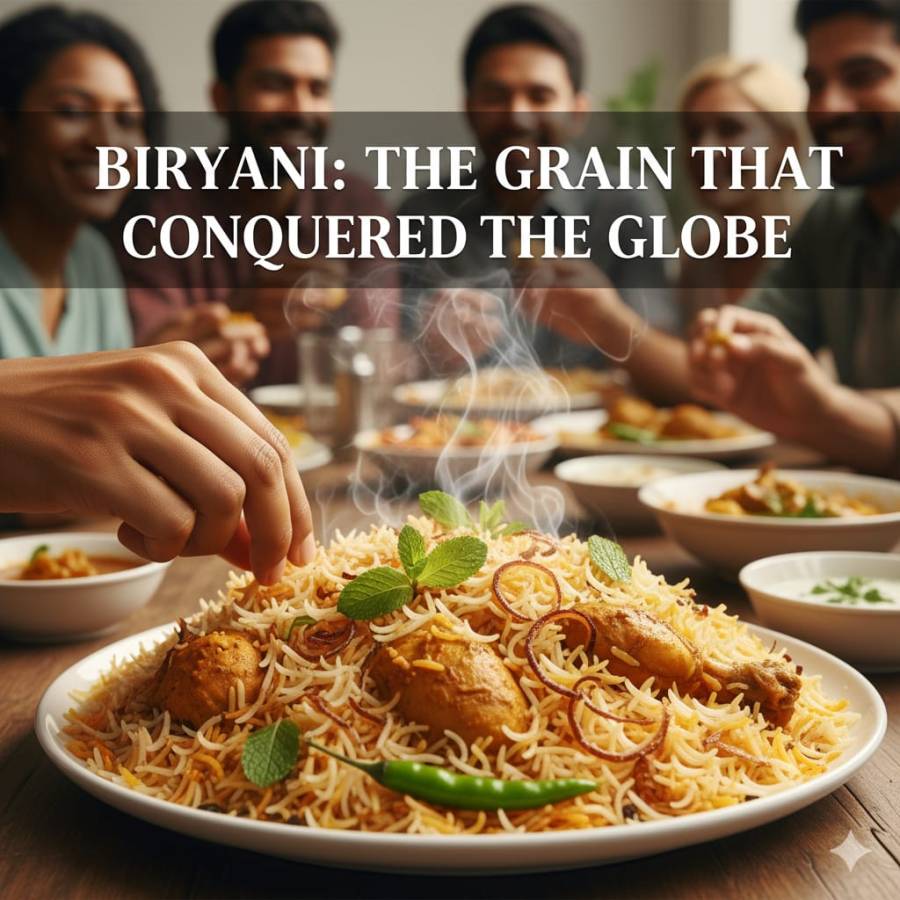
When a Japanese diplomat eats biryani with his hands, it signals that the dish has crossed every cultural border.
When Japanese Ambassador ONO Keiichi sat down at a table in Delhi recently, he didn’t reach for a fork. Instead, he took a lesson from a local friend, using his fingers to scoop up a mouthful of fragrant rice and tender meat. His subsequent post on X went viral for a simple reason. He compared the experience to eating sushi, noting that biryani, like Japan’s national treasure, “tastes even better when eaten by hand.”
This wasn’t just a diplomatic gesture; it was a snapshot of a larger culinary shift. Once a royal delicacy confined to the Mughal courts and the vibrant streets of Hyderabad and Lucknow, biryani has officially broken its borders. It is no longer just "Indian food"—it is becoming a global staple, challenging the long-standing reign of the pizza and the burger.
A Universal Comfort in a Single Pot
Why is biryani suddenly everywhere, from the high-rises of Dubai to the rain-slicked streets of London? The answer lies in its versatility. Unlike many dishes that demand a specific setting, biryani is the ultimate "complete meal." It carries carbohydrates, proteins, and a complex profile of spices in a single, delivery-friendly package.
In a world increasingly driven by "convenience culture," biryani fits the bill perfectly. It travels well, stays warm, and offers a sensory explosion that a sandwich simply cannot match. In 2025 alone, delivery platforms in India reported over 93 million biryani orders—roughly three orders every second. But that hunger has spread. In London’s Whitechapel or New York’s Jackson Heights, biryani isn't just for the diaspora anymore; it’s the Friday night choice for everyone.
The "Sushi" Comparison: Beyond the Spoon
Ambassador ONO’s observation about eating with hands touches on something profound. In many cultures, the tactile connection with food is essential.
- The Sensory Experience: Eating with hands allows you to feel the temperature and texture before the first bite.
- Cultural Connection: As the Ambassador noted, it brings people "a little closer."
This shift toward "authentic" eating experiences is a hallmark of the modern global diner. People don't just want the calories; they want the story. They want to know the difference between the potato-laden Kolkata style, the spice-heavy Hyderabadi dum, and the delicate, floral Lucknowi (Awadhi) biryani.
The New Global Fast Food?
We are seeing the "McDonaldization" of biryani, but with a gourmet twist. Major chains are now standardizing the slow-cooking dum process to ensure that a plate of rice in New Jersey tastes exactly like one in Hyderabad.
"Biryani has the potential to become the Indian answer to Italy’s Pizza and China’s Noodles," says Kaushik Roy, a leader in the biryani industry.
Unlike traditional fast food, which is often criticized for being overly processed, biryani is perceived as "real food." It’s slow-cooked, aromatic, and deeply rooted in history. This authenticity is its greatest strength in an era where diners are moving away from "junk" and toward heritage.
A Plate with No Borders
The beauty of biryani is its ability to adapt. In Malaysia, you’ll find it with a side of achar (pickled vegetables); in the Middle East, it morphs into the milder Mandi. It is a culinary chameleon that respects local palates while keeping its spicy soul intact.
When a diplomat from Japan, a country known for its refined food traditions, eats a plate of rice with his bare hands, it says something important. Biryani is no longer seen as an “ethnic” novelty. It has become a shared symbol of comfort, care, and human connection.




























Leave a Comment