
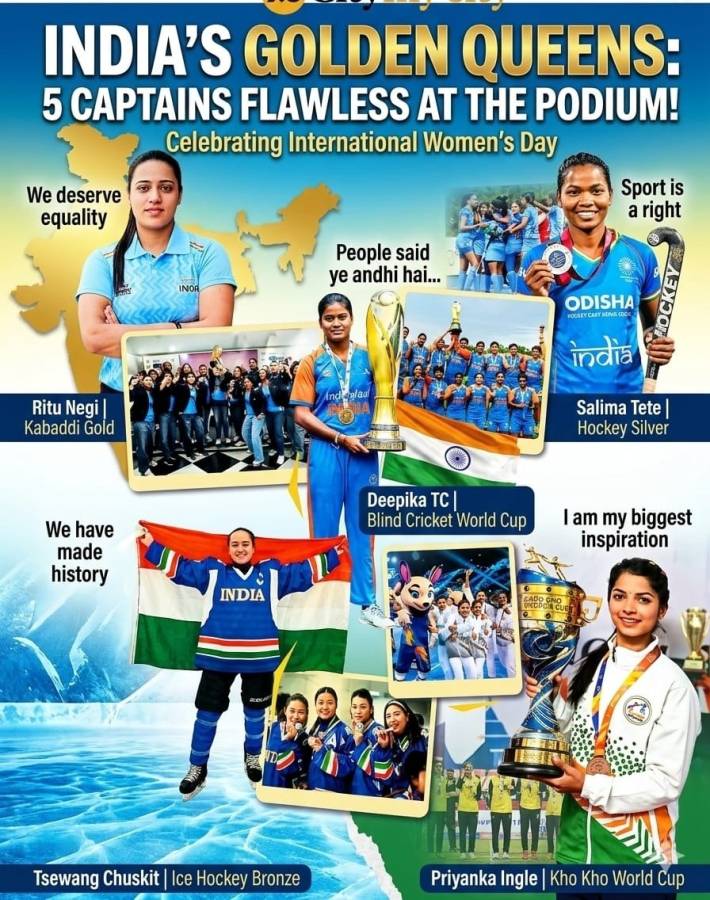
They come from different corners of India, play different sports, and face different challenges—but these five women captains share one mission: to lead India to glory.
As the world marks International Women’s Day 2026 under the theme “Rights. Justice. Action for All,” stories of women’s leadership and achievement are taking center stage across different fields. In India, sport has become one of the most powerful platforms where women are not only participating but leading from the front. Across disciplines as diverse as kabaddi, blind cricket, hockey, ice hockey, and kho kho, a group of women captains has emerged who are changing perceptions and setting new benchmarks for excellence.
Their journeys come from very different corners of the country—villages in the Himalayas, tribal regions, bustling southern cities, and remote high-altitude landscapes. Yet they share a common thread: determination to succeed despite social barriers, limited resources, and long-standing stereotypes about women in sport. Today, they are not just athletes; they are symbols of a broader transformation in Indian society.
One of the most striking examples is Ritu Negi, the captain of the Indian women’s kabaddi team. Hailing from the small village of Sharog in Himachal Pradesh, Ritu grew up in an environment where pursuing sports—especially a physically demanding contact sport—was not considered a conventional path for girls. Kabaddi requires strength, agility, and fearlessness, and for a young girl from a conservative rural background, choosing this sport was itself an act of defiance.
Despite the skepticism around her, Ritu remained focused on her goal. Years of discipline and persistence eventually led her to captain the national team. Under her leadership, India won the gold medal at the 2025 Kabaddi World Cup, defeating Chinese Taipei in a commanding performance. The victory reinforced India’s dominance in the sport and brought Ritu national recognition, including the prestigious Arjuna Award. For many young girls from small towns and villages, her story represents proof that ambition can overcome social expectations.
Another remarkable leader is Deepika TC, captain of the Indian women’s blind cricket team. Deepika’s journey highlights a different kind of challenge—overcoming the limitations that society often associates with visual impairment. For many athletes with disabilities, the struggle is not just about training and competition but also about convincing others that they belong in the sporting arena.
Deepika and her teammates achieved a historic milestone in November 2025 when they won the inaugural Women’s T20 World Cup for the Blind in Colombo. India defeated Nepal in the final, marking a landmark moment for blind cricket. Deepika’s leadership has been widely praised for bringing confidence and cohesion to the team. Beyond the trophy, the victory sent a powerful message that talent and determination are not defined by physical limitations.
In the world of hockey, Salima Tete has become one of the most prominent faces of India’s rising sporting ambition. Born in Jharkhand, Salima grew up in a region known for producing talented hockey players despite limited resources. Like many young athletes from rural India, she discovered the sport through local fields and grassroots training programs.
Salima’s speed and skill quickly set her apart, eventually earning her a place in the national team and later the captaincy. As the midfield engine of the Indian women’s hockey team, she plays a crucial role in both attack and defense. After India’s historic fourth-place finish at the Tokyo Olympics, the team continued to build momentum under leaders like Salima. One of the highlights of this period was India’s silver medal at the 2025 Women’s Asia Cup. Her contributions to Indian hockey have also been recognized with the Arjuna Award, further cementing her status as a role model for aspiring athletes.
While many sports flourish in India’s plains and cities, ice hockey presents a very different challenge. The sport is played mainly in the high-altitude region of Ladakh, where winters transform lakes and open grounds into natural ice rinks. Tsewang Chuskit, captain of the Indian women’s national ice hockey team, has been at the forefront of building the sport in this remote environment.
Unlike athletes in more established sports, Chuskit and her teammates often train with limited infrastructure and second-hand equipment. Yet their determination has helped India gain recognition in international ice hockey competitions. Under Chuskit’s leadership, the team achieved a historic milestone by winning a bronze medal at the 2025 IIHF Asia Cup—the first international medal for Indian women’s ice hockey. The achievement highlighted the potential of athletes from regions that rarely receive national attention.
Another inspiring story comes from Priyanka Ingle, captain of India’s kho kho team. Kho kho is one of India’s traditional sports, played widely in schools and villages, but for many years it struggled to gain international recognition. Priyanka’s leadership helped change that narrative.
In 2025, India won the inaugural Kho Kho World Cup, defeating teams from around the world and demonstrating the tactical sophistication of the sport. Priyanka’s journey is also notable because she balances her sporting career with a government job as a tax assistant. Her ability to manage professional responsibilities while competing at the highest level reflects the dedication required of many Indian athletes who pursue sport alongside other careers.
Together, these five captains—Ritu Negi, Deepika TC, Salima Tete, Tsewang Chuskit, and Priyanka Ingle—represent a powerful shift in Indian sport. Their achievements show that women are not only participating but also leading teams to historic victories across a wide range of disciplines.
On International Women’s Day 2026, their stories highlight how investment in women’s sport can transform both individual lives and national pride. They are inspiring a new generation of young girls to see sport as a viable path, not just a pastime. In doing so, they are helping shape a future where Indian women continue to rise as leaders on the global sporting stage.




















Leave a Comment