
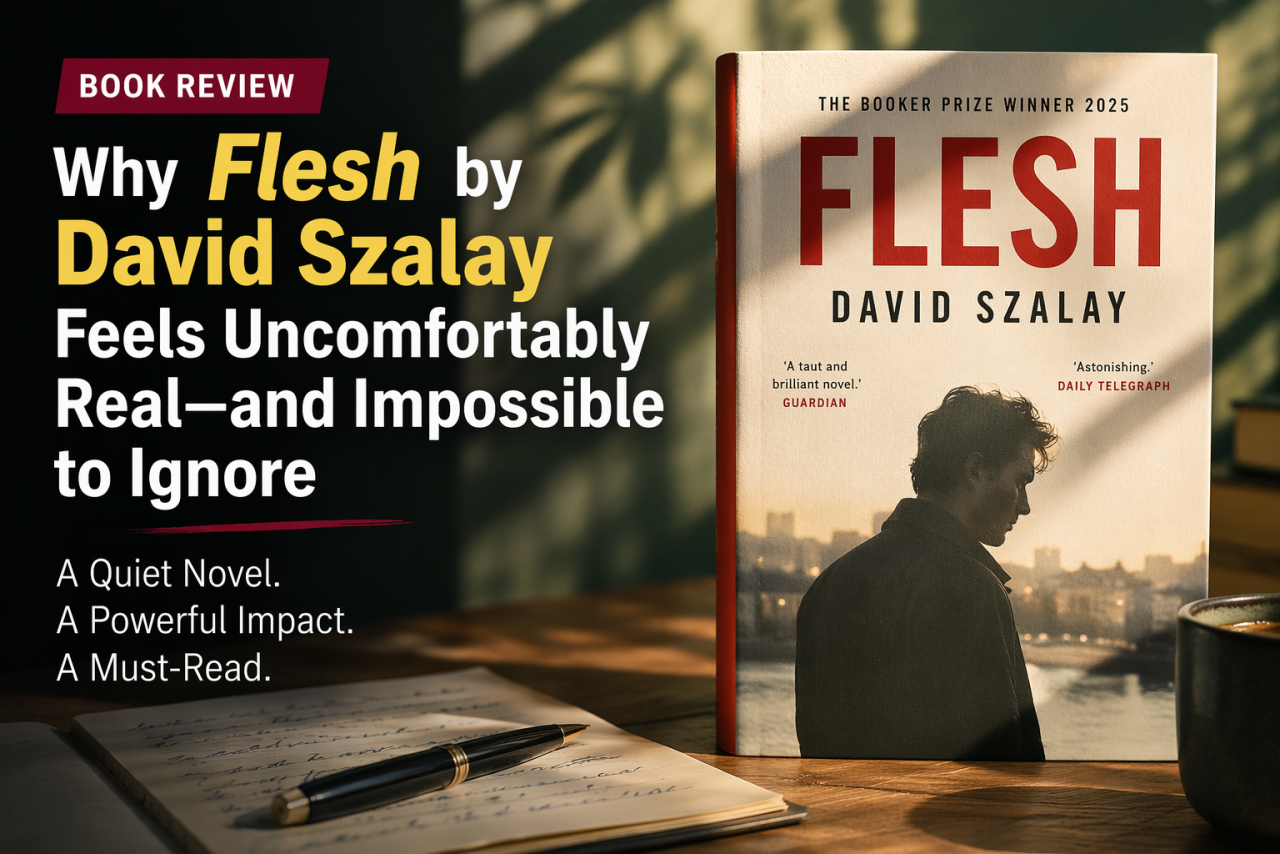
Not every novel shouts for attention—Flesh quietly exposes the truth about modern life, and that’s exactly why it stays with you.
Some novels try to impress you. Flesh stays with you.
In his latest work, David Szalay doesn’t rely on dramatic twists or heavy plotting. Instead, he builds something quieter—and far more unsettling. This is a novel about how life actually unfolds: unevenly, without clear turning points, and often without the kind of closure we expect from stories.
At the center of Flesh is a man moving through different stages of life. But this isn’t a typical “journey” narrative. There are no big revelations, no defining heroic moments. What Szalay shows instead is how a life is shaped slowly—by small decisions, missed chances, relationships that don’t quite work, and the constant pressure of simply getting through.
What makes the novel stand out is how grounded it feels. Szalay pays close attention to physical reality—the body, its needs, its limits. Tiredness, desire, discomfort, aging—these aren’t background details. They shape how the character thinks, reacts, and chooses. You don’t just understand the character intellectually; you feel the weight of his existence.
The structure of the novel adds to this effect. It moves in fragments rather than a smooth timeline. Scenes appear, do their work, and end—sometimes abruptly. At first, this might feel disjointed. But gradually, it starts to feel familiar, even accurate. After all, this is how we remember our own lives: not as a clean story, but as scattered moments that only partly connect.
Szalay’s writing style is simple on the surface, but very precise. He avoids dramatic language and lets meaning build quietly. Conversations feel real—often awkward, incomplete, or slightly off. People don’t say exactly what they mean. They hesitate, deflect, or leave things unsaid. That silence becomes important. It shows the emotional distance between people more clearly than any dramatic speech could.
One of the novel’s strongest threads is its take on masculinity. Not in a loud or ideological way, but in a deeply observed, everyday sense. The protagonist struggles with expectations—success, control, emotional restraint—but never fully understands or questions them. This makes his life feel limited in ways he can’t quite explain. It’s a subtle but powerful portrayal of how social roles shape personal choices.
There’s also an undercurrent of class and mobility running through the book. As the protagonist moves across different environments, you begin to see how opportunity isn’t equally available. These shifts are never loudly announced, but they influence everything—from relationships to self-worth.
What Flesh does especially well is capture time—not as a clear path, but as something that slips by while you’re busy dealing with the present. There are no neat conclusions here. No moment where everything suddenly makes sense. Instead, there’s a slow realization: life doesn’t always come together the way we expect it to.
And that’s exactly why the novel works.
It feels honest. Sometimes uncomfortably so.
By the end, Flesh doesn’t give you answers—but it leaves you with recognition. You see parts of real life in it: the uncertainty, the compromises, the things left unsaid.
In a literary landscape often filled with over-explained emotions and neatly tied endings, Szalay does something braver. He keeps things real.
And that’s what makes Flesh worth reading.
Some novels try to impress you. Flesh stays with you.
In his latest work, David Szalay doesn’t rely on dramatic twists or heavy plotting. Instead, he builds something quieter—and far more unsettling. This is a novel about how life actually unfolds: unevenly, without clear turning points, and often without the kind of closure we expect from stories.
At the center of Flesh is a man moving through different stages of life. But this isn’t a typical “journey” narrative. There are no big revelations, no defining heroic moments. What Szalay shows instead is how a life is shaped slowly—by small decisions, missed chances, relationships that don’t quite work, and the constant pressure of simply getting through.
What makes the novel stand out is how grounded it feels. Szalay pays close attention to physical reality—the body, its needs, its limits. Tiredness, desire, discomfort, aging—these aren’t background details. They shape how the character thinks, reacts, and chooses. You don’t just understand the character intellectually; you feel the weight of his existence.
The structure of the novel adds to this effect. It moves in fragments rather than a smooth timeline. Scenes appear, do their work, and end—sometimes abruptly. At first, this might feel disjointed. But gradually, it starts to feel familiar, even accurate. After all, this is how we remember our own lives: not as a clean story, but as scattered moments that only partly connect.
Szalay’s writing style is simple on the surface, but very precise. He avoids dramatic language and lets meaning build quietly. Conversations feel real—often awkward, incomplete, or slightly off. People don’t say exactly what they mean. They hesitate, deflect, or leave things unsaid. That silence becomes important. It shows the emotional distance between people more clearly than any dramatic speech could.
One of the novel’s strongest threads is its take on masculinity. Not in a loud or ideological way, but in a deeply observed, everyday sense. The protagonist struggles with expectations—success, control, emotional restraint—but never fully understands or questions them. This makes his life feel limited in ways he can’t quite explain. It’s a subtle but powerful portrayal of how social roles shape personal choices.
There’s also an undercurrent of class and mobility running through the book. As the protagonist moves across different environments, you begin to see how opportunity isn’t equally available. These shifts are never loudly announced, but they influence everything—from relationships to self-worth.
What Flesh does especially well is capture time—not as a clear path, but as something that slips by while you’re busy dealing with the present. There are no neat conclusions here. No moment where everything suddenly makes sense. Instead, there’s a slow realization: life doesn’t always come together the way we expect it to.
And that’s exactly why the novel works.
It feels honest. Sometimes uncomfortably so.
By the end, Flesh doesn’t give you answers—but it leaves you with recognition. You see parts of real life in it: the uncertainty, the compromises, the things left unsaid.
In a literary landscape often filled with over-explained emotions and neatly tied endings, Szalay does something braver. He keeps things real.
And that’s what makes Flesh worth reading.
























Leave a Comment