
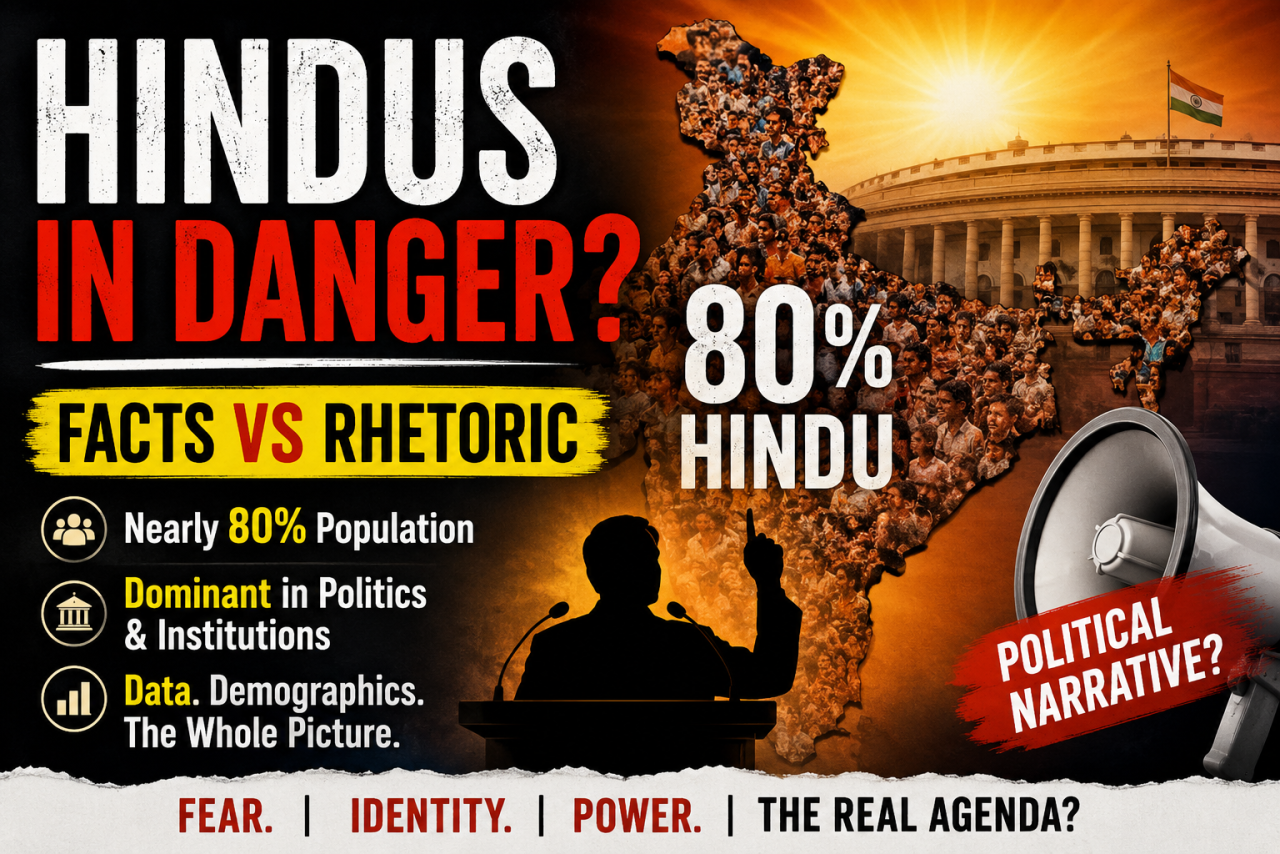
If Hindus constitute nearly 80% of India's population, why does the narrative of Hindu insecurity continue to dominate politics? The answer lies less in demographic reality than in the strategic power of identity and perception.
Few political slogans in contemporary India have been as influential as the claim that “Hindus are in danger.” Over the past decade, this idea has become a recurring theme in political speeches, television debates, social media campaigns, and election rallies. It has helped shape public opinion, mobilize voters, and redefine the country's political landscape.
But how does this claim stand up to demographic, constitutional, and social realities? Is the Hindu majority genuinely under threat, or is the narrative serving a different political purpose?
To answer these questions, it is necessary to separate emotions from evidence.
The Demographic Reality
India is overwhelmingly Hindu. According to the 2011 Census, Hindus constituted about 79.8 percent of the country's population, while Muslims accounted for 14.2 percent. Christians, Sikhs, Buddhists, Jains, and others together made up the remaining 6 percent.
Even though different religious communities have different population growth rates, demographic projections show that Hindus will remain a substantial majority in India for the foreseeable future. Studies by organizations such as the Pew Research Center estimate that Hindus will continue to represent roughly three-quarters or more of India's population even by the middle of this century.
In simple numerical terms, there is no realistic scenario in which Hindus become a minority in India within the next several generations.
This fact raises an obvious question: if the majority community is not facing demographic extinction, why does the perception of danger remain so powerful?
The Difference Between Numbers and Identity
Political narratives often operate in the realm of identity rather than statistics.
The fear that a community is "under threat" does not necessarily arise from population decline. It can emerge from concerns about culture, traditions, values, historical grievances, or political representation.
Many supporters of the Hindu-in-danger narrative argue that Hindu civilization faced centuries of invasions, colonial rule, and cultural suppression. They believe that these historical experiences created vulnerabilities that still influence contemporary politics.
For them, the issue is not whether Hindus are numerically dominant but whether Hindu interests receive adequate recognition and protection.
Critics, however, argue that historical grievances are often selectively presented and amplified to create a permanent sense of insecurity among the majority population.
Why Political Parties Use Such Narratives
Political science offers a useful explanation.
Throughout the world, political movements often strengthen support by creating a shared identity and emphasizing a perceived external or internal threat.
Humans tend to unite more strongly when they believe their group faces danger. This phenomenon has been observed across countries, religions, ethnic groups, and ideological movements.
In India's case, the Hindu identity encompasses extraordinary diversity. It includes thousands of castes, languages, regional cultures, and traditions. Building a unified political constituency out of such diversity is challenging.
The narrative of collective vulnerability can help overcome these internal differences by encouraging people to think of themselves primarily as members of a larger Hindu community.
From a political perspective, this is an effective strategy because it transforms fragmented social groups into a more cohesive voting bloc.
Electoral Evidence
The rise of the BJP coincided with a shift in political messaging from caste-based mobilization toward broader Hindu identity politics.
Historically, Indian elections were often dominated by regional, caste, and local issues. Over time, religious identity became a more central organizing principle in national politics.
Issues such as the Ram Temple, uniform civil code, religious conversions, and historical disputes became symbols of cultural assertion.
Whether one supports or opposes these causes, their political significance lies in their ability to create a sense of collective purpose among large sections of Hindu voters.
The perception of threat often increases political participation. People who believe their identity is under challenge are generally more likely to vote, organize, donate, and engage in political activity.
What Does the Constitution Say?
India's Constitution does not define the country as a Hindu state. Instead, it establishes a democratic republic that guarantees equal citizenship regardless of religion.
Hindus enjoy the same constitutional protections as all other citizens. They also occupy the overwhelming majority of positions in politics, government, business, academia, media, and public life simply because they constitute the vast majority of the population.
The President, Prime Minister, Chief Ministers, judges, military officers, civil servants, and most elected representatives are predominantly Hindu.
From an institutional perspective, it is difficult to argue that Hindus lack representation in India's power structures.
This does not mean every Hindu individual enjoys privilege or prosperity. Millions face poverty, unemployment, and social discrimination. However, those challenges are largely economic and social rather than religious.
The Psychology of Majority Anxiety
One of the most interesting findings in political psychology is that majority groups can sometimes experience insecurity despite holding demographic dominance.
This phenomenon is not unique to India. Similar patterns can be found in the United States, Europe, and many other societies.
Rapid social change, globalization, migration, economic uncertainty, and technological disruption can create a feeling that traditional identities are losing influence.
When people experience uncertainty, narratives centered on cultural preservation often become attractive.
In such circumstances, political leaders may frame ordinary social changes as existential threats to the community.
The resulting fear may feel genuine even when objective indicators suggest otherwise.
The Role of Social Media
The rise of social media has amplified identity-based narratives.
Platforms reward emotional content because it generates engagement. Stories that provoke fear, anger, or outrage tend to spread more rapidly than those emphasizing nuance or statistical reality.
As a result, isolated incidents involving religious tensions can appear to confirm the belief that an entire community is under attack.
Repeated exposure to such content can create perceptions that are disconnected from broader demographic and institutional realities.
In the digital age, feelings often travel faster than facts.
A More Important Question
Perhaps the more important question is not whether Hindus are in danger, but what kind of challenges India actually faces.
India's largest problems today include employment generation, education quality, healthcare access, environmental degradation, urban infrastructure, agricultural distress, and technological transformation.
These issues affect citizens across religious lines.
When public debate becomes dominated by identity-based fears, attention can shift away from these structural challenges.
This does not mean cultural concerns are unimportant. Every society has the right to preserve its traditions and heritage. However, a distinction must be made between cultural confidence and perpetual anxiety.
Final Take
The available demographic and institutional evidence suggests that Hindus are not in danger in the conventional sense of becoming a marginalized or disappearing community in India. They remain an overwhelming majority and possess significant representation across virtually every sphere of national life.
The persistence of the "Hindus are in danger" narrative is therefore better understood as a political and psychological phenomenon than a demographic one.
Its power comes not from census figures but from identity, history, emotion, and electoral strategy.
Understanding this distinction is essential for a mature democracy. Citizens should critically examine all claims of collective threat—whether they concern majority groups or minority communities—and evaluate them against facts, data, and constitutional principles.
A democracy grows stronger when its debates are guided by evidence rather than fear.
Few political slogans in contemporary India have been as influential as the claim that “Hindus are in danger.” Over the past decade, this idea has become a recurring theme in political speeches, television debates, social media campaigns, and election rallies. It has helped shape public opinion, mobilize voters, and redefine the country's political landscape.
But how does this claim stand up to demographic, constitutional, and social realities? Is the Hindu majority genuinely under threat, or is the narrative serving a different political purpose?
To answer these questions, it is necessary to separate emotions from evidence.
The Demographic Reality
India is overwhelmingly Hindu. According to the 2011 Census, Hindus constituted about 79.8 percent of the country's population, while Muslims accounted for 14.2 percent. Christians, Sikhs, Buddhists, Jains, and others together made up the remaining 6 percent.
Even though different religious communities have different population growth rates, demographic projections show that Hindus will remain a substantial majority in India for the foreseeable future. Studies by organizations such as the Pew Research Center estimate that Hindus will continue to represent roughly three-quarters or more of India's population even by the middle of this century.
In simple numerical terms, there is no realistic scenario in which Hindus become a minority in India within the next several generations.
This fact raises an obvious question: if the majority community is not facing demographic extinction, why does the perception of danger remain so powerful?
The Difference Between Numbers and Identity
Political narratives often operate in the realm of identity rather than statistics.
The fear that a community is "under threat" does not necessarily arise from population decline. It can emerge from concerns about culture, traditions, values, historical grievances, or political representation.
Many supporters of the Hindu-in-danger narrative argue that Hindu civilization faced centuries of invasions, colonial rule, and cultural suppression. They believe that these historical experiences created vulnerabilities that still influence contemporary politics.
For them, the issue is not whether Hindus are numerically dominant but whether Hindu interests receive adequate recognition and protection.
Critics, however, argue that historical grievances are often selectively presented and amplified to create a permanent sense of insecurity among the majority population.
Why Political Parties Use Such Narratives
Political science offers a useful explanation.
Throughout the world, political movements often strengthen support by creating a shared identity and emphasizing a perceived external or internal threat.
Humans tend to unite more strongly when they believe their group faces danger. This phenomenon has been observed across countries, religions, ethnic groups, and ideological movements.
In India's case, the Hindu identity encompasses extraordinary diversity. It includes thousands of castes, languages, regional cultures, and traditions. Building a unified political constituency out of such diversity is challenging.
The narrative of collective vulnerability can help overcome these internal differences by encouraging people to think of themselves primarily as members of a larger Hindu community.
From a political perspective, this is an effective strategy because it transforms fragmented social groups into a more cohesive voting bloc.
Electoral Evidence
The rise of the BJP coincided with a shift in political messaging from caste-based mobilization toward broader Hindu identity politics.
Historically, Indian elections were often dominated by regional, caste, and local issues. Over time, religious identity became a more central organizing principle in national politics.
Issues such as the Ram Temple, uniform civil code, religious conversions, and historical disputes became symbols of cultural assertion.
Whether one supports or opposes these causes, their political significance lies in their ability to create a sense of collective purpose among large sections of Hindu voters.
The perception of threat often increases political participation. People who believe their identity is under challenge are generally more likely to vote, organize, donate, and engage in political activity.
What Does the Constitution Say?
India's Constitution does not define the country as a Hindu state. Instead, it establishes a democratic republic that guarantees equal citizenship regardless of religion.
Hindus enjoy the same constitutional protections as all other citizens. They also occupy the overwhelming majority of positions in politics, government, business, academia, media, and public life simply because they constitute the vast majority of the population.
The President, Prime Minister, Chief Ministers, judges, military officers, civil servants, and most elected representatives are predominantly Hindu.
From an institutional perspective, it is difficult to argue that Hindus lack representation in India's power structures.
This does not mean every Hindu individual enjoys privilege or prosperity. Millions face poverty, unemployment, and social discrimination. However, those challenges are largely economic and social rather than religious.
The Psychology of Majority Anxiety
One of the most interesting findings in political psychology is that majority groups can sometimes experience insecurity despite holding demographic dominance.
This phenomenon is not unique to India. Similar patterns can be found in the United States, Europe, and many other societies.
Rapid social change, globalization, migration, economic uncertainty, and technological disruption can create a feeling that traditional identities are losing influence.
When people experience uncertainty, narratives centered on cultural preservation often become attractive.
In such circumstances, political leaders may frame ordinary social changes as existential threats to the community.
The resulting fear may feel genuine even when objective indicators suggest otherwise.
The Role of Social Media
The rise of social media has amplified identity-based narratives.
Platforms reward emotional content because it generates engagement. Stories that provoke fear, anger, or outrage tend to spread more rapidly than those emphasizing nuance or statistical reality.
As a result, isolated incidents involving religious tensions can appear to confirm the belief that an entire community is under attack.
Repeated exposure to such content can create perceptions that are disconnected from broader demographic and institutional realities.
In the digital age, feelings often travel faster than facts.
A More Important Question
Perhaps the more important question is not whether Hindus are in danger, but what kind of challenges India actually faces.
India's largest problems today include employment generation, education quality, healthcare access, environmental degradation, urban infrastructure, agricultural distress, and technological transformation.
These issues affect citizens across religious lines.
When public debate becomes dominated by identity-based fears, attention can shift away from these structural challenges.
This does not mean cultural concerns are unimportant. Every society has the right to preserve its traditions and heritage. However, a distinction must be made between cultural confidence and perpetual anxiety.
Final Take
The available demographic and institutional evidence suggests that Hindus are not in danger in the conventional sense of becoming a marginalized or disappearing community in India. They remain an overwhelming majority and possess significant representation across virtually every sphere of national life.
The persistence of the "Hindus are in danger" narrative is therefore better understood as a political and psychological phenomenon than a demographic one.
Its power comes not from census figures but from identity, history, emotion, and electoral strategy.
Understanding this distinction is essential for a mature democracy. Citizens should critically examine all claims of collective threat—whether they concern majority groups or minority communities—and evaluate them against facts, data, and constitutional principles.
A democracy grows stronger when its debates are guided by evidence rather than fear.

















Leave a Comment